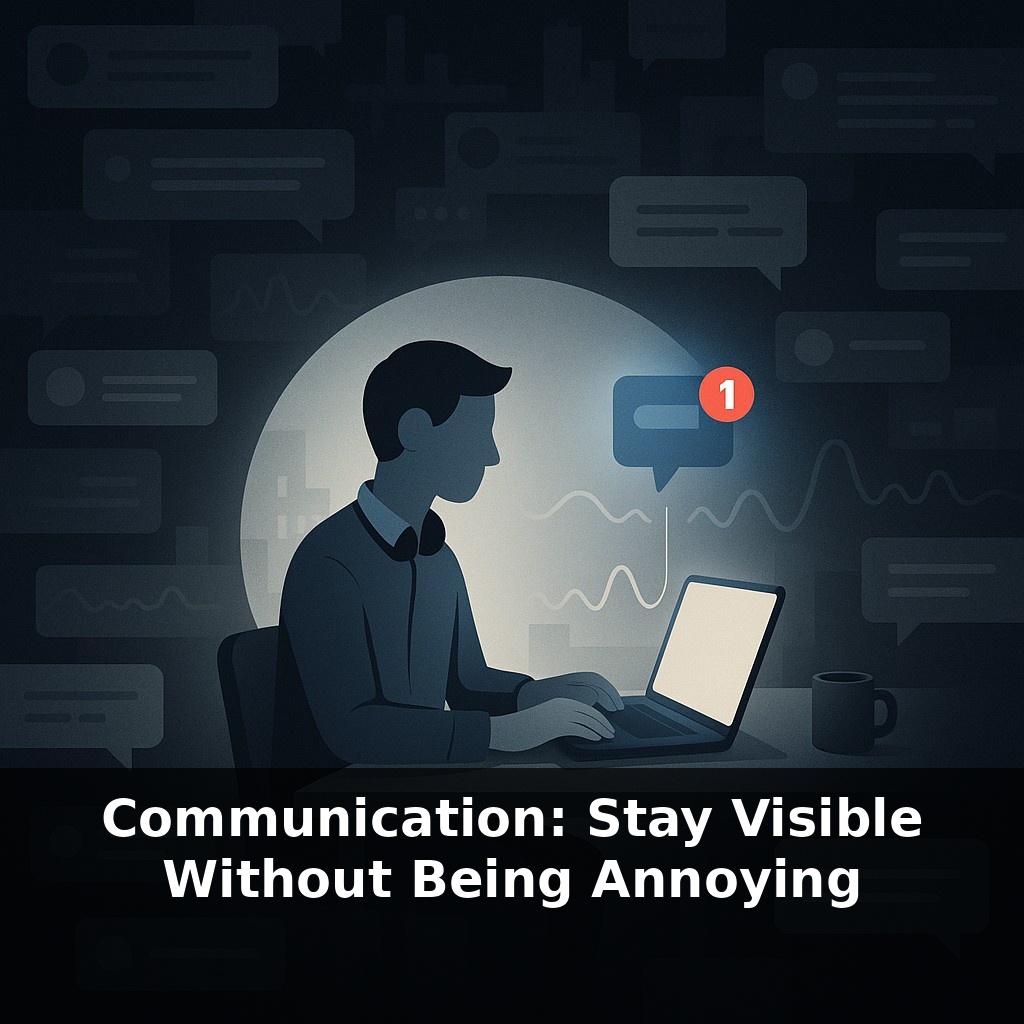
Right now, the average Slack user opens it nearly 10 times an hour—yet the people who get promoted the fastest often send fewer messages, not more. One colleague’s inbox is overflowing; another’s is quiet but trusted. How do you stay visible without becoming digital noise?
Think about the last week: whose updates do you actually remember— and whose messages blur together like background chatter at a crowded café? In remote work, attention is the scarcest currency you trade with your team. Visibility isn’t just “being present”; it’s becoming a reliable mental shortcut in other people’s heads: “If I open this, I’ll quickly understand what’s going on and what, if anything, I need to do.”
That means *how* you communicate matters as much as *how often*. Sparse but well-structured updates can quietly outrun a flood of pings, especially when you reduce the decoding work for everyone else. The leaders people trust most tend to do three things differently: they set a clear rhythm, they choose channels deliberately, and they write so others can skim in seconds but act with confidence. In this episode, you’ll turn those into a concrete, low‑friction system you can start using this week.
In remote work, most people default to two extremes: constant chatter or near-silence. Both quietly hurt your reputation. What your teammates actually experience is a stream of interruptions competing with their real work; every notification is like someone lightly tapping their shoulder while they’re trying to solve a puzzle. The goal isn’t to “speak up more,” it’s to design your updates so they land at the right moment with the least possible friction. That means aligning your messages with decision points, deadlines, and risk moments—so when your name appears, people expect clarity, not another mental tab to keep open.
Think of your communication like a product you’re shipping to busy teammates: it needs to be easy to “unbox,” quick to understand, and obvious what to do with it. The research on remote visibility points in the same direction: it’s not the quantity of touchpoints that makes you stand out, it’s whether every touchpoint reduces someone else’s cognitive load.
Start by designing a simple cadence that others can predict. For example: a short “Here’s what I’m tackling” post early in the week, and a “Here’s what shipped and what’s blocked” wrap‑up before the weekend. The key is consistency and format, not length. When people know roughly when and how you’ll update them, they stop hunting you down for ad‑hoc “quick syncs,” because the answers tend to show up on schedule.
Next, make every update ruthlessly scannable. Use tight subject lines (six words or fewer is a good constraint), front‑load the headline in the first sentence, and then separate sections clearly: context, decisions, risks, next steps. That way someone checking messages between meetings can get the gist in seconds, and only dive deeper if they truly need details. You’re trading a bit more effort in writing for a lot less effort in everyone else’s reading.
Channel choice is part of this design. Put durable information where it can be found later (docs, issues, handbooks), and use chat for short‑lived questions or pointers back to the source of truth. This is one reason GitLab’s massive public handbook actually decreases internal noise: answers live in one predictable place instead of scattering across DMs and threads.
When you do speak up in group channels, be explicit about why you’re appearing in someone’s notification list. A clear tag like “[FYI] no action,” “[Decision needed],” or “[Heads‑up: risk]” trains people to trust that your messages won’t ambush them with surprise work. That’s how you’re “present” even when you’re offline: your trail of well‑labeled updates continues to work on your behalf.
Think of a teammate who always seems “on top of things,” even when they’re not talking much. Often, they’re doing something subtle: leaving a breadcrumb trail of artifacts that quietly advertise their work. A quick Loom walk‑through attached to a pull request, a two‑line summary at the top of a Confluence page, a short comment on a Jira ticket that says, “This changed, here’s why.” Each of these is like a label on a spice jar: easy to spot, easy to use, and no one has to open every container to guess what’s inside.
You can borrow that pattern without becoming a constant broadcaster. For any task longer than a day, create one “home base” (a doc, issue, or note) and update *that* instead of spraying status into multiple chats. Then, when you do post in a channel, you’re just pointing people to the shelf where the jar already lives. Over time, you become known as the person whose work is easy to locate, easy to understand, and easy to build on—without adding more noise to anyone’s day.
AI will soon act like a gatekeeping editor, highlighting only the few lines that matter from your long threads. In that world, you’re not just writing messages—you’re training algorithms what to surface about you. Communication contracts will play the role recipes do in a busy kitchen: agreed timings, portions, and plating so no one gets overwhelmed. Experiment now with lightweight norms—response hours, tags, and update cadences—so future tools amplify your best habits, not your noisiest ones.
Treat each message like a small experiment: “Did this save someone five minutes?” Over time, you’ll notice who responds, what gets forwarded, which notes spark clearer decisions. Like seasoning a dish, you can adjust: less garnish, more depth. You’re not aiming to talk more, but to leave just enough thoughtful traces that your work is easy to find and easy to trust.
Start with this tiny habit: When you open Slack or email in the morning, add one sentence of “what I’m working on today” to the message you were already going to send (e.g., a quick update in a project channel or reply). Keep it to a single sentence that names a specific outcome, like “Today I’m focusing on drafting the Q3 launch timeline so we can review it Thursday.” If you’re not sending anything yet, drop that same one-liner into the team channel where work-in-progress updates usually go. Do this once a day for a week—no extra meetings, no big status reports, just one clear, visible breadcrumb about your work.