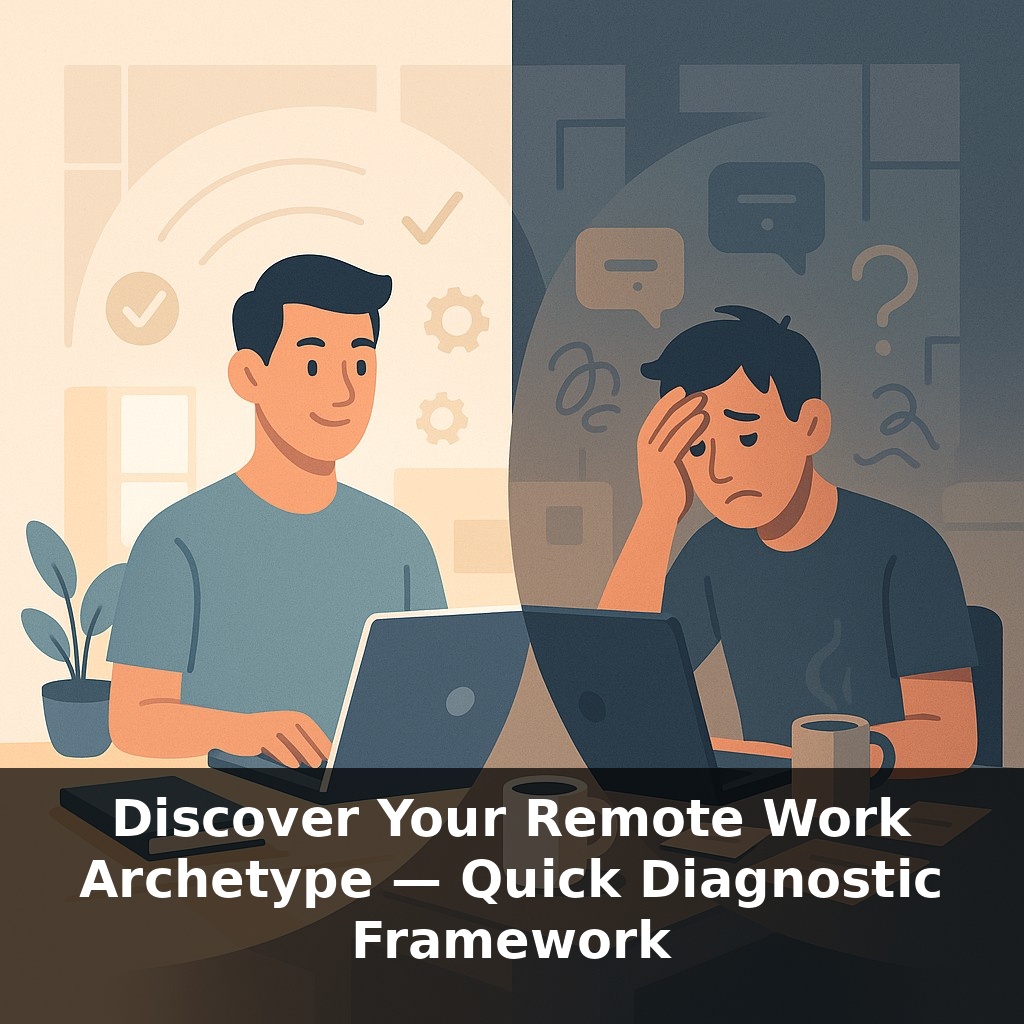
Discover Your Remote Work Archetype — Quick Diagnostic Framework
📝 Transcript
You and a coworker both work from home. Same company, same tools, same hours. One ends the day energized and ahead; the other feels behind and drained. The twist? Research shows the difference often isn’t discipline—it’s an invisible work style mismatch.
Some people hit their stride at 6 a.m. in total silence; others don’t truly “switch on” until after lunch, bouncing between Slack threads and Spotify playlists. Same job description, wildly different “best case” conditions. Recent remote-work research suggests this isn’t random quirkiness—it clusters into a few repeatable patterns that quietly shape when you think clearly, how you recover from context switching, and what kind of collaboration actually fuels you instead of draining you.
This is where remote work archetypes come in. They’re not personality labels or fluffy “types,” but behavioral blueprints tied to concrete choices: When do you protect focus? How often do you need feedback? What kind of digital noise is helpful signal versus pure distraction?
Your goal isn’t to fit into a box; it’s to find the starting template that most closely matches how you already work when a day goes unusually well—then use it on purpose.
Think of today’s experiment as zooming out on your workday the way a meteorologist studies a week of changing skies: you’re looking for patterns, not judging individual storms. The questionnaire you’re about to take won’t ask what you *wish* your ideal day looked like; it zeroes in on what you actually do when deadlines tighten, when Slack won’t stop pinging, or when you hit a flow state and forget the time. That’s where your archetype lives—in the choices you default to under real pressure, not the version you’d put on a performance review.
Here’s where we turn the idea into something you can actually use.
You’re going to map how you *already* operate, then let the diagnostic tell you which pattern that most closely matches—rather than forcing yourself into a trendy routine you saw on LinkedIn.
First, you’ll answer a short set of scenario-based questions. Each one quietly pits two real-world tradeoffs against each other:
- When a big deadline looms, do you naturally clear your calendar or pull more people into the loop? - If your manager is offline for a day, do you move ahead with assumptions or pause until you can confirm? - When you’re tired, do you gravitate toward mechanical tasks or creative ones? - During long stretches of solo work, do you instinctively break for quick check-ins, or double down and surface later with something polished?
None of these are “good” or “bad.” They’re simply the levers you tend to pull without thinking. The diagnostic aggregates those micro-choices into a signal that points strongly toward one of four dominant styles.
But numbers alone don’t run your calendar—you do. So once you see your likely pattern, you’ll also get a first-draft operating manual in three areas where remote friction usually shows up:
1) **Scheduling:** When to stack meetings versus defend uninterrupted blocks; whether short, recurring check-ins or fewer, deeper sessions suit you better; which hours you should treat as “prime” and which as admin time.
2) **Communication cadence:** How often you should proactively surface updates so others don’t need to “tap you on the shoulder”; which channels (async docs, quick Looms, live calls) to default to for different types of work.
3) **Environment:** How tightly you should control interruptions, what kind of background activity helps or hurts, and whether you benefit more from a single, stable setup or from deliberately shifting locations across the week.
Treat this not as a verdict, but as your *Version 1.0* settings. You’ll pressure-test them against reality: does following this pattern leave you clearer, faster, and less drained—or not quite? That feedback loop is where the archetype becomes practical, and where you start customizing instead of copying someone else’s “perfect” remote routine.
Think about two designers on the same product team. One moves fastest when they disappear for three hours, then drop a near-final mock into the shared doc. The other prefers to post rough sketches every 30 minutes in the team channel, riffing with comments as they appear. If you force the first into constant check-ins, their work quality tanks. Push the second into “radio silence,” and they stall out, second-guessing every decision.
Now zoom out to a startup where engineering runs async-first, but sales lives in rapid-fire huddles. A new hire who thrives on slow, deep dives might excel in engineering but flounder in sales—not because they lack skill, but because the default rhythms are misaligned with how they get traction.
One more twist: your pattern can shift with role changes. A developer promoted to tech lead might find their previous habits suddenly backfire, as more of their value comes from unblocking others than from solo output. The same diagnostic lens still applies—you’re just optimizing for a new kind of day.
Some teams are already quietly routing projects based on how people actually get things done: the fast-response “sprinters” guard incident channels, while long-horizon “architects” own thorny, ambiguous problems. As tools learn these tendencies, your calendar could reshuffle itself before you burn out, nudging focus days ahead of complex handoffs. The open question: who steers this—individuals, managers, or algorithms tuned to company priorities?
Your week isn’t a puzzle to “solve” once; it’s more like a weather system you keep learning to read. As you notice which hours feel like tailwinds and which feel like headwinds, you’ll spot signals you’ve been ignoring. Over time, your calendar becomes less of a static grid and more of a living map that bends around how you actually work best.
Here’s your challenge this week: Block 90 minutes and run a “mini archetype sprint” on yourself by working through three distinct modes back-to-back: 30 minutes as a Deep-Work Architect (single hard task, no notifications, timer on), 30 minutes as a Social Synchronizer (one focused collaboration session or co-working block), and 30 minutes as a Nomadic Optimizer (work from a different environment and deliberately tweak your setup for comfort and focus). After each block, rate your energy, focus, and output on a 1–10 scale. By the end, pick the archetype that scored highest across those three metrics and commit to designing next week’s calendar so that at least 60% of your work time is built around that primary archetype’s strengths.
From this course
Remote Work Productivity Lab: Foundation Sprint
10 episodesUnlock all episodes
Full access to 10 episodes and everything on OwlUp.
Subscribe — $1.99/monthLess than a coffee ☕ · Cancel anytime