Most people’s most valuable focus hours are spent on email they won’t remember and meetings they didn’t need. Yet research shows a short, structured morning check‑in can quietly flip that script—turning your first hours into a daily sprint toward what actually matters.
Most people lose their sharpest brain time to “just checking” Slack, email, and dashboards—then wonder why deep work never quite happens. Today we’ll zoom in on a 15‑minute pivot point: the window between “I’m online” and “I’m actually working.” What you do there reliably predicts whether your day feels spacious or scrambled.
Instead of reacting to the loudest notification, we’ll design a simple 3‑step morning protocol that deliberately points your best attention at a few high‑impact moves. Think of it as updating your GPS before you start driving: same car, same road, but now every turn serves a destination you chose.
We’ll combine three levers—goal priming, time‑blocking, and energy alignment—into one quick routine you can run before your first message. No perfection needed; consistency beats complexity.
Those first messages and dashboards you see? They’re like magnets pulling your day off course—especially when you’re working remotely and everything important, urgent, and random arrives through the same few apps. Left alone, your brain will chase whatever flashes brightest, not what actually moves the needle. That’s why we’re zooming in on *how* you choose your first real task, not just *what* it is. The 3‑step structure you just saw isn’t about rigidity; it’s about giving your attention a short runway so it can reach cruising altitude before turbulence hits. And yes, it has to work on messy, meeting‑filled days too.
Here’s how the 3-step morning protocol actually looks in practice, in under 15 minutes, *before* you open anything that pings.
**Step 1 – Prime 1–3 Concrete Wins (3–4 minutes)** Skip the full to‑do list. You’re looking for “end‑of‑day evidence” you made progress that mattered. Ask:
- “If the day derails at 2 p.m., what 1–3 things would still make today count?” - “Which items, if finished, reduce future stress the most?”
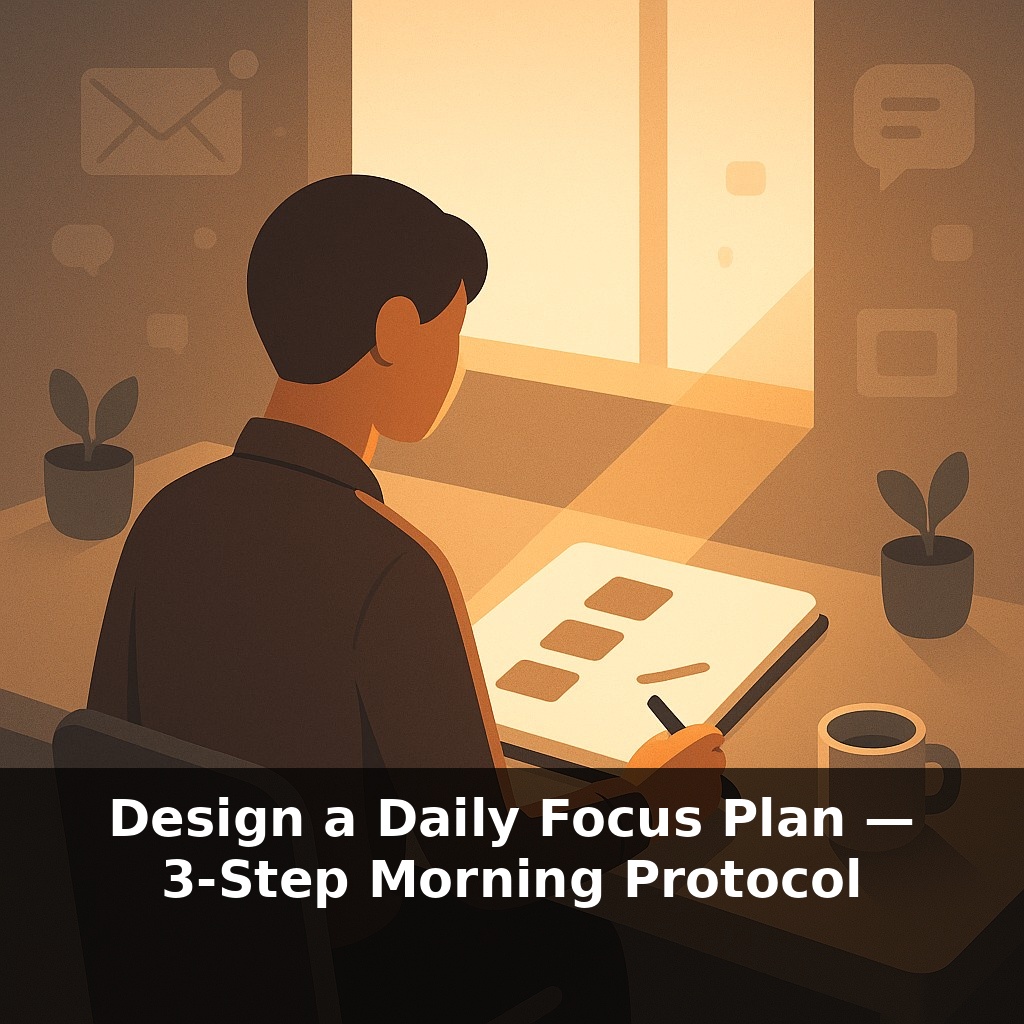
Write those 1–3 wins where you’ll see them all day (not buried in an app): sticky note, notebook, or the top of your digital doc. Be specific: “Draft client proposal outline,” not “Client work.”
Now pressure-test them against reality: anything here that obviously won’t fit around immovable meetings gets demoted *now*, not at 4 p.m. This is about choosing, not wishing.
**Step 2 – Sketch a Realistic Time Map (6–7 minutes)** Grab your calendar. You’re not redesigning the whole day; you’re shaping the *edges* around what already exists.
1. Mark non‑negotiables (meetings, appointments) as fixed blocks. 2. For each of your 1–3 wins, assign: - a **start time** - a **minimum block length** (even 25 focused minutes counts) 3. Add one “shock absorber” block—30–45 minutes of unallocated time—for overflow, email, or surprises.
When the calendar is packed, think like an air‑traffic controller: can you merge small tasks into one shared block? Can one meeting become an async update? Even moving a call by 15 minutes can unlock a contiguous focus window.
Treat this plan as a first draft. You’ll edit on the fly, but starting with a sketch keeps you from spending the day reactively coloring outside invisible lines.
**Step 3 – Match Work to Your Energy Curve (3–4 minutes)** Look at the next 4 hours and your likely alertness. Using your own wake time, roughly note:
- **High-focus slots** (usually 90–120 minutes after waking) - **Medium-focus slots** - **Low-focus slots**
Now align:
- Put the hardest part of your top win into the **next high-focus slot**, even if it’s short. - Reserve low-focus space for admin, light email, or quick checks. - If you’re not in that peak window yet, front-load setup work (gather docs, outline, clarify requirements) so the later block starts fast.
Think of it like a doctor sequencing a morning of patients: complex cases when their mind is sharpest, routine follow‑ups when intensity naturally dips.
As you run this protocol over a week, you’ll start noticing patterns—when your brain quits early, when meetings drain you, what actually fits in 30 minutes. That’s where the real customization begins.
Lena, a product manager, treats this like tuning a radio: each morning she adjusts the dial until the signal of her most important work comes in clear and the static of everything else fades a bit. Her twist: she color-tags the day—red for “one big push,” amber for “maintenance,” green for “experiments.” By lunch, she only asks, “Did I honor the color?” not “Did I clear everything?”
A designer I coached tried pairing this with “micro‑themes.” On heavy-collaboration days, her top item is always something that can be finished in a single sitting—shipping a Figma component, not redesigning a flow. On quiet days, she flips it: one chunky, slightly uncomfortable project that nudges her skills forward.
You can also experiment with constraints. One engineering lead gives himself a “three open tabs” rule during his first planned block. Another writes his 1–3 priorities on a sticky note that must be visible in every meeting; if a topic doesn’t touch the note, he keeps his contributions minimal and saves energy for where it counts.
As tools get smarter, your morning planning might shift from manual sketching to co-design with data. Wearables could suggest “focus weather” for the day—forecasting storms of distraction after poor sleep and nudging you to shorten commitments. AI may auto-cluster related work into single sittings, like grouping all “client trust” actions together. The interesting question won’t be “What can I fit in?” but “What deserves my clearest 90 minutes?”
Some days this will feel smooth; others, more like tuning a stubborn instrument. That’s useful data. Notice which small tweaks—shorter blocks, clearer “done,” quieter starts—shift the whole day’s tone. Over time, this becomes less a checklist and more a daily calibration, like adjusting a camera lens until the work that matters snaps into sharp focus.
Before next week, ask yourself: 1) “If I had to pick just one ‘needle-moving’ task for tomorrow morning, what exactly would it be—and where, on my calendar, will that 60–90 minute deep-focus block actually live?” 2) “Looking at my usual morning, which two distractions (like checking email in bed or scrolling social) most often blow up my focus—and what specific boundary will I put in place for each, starting tomorrow?” 3) “What 3-part morning cue will I commit to for the next five days—such as a 5-minute review of my Daily Focus Plan, setting a single priority on a sticky note, and clearing my desk—and how will I know it’s working by Friday?”