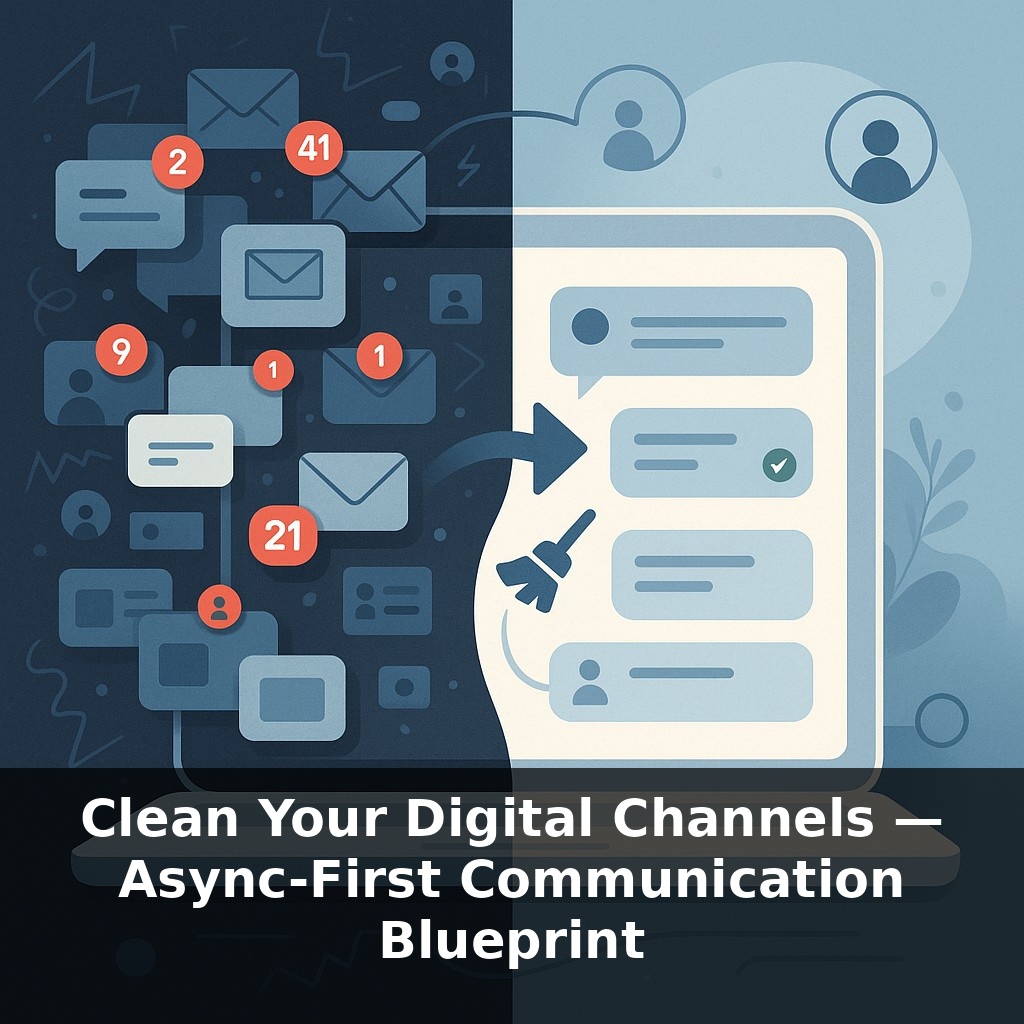
Every few minutes, most remote workers tap their inbox or chat… yet still feel out of the loop. How can constant communication create constant confusion? In this episode, we’ll explore why cleaning up your digital channels might speed up your team by slowing messages down.
Most remote teams run on tools that were never consciously designed—Slack channels that multiplied during crunch time, email lists no one remembers creating, DMs that quietly replaced real documentation. Over time, your “communication system” becomes more like a junk drawer than an operating system: everything’s technically there, but no one can find what they need without rummaging.
In earlier episodes, we focused on defending time for deep work and taming meetings. Now we’ll look at the other half of the equation: the invisible drag from scattered, noisy channels. An async‑first approach isn’t just fewer pings; it’s rethinking *where* work lives, *how* information flows, and *when* people are expected to respond.
In this episode, we’ll break down a practical blueprint: tightening channel hygiene, upgrading message quality, and turning your team’s knowledge into something you can actually reuse.
Think of your digital workspace as a city at rush hour: messages weaving across lanes, stray notifications honking for attention, and everyone slightly delayed getting where they actually need to go. The goal of async‑first isn’t to empty the streets; it’s to add traffic lights, bus lanes, and clear signs so movement becomes smoother and more predictable. That requires zooming out from individual pings to the underlying routes: which tools handle decisions, where updates live long‑term, and how people know what deserves attention now versus later. Once those routes are intentional, deep work stops colliding with drive‑by requests.
Start with where attention actually leaks: notifications. RescueTime found the average knowledge worker checks comms tools every six minutes; that’s not just habit, that’s design. Most apps ship with “notify on everything” as the default, which quietly trains your brain to scan for red dots instead of results. The first pillar of an async‑first blueprint is a notification audit: deciding what genuinely merits an interruption versus what can wait for your next planned sweep. Many teams formalize this by limiting real‑time alerts to direct mentions, incidents, and calendar events, and pushing everything else into silent, batch‑friendly feeds.
Next comes the structure of your channels themselves. High‑performing async teams treat channels like neighborhoods with zoning laws, not random side streets. For instance: one channel strictly for decisions and outcomes; another for daily status; a separate, clearly labeled space for social chatter. GitLab’s public handbook shows how far this can go: they assign specific tools and channels to each type of work artifact, so people know *where* something should live before they even start typing.
But structure alone isn’t enough if messages arrive half‑baked. Async thrives on rich, self‑contained updates: context, goal, options, and a clear ask, all in one place. Zapier’s internal guidelines push people to share decisions in written memos rather than ad‑hoc chats, which is a big reason they cut internal chat volume by almost a third. The more your message can stand on its own—without “quick clarifying calls”—the less your team pays the meeting tax later.
Finally, everything important needs an upgrade path from “conversation” to “knowledge.” That’s where transparent, searchable repositories come in. Instead of hunting through DMs, you promote key threads into pages in Notion, Confluence, or your internal wiki, tagged by project and owner. Over time, this turns one‑off answers into shared assets. It’s closer to preventive medicine than reactive care: you invest a little effort now to avoid a chronic condition of repeated questions and heroic Slack archaeology later.
Think of your channels like a clinic with triage, not a crowded waiting room. Patients (messages) still arrive all day, but someone has decided what gets fast‑tracked, what can wait, and what becomes part of the long‑term chart. For example, in a product team, a “#incidents” channel might be reserved for true emergencies with an agreed 15‑minute response, while “#product‑ideas” runs on a 48‑hour rhythm and is reviewed in a weekly async roundup. Marketing might keep a “launch‑log” thread where each campaign gets one master post: brief, metrics, assets, outcomes, and retro all nested there. A new teammate can scroll that single thread and understand six months of decisions in an afternoon. Some teams go further and tag every message with lightweight prefixes like [Decision], [Question], [FYI], or [Blocker], so even a quick skim tells you what deserves attention during your next communication window and what can wait until your deep‑work block is over.
Async norms won’t stay a niche productivity hack; they’re drifting toward baseline infrastructure. As AI starts auto-summarizing threads and drafting replies, your biggest edge won’t be faster typing, but clearer intent and better written thinking. Lawmakers are already circling “right to disconnect” rules, so vague expectations will become a liability. Teams that treat their written trail like a living product roadmap will navigate change like skilled sailors reading subtle wind shifts.
As you experiment, notice how quieter channels can surface whose voices were missing before—like lowering background music so you finally catch a subtle instrument. Async norms often create space for thoughtful contributors, different time zones, and deeper questions. Treat this less as a rigid system and more as an evolving studio where your team refines how it thinks together.
Start with this tiny habit: When you open Slack or email in the morning, mute just **one** noisy channel or thread that isn’t mission-critical for today. Then, star or pin **one** async-friendly space (like your team’s updates channel or weekly summary doc) so it’s easier to find next time. That’s it for today—one mute, one star—so your digital world is a tiny bit quieter and more async on purpose.