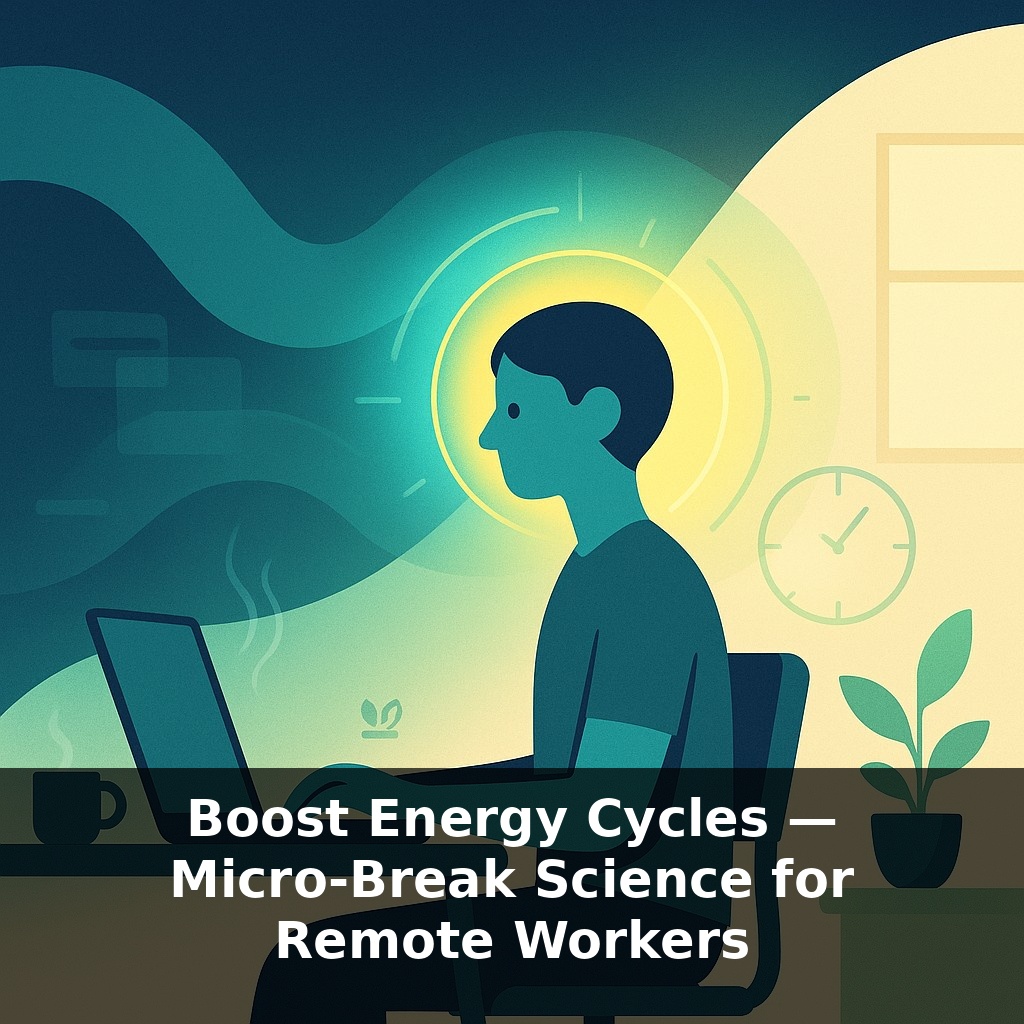
Your brain does its best work in waves, not marathons. Right now, as you listen, your focus is already rising or falling in a quiet ninety‑minute rhythm. The paradox is this: the fastest way to feel less drained by work… is to stop working for just a few intentional minutes.
Most remote workers treat fatigue like a character flaw instead of a signal. You feel your attention fray, so you push harder, pile on caffeine, open one more tab—and quietly slide into “busy but ineffective” mode. Yet the data says something different: in lab settings and real companies, tiny five‑minute breaks with light movement and natural light consistently lift performance, not stall it. This isn’t about being “soft” or “low stamina”; it’s about working with the same underlying rhythms we’ve already talked about, but now at street level—inside your actual day. Think less spa day, more pit stop: stand, move, step to a window or balcony, then return. In this episode, we’ll translate those research numbers into a simple, repeatable pattern you can test in your next work block—no wearable, no app, just a small behavioral tweak with outsized returns.
Think of today’s episode as zooming the camera in. We’ve talked about rhythms and breaks in theory; now we’re looking at how they collide with real remote‑work days: back‑to‑back calls, Slack pings, kids in the next room, lunch at 3 p.m. Micro‑breaks aren’t another “productivity hack” to bolt on; they’re the hinges your work blocks swing on. The research numbers you heard are averages, not commandments—your pattern might look more like 40 minutes, or 80. Our job here is to treat your day like a prototype: test, observe, tweak. Instead of asking, “Am I disciplined enough?” we’ll ask, “What timing actually makes my next 30 minutes sharper?”
Think of this section as moving from “breaks are good” to “here’s what actually happens in those five minutes, and how to make them count in a messy remote day.”
The lab and field data you heard about share a common pattern: performance doesn’t just drift downward; it drops in steps. You’re fine, you’re fine… and then accuracy, reaction time, or code quality suddenly slide. Most people only notice that last step—when they’re rereading the same sentence or mis-clicking. The skill to build is noticing the *early* signs and pairing them with a specific micro-break recipe, instead of waiting for a crash.
Those early signs are usually subtle and physical: shoulders creeping toward your ears, jaw tension, shallow mouth breathing, fixed gaze, restless tab‑hopping, or needing to reread chat messages. For knowledge work, a surprisingly reliable signal is “micro-procrastination”: you glance at the task, then reflexively open something easier “just for a second.” That’s your cue, not a character flaw.
Here’s where environment matters more than you think. Remote workers often do breaks badly: scrolling on the same screen, in the same chair, under the same dim bulb. The research behind movement and daylight is basically saying, “Change the sensory channel.” Swap seated for standing, near focus for far focus, artificial glow for outdoor or window light. Even in a small apartment, that might mean: stand up, walk to the brightest spot you have, look out and track objects in the distance while rolling your shoulders or doing calf raises.
Timing is less rigid than many apps suggest. Instead of a fixed “work 50, break 5” formula, treat those 90–120‑minute waves as a *ceiling*, not a goal. Some tasks—strategy docs, deep coding—will legitimately carry you close to that upper range before you feel frayed. Others—context‑switching in chats, emotionally heavy calls—will drain you in half the time. The point is to insert a tiny reset just before the cliff, not on a heroic schedule.
From a manager’s perspective, this is less about policing minutes and more about protecting quality. Teams that normalize stepping away briefly tend to get cleaner decisions at the end of meetings, fewer sloppy errors late in the afternoon, and more sustainable output over weeks instead of a spiky pattern of sprints and crashes.
A practical way to experiment is to assign “micro-roles” to different breaks, instead of treating them as tiny, generic pauses. One break might be a “reset break” before you switch from solo work into a high‑stakes call: stand up, step to the brightest spot you have, and let your eyes track something moving outside while you loosen your hands and jaw. Another might be a “decision break” slotted right before you finalize a document or send a tough message—two minutes of walking plus three minutes away from screens so your brain can quietly re-rank what actually matters in that draft.
You can also match breaks to specific friction points in your day. If you tend to spiral after feedback, schedule a short decompression break immediately after review meetings so reactions don’t leak into your next task. If your energy reliably dips after lunch, try a brief “activation break” with slightly brisker movement and cooler light, then reserve that window for lighter cognitive work, rather than forcing deep concentration when your system is naturally idling.
Your challenge this week: Run a 5‑day “micro‑break lab” on yourself.
Day 1–2: Keep your normal routine, but jot down three times a day when you notice early friction—slower thinking, more typos, tiny avoidance behaviors. Don’t change anything yet; just capture the time of day and what you were doing.
Day 3–4: At one of those recurring friction points, insert a single 5‑minute break combining light movement and your brightest available light source. Protect it like a meeting. Note how the *next* 25–30 minutes feel and what you actually complete.
Day 5: Pick the *one* break that clearly improved your post‑break work and formalize it: calendar block, recurring timer, or team norm. Treat it as a standing part of your workflow, not a bonus.
By the end of the week, you’re not guessing about micro‑breaks; you’ll have a personally tested “energy checkpoint” you can scale across more of your day.
As AI quietly tracks patterns in keystrokes, video calls, and even posture, “energy traces” may become as visible as calendar events. Instead of obsessing over online status, teams could watch gentle tide charts of when focus crests and ebbs, then schedule demanding work to match. Like city planners studying traffic flow before redesigning streets, leaders might redesign workdays—shorter meetings, smarter handoffs—around real human stamina, not wishful thinking about endless concentration.
Treat this as an ongoing experiment, not a finished system. Over time, you’ll notice certain tasks “cost” more energy, like hills on a running route, and others feel like easy flats. Use those patterns to place micro‑breaks where the climbs are steepest. Done well, your calendar becomes less a cage of boxes and more a map of how you actually work best.
To go deeper, here are 3 next steps: (1) Install a micro-break timer like **Stretchly** or the **Micro Breaks** Chrome extension and set it to ping you every 50 minutes, then follow each alert with a 3-minute “energy reset” (stand up, 10 squats, 30-second wall stretch, 60 seconds of looking out a window or at a distant point). (2) Grab **“The Power of Full Engagement” by Jim Loehr & Tony Schwartz** and read just Chapter 1 today, highlighting any examples of oscillating effort-and-recovery that you can copy into your own remote-work day (e.g., batching deep work into 90-minute sprints followed by 10–15 minute breaks). (3) Open the free **Insight Timer** or **Calm** app and save a 5-minute “energizing” or “focus reset” meditation to a custom playlist called “Micro-Breaks,” then schedule it right before your usual mid-afternoon slump so you actually test how it affects your energy curve this week.