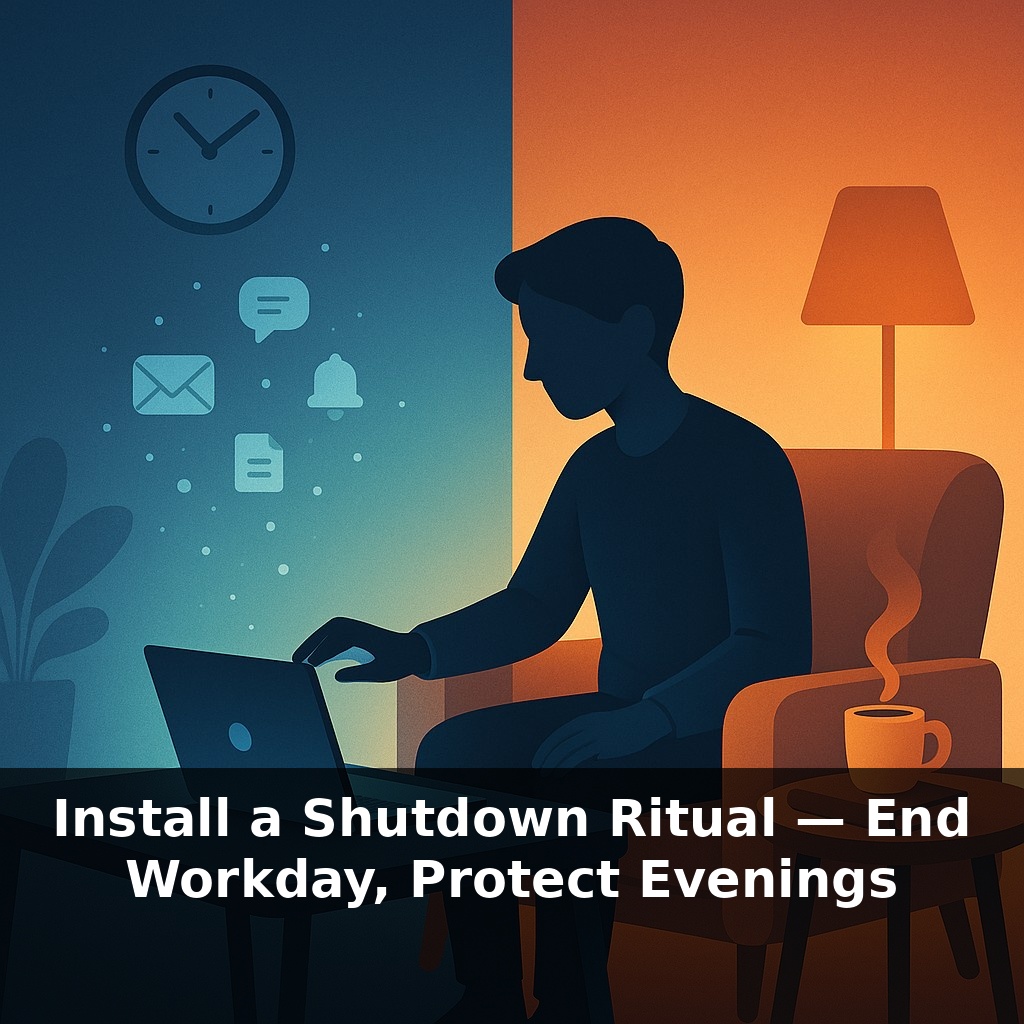
By late evening, a hidden workday “second shift” appears in email data—activity spikes again, long after office hours. You’re on the couch, laptop half‑open, brain still half‑working. The paradox: you’ve left work, but work hasn’t left you. Why does your day refuse to actually end?
So if the second shift is so costly, why is it so sticky—especially for remote workers? One big culprit: open loops. A half-drafted proposal, a Slack thread you “owe” a response, numbers you meant to double‑check. They trail you into the evening like browser tabs you never quite close, each one quietly pinging your attention. The research is blunt: unfinished tasks sit higher in memory and make it harder for your brain to stand down. That’s why simply “stopping work” isn’t enough; the system needs a real shutdown. Not dramatic, not an hour-long ritual—more like a brief landing sequence. In this episode, we’ll treat the end of your workday the way we treated your calendar and communication earlier in the series: as something you can deliberately design, so evenings become actual off‑time instead of a low‑grade continuation of the day.
Think about the moments just before you stop working: you’re wrapping a call, skimming one last doc, telling yourself, “I’ll finish this later.” That “later” usually means tonight. This isn’t just a willpower problem; it’s an architectural one. Remote work erased commutes, office doors, even the simple cue of watching coworkers pack up. Without those signals, your brain never gets a clear “day is over” marker. Instead, it keeps scanning for threats and loose ends, like a security guard pacing long after the building should be closed. A shutdown ritual rebuilds that missing doorway between work and the rest of your life.
Here’s the practical version of that missing doorway: a three-part shutdown ritual that takes under 10 minutes but pays you back all evening.
Step one is **close today’s loops on paper, not in your head.** You’re not trying to *finish* everything; you’re trying to give each item a “home” so your brain doesn’t have to babysit it. Scan your tools—project board, inbox, notes—and list only what’s still in motion: “Draft Q2 summary – at 60%,” “Reply to finance – waiting on numbers,” “Update deck after feedback.” For anything midstream, add a one-line note: “Next move: add revenue chart,” or “Next move: ping Alex for data.” This tells your brain, “This isn’t dropped; it’s parked.” Because of the Zeigarnik effect, that small written cue is often enough to stop the mental replays.
Step two is **shape a concrete plan for tomorrow.** Not a full agenda—three to five anchors. Research shows those who create a written end-of-day plan start faster and stay more focused, because they’ve already cleared the “What should I do?” friction. Identify: - Your 1 high-impact task (the thing tomorrow will be judged by). - 1–2 support tasks that move work forward. - Any fixed-time commitments that are truly non-negotiable. Assign rough time blocks, even if they’ll move. This isn’t about predicting the day perfectly; it’s about giving your future self a starting line instead of a blank page.
Step three is **an explicit mental sign-off.** This is where remote workers tend to skip ahead. Create a short, repeatable script and cue that says, “System closed.” For example: you close all work apps, physically move your laptop out of sight, then say—out loud or in a note to yourself—“Work is done for today. I’ll pick up with [tomorrow’s #1 task] at [time].” It may feel slightly awkward; that’s fine. The point is a clear boundary your brain can learn to recognize.
Your challenge this week: run this exact three-step sequence for five workdays in a row. Time how long it takes, and each evening, quickly rate from 1–10 how much work is “mentally present.” At week’s end, compare your first two nights to your last two. If you see even a small drop, you’ve started to rebuild that missing doorway—on purpose.
A helpful way to test your ritual is to treat it like adjusting stage lights before a performance. You’re not changing the script of your day; you’re changing which parts stay lit after hours. For example, a product manager might end by jotting, “Next: clarify success metric with data team,” then dragging that note into tomorrow’s 10 a.m. slot. The cognitive “spotlight” moves from a vague worry to a scheduled moment.
Or think of a team lead who ends each day with a 90‑second voice memo to themselves: “Tomorrow: open with hiring dashboard, then review sprint board before lunch.” They listen to it once in the morning, then delete. The point isn’t the tool; it’s the small, reliable closing scene.
You can also extend this to team norms. A sales manager might add a line to their daily wrap-up message: “My shutdown’s done; replies next morning.” Over time, that quiet phrase becomes a social cue that it’s safe for others to dim their own lights too.
Soon, these tiny end-of-day habits could shape more than just your evenings. Teams might set shared “lights-out” moments, the way cities dim office towers after hours. Leaders could review recovery metrics alongside revenue, treating rest as infrastructure, not indulgence. Your future calendar might auto-suggest a shutdown window based on workload and stress signals, like a weather app warning of storms. The key shift: you’re not just managing time anymore—you’re actively managing how your mind returns to baseline.
As this practice settles in, notice what else shifts: sleep quality, patience with family, even how creative you feel the next morning. You may find your best ideas surface while cooking or walking the dog, precisely because your mind trusts it can wander. Over time, those quiet, protected evenings become less like leftovers from work and more like prime time for your actual life.
Before next week, ask yourself: “What exactly will I say or do in the last 10 minutes of my workday so my brain knows, ‘Work is done’—for example, a quick inbox scan to star tomorrow’s priorities, closing all work tabs, and literally saying out loud, ‘Shutdown complete’?” “What 2–3 specific behaviors tend to pull me back into ‘work mode’ in the evening (like ‘just checking Slack’ or opening my laptop on the couch), and what clear rules or boundaries will I set around each—starting tonight?” “If my shutdown ritual worked perfectly for the next five days, how would my evenings feel different, and what’s one small, enjoyable thing I’ll add to my post-work routine (like a walk, cooking, or reading) to fill the space I usually give to work?”