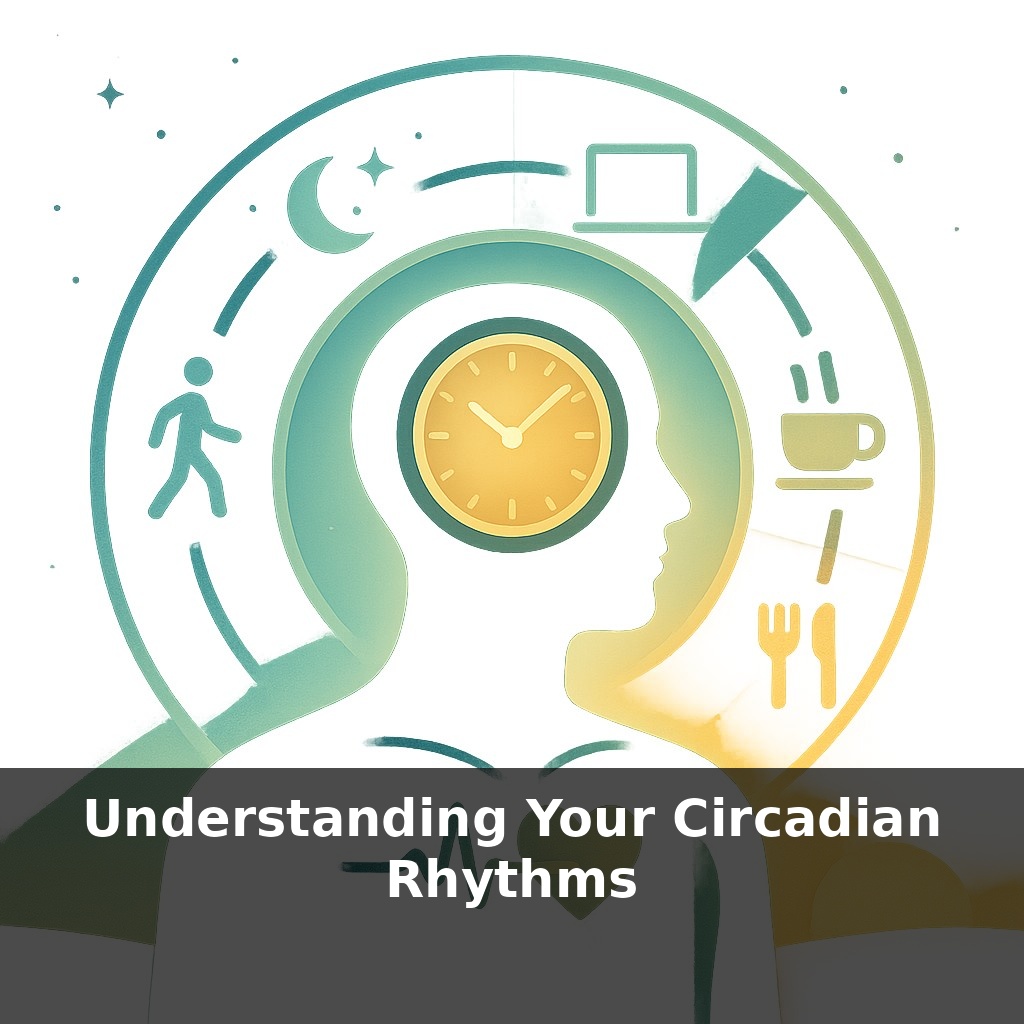
Understanding Your Circadian Rhythms
📝 Transcript
Right now, as you listen to this, every cell in your body is quietly keeping time—yet your work schedule, late-night screens, and coffee habits might be marching to a totally different beat. When those clocks disagree, your mood, focus, and health all start to pay the price.
Think about your day not as a list of tasks, but as a series of “best‑by” windows. There are hours when your brain is primed for deep work, others when your body handles food more gracefully, and a zone where sleep pressure and your inner night finally line up. Most people never learn these personal time windows—they just fight their way through mornings with caffeine and bulldoze past evenings with brightness and noise. Yet research shows your reaction time, insulin sensitivity, pain tolerance, and even how well vaccines work can swing dramatically depending on *when* things happen. In this series, we’re going to treat timing like a hidden lever for your energy, mood, and health—less about becoming a “morning person,” more about discovering the schedule your biology has been quietly asking for all along.
Your “best‑by” windows aren’t fixed like a printed label; they shift slightly based on what you do with light, food, movement, and social cues. This is where your circadian *tendencies* come in—some people naturally tilt earlier, others later, and most sit somewhere in between. You might notice this as a reliable mid‑morning focus spike, a predictable 3 p.m. slump, or a second wind that hits just when you meant to wind down. Treat the next few days like debugging a program: you’ll watch when your energy crashes or peaks, then trace what happened in the hours before.
Let’s zoom in on what’s actually steering those “best‑by” windows under the hood. Your brain’s master clock sits in the suprachiasmatic nucleus, but it’s not running on vibes or willpower—it’s running on light, darkness, and timing signals from the rest of your day.
Light is the primary lever. Specialized cells in your eyes send a direct line of information to that master clock, and they especially care about blue‑enriched light in the 460–480 nm range—the kind you get from a bright morning sky…and your LED screens. Early, strong light exposure pushes your internal day earlier; late, bright light pushes it later. That means a 20‑minute walk outside at 8 a.m. and a 20‑minute doomscroll at 11 p.m. are not neutral swaps. To your clock, they’re opposite instructions.
Darkness is a separate, equally loud signal. As evening light falls, your brain starts secreting melatonin, roughly two hours before you usually fall asleep. Melatonin isn’t a knockout drug; it’s a “night has started” flag that tells the rest of your body to flip into nighttime mode: cooling your core temperature, shifting metabolism, tweaking immune activity. When you blast that window with blue‑heavy light, you’re essentially hitting “snooze” on that flag.
Here’s where timing stacks: food, movement, and social interaction all act as secondary time cues. Eat a large meal at midnight, and your metabolic organs get the message that the day isn’t over. Lift heavy weights late at night, and your system gets a “we’re still on” signal. Stay up chatting under bright lights, and your clock quietly shuffles tomorrow’s schedule forward.
Underneath all this, your genes are running timed programs. In mice, up to 70% of genes are expressed rhythmically in at least one tissue. That’s why the same blood pressure pill or chemotherapy drug can have very different effects depending on *when* you take it; your liver, gut, and even tumor cells are not in the same state at 8 a.m. and 8 p.m.
Think of it like a software update that only installs cleanly during low‑traffic hours: try to force everything at the wrong time, and you don’t just get glitches—you sometimes corrupt the system you were trying to optimize.
Think of your day like editing a shared online document with coworkers in different time zones: each organ “logs in” more actively at certain hours, and if you keep changing things while another system is trying to save or back up, you get conflicts. For example, your gut tends to “prefer” a defined daytime eating window. When late‑night meals become routine, your digestive system is still processing yesterday’s work when today’s calories arrive, so more of that energy is shunted into storage instead of being burned efficiently.
Your brain has its own timing quirks. Deep, insight‑heavy thinking often shows up in a different band of the day than fast, reactive work. That’s why some people draft tricky emails or strategic plans in one window and reserve shallow tasks—like inbox cleanup—for another. Even your emotional calibration follows a pattern: many people are more resilient to stress at certain hours and more irritable at others.
Over time, those small timing mismatches don’t just feel like “off days”; they accumulate like compound interest, nudging your baseline mood, weight, and focus in directions you may not like.
Your daily rhythms may soon shape more than your sleep. As wearables learn your patterns, your phone could quietly rearrange meetings away from your “biological low,” like rescheduling a game right before halftime. Medications might ship with timing instructions tailored to your data, and gyms or meal services could offer “chronotype‑friendly” plans. Even city lighting, transit, and school hours might shift, treating social schedules as adjustable knobs instead of fixed defaults.
Tuning into these patterns isn’t about perfection; it’s about running small experiments. Shift one thing at a time—light, meals, or movement—and watch how your days feel different, like adjusting sliders on a sound mixer. Your challenge this week: pick one anchor—wake time, breakfast, or walk—and keep its timing consistent within 30 minutes, every day.
From this course
Resetting Your Sleep Cycle Naturally
5 episodesUnlock all episodes
Full access to 5 episodes and everything on OwlUp.
Subscribe — $1.99/monthLess than a coffee ☕ · Cancel anytime