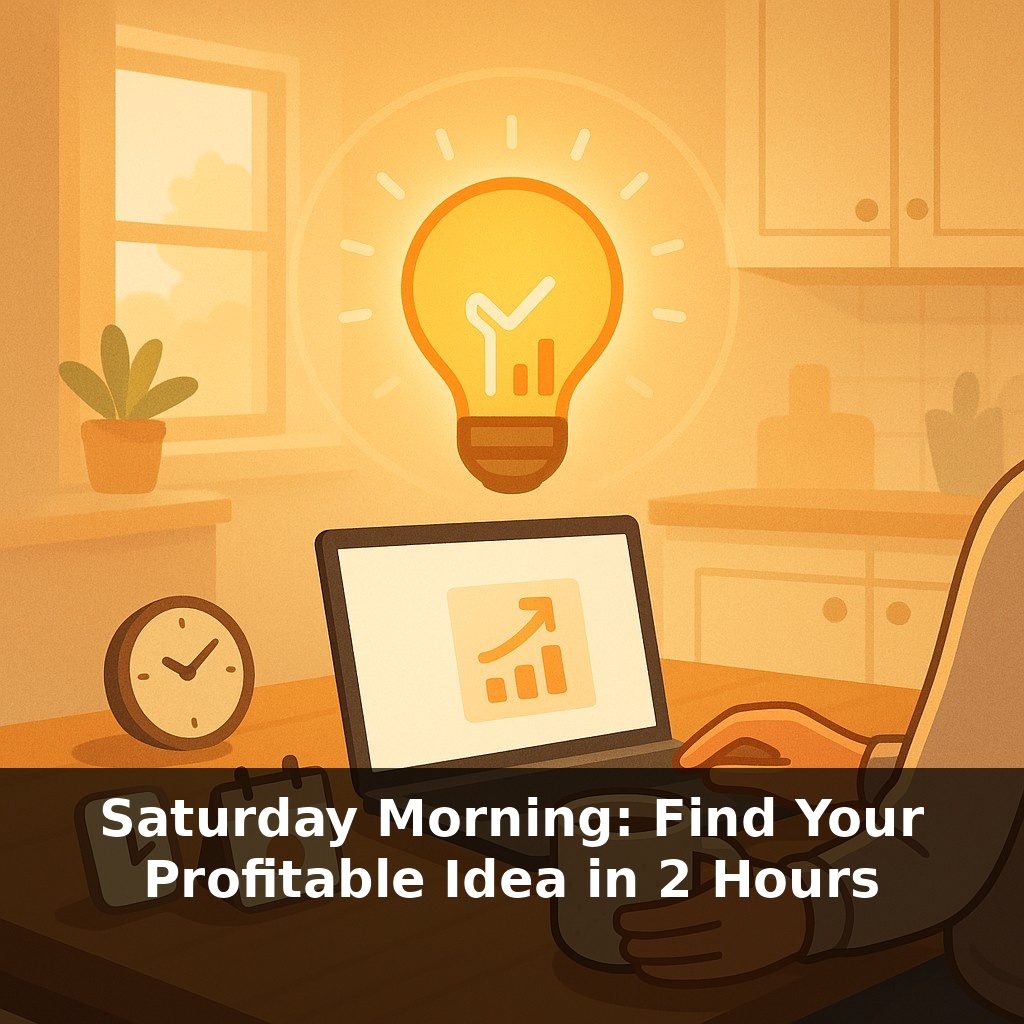
Saturday Morning: Find Your Profitable Idea in 2 Hours
📝 Transcript
About a third of new businesses die for one simple reason: nobody actually wanted what they sold. Yet, this Saturday, you could be sitting at your kitchen table, coffee in hand, quietly uncovering an idea people are already begging to pay you for.
Most people think they need a flash of genius, a blank week, and a whiteboard full of diagrams to find something worth building. In reality, what you need looks a lot more ordinary: two focused hours, a curious mindset, and a willingness to be wrong quickly. This is less about “dreaming up” the perfect thing and more about noticing weak signals hiding in plain sight—search terms people repeat, complaints that never seem to get resolved, small workarounds your friends rely on every day. Like a doctor running a few quick tests before committing to a treatment, you’ll run lightweight checks that reveal which hunches are actually alive. In this episode, we’ll turn your Saturday morning into a structured experiment: a step-by-step sprint that starts with messy, unfiltered problems from real people and ends with a short, ranked list of ideas that have early proof they can pay their own way.
Today you’re going to zoom in on something narrower than “a business” and more concrete than “a passion”: specific customer problems that already show up in numbers and conversations. We’ll focus on spots where three lines cross: people clearly struggling with something, evidence they’re actively searching for help, and solutions that don’t quite satisfy them yet. Instead of guessing, you’ll pull real signals from search data, social comments, and quick chats. Think less about inventing a new world and more about spotting cracks in the one you already move through every day.
Start with the constraint: two hours, one morning, one clear outcome—a short list of ideas that aren’t just “interesting,” but show early signs of cash flow. To get there, you’ll move through three modes: listening, scanning, and testing.
First, listening. For 30–40 minutes, you’re not brainstorming solutions at all. You’re collecting raw complaints. Text three to five people in different circles—one at work, one friend with kids, one freelancer, one hobby community member—and ask a narrow, present-tense question like, “In the last month, what’s something that’s repeatedly wasted your time or money?” Push for specifics: “Last week?” “What did you actually do instead?” You’re hunting for patterns like “every Sunday night…” or “whenever I have to submit…” Those recurring annoyances are candidates; one-off annoyances are not.
Next, scanning. Take two or three of the most concrete frustrations you heard and see how big they might be beyond your circle. Use search tools and public chatter to gauge scale. Plug phrases into keyword tools and note: - Monthly volume (is there a real crowd?) - Paid competition (are advertisers present?) - Exact wording people use (future copy for your offer)
Then hop to social platforms and forums. Type those same phrases in and skim: - Upvoted complaints - Workarounds people recommend - Products or apps mentioned, along with “but…” and “wish…”
You’re not judging feasibility yet; you’re mapping demand plus dissatisfaction.
Finally, testing. Pick one problem that checks three boxes: vivid story from someone you know, non-trivial search volume, and clear frustration with current fixes. Your goal in the next 40–50 minutes is not to build anything; it’s to write a simple promise and ask for a small, real commitment. That might be: - A pre-order at a discounted price - A paid “beta” spot - A deposit to reserve a service slot next week
Draft a no-frills landing page or even a single, focused post that describes: 1) The painful situation, in the exact words you collected 2) A specific outcome, with a clear time frame 3) What they need to do now (pay, reserve, reply)
This is your minimum-viable-offer: just enough clarity that a stranger can say “yes” or “no” with their wallet or calendar, not just with compliments. Set a tiny, numeric bar—say, three to five people committing within a few days. You’re designing a quick signal that tells you which ideas belong at the top of your list when your two hours are up.
Think about three very different Saturdays. In one, a graphic designer notices her group chat complaining about ugly, confusing invoices. She screenshots a few, then checks how often “invoice template freelance” pops up online. By lunchtime, she’s pre-selling a clean, niche-specific template pack to five people in that same chat. In another, a cycling coach keeps hearing students grumble about “never knowing how hard to train” before races. He skims niche forums, sees the same wording, and posts a stripped-down offer: a 2-week personalised taper plan for the next event. No app, no logo—just a form and a payment link. In a third, a home cook sees neighbors ranting in a local group about last-minute dinner chaos. She throws up a one-page “weeknight rescue” plan: three 20-minute recipes, a shopping list, and a Sunday prep call. One morning, three domains, same pattern: listen closely, check for a crowd, then ask for a modest but real commitment to see if the spark catches.
Soon, the “Saturday sprint” won’t stop at a landing page. You’ll sketch a concept, ask an AI to draft 10 variants, and watch live data stack up as tiny audiences vote with clicks, sign-ups, and micro-payments. Crowdfunding may shrink to the size of a group chat: five strangers cover your initial costs before you’ve written a line of code. Your real job shifts from guessing to curating: choosing which signals to amplify and which to ignore as you iterate through many fast, low-risk bets.
Treat this two-hour sprint less like a test and more like tasting dishes in a kitchen: you’re sampling, not committing to a full menu yet. Over a few weekends, those samples add up—patterns harden, language sharpens, and one dish keeps getting emptied first. That’s your cue. Your challenge this week: block a single Saturday slot and run your first tiny tasting.
From this course

Start Your Side Business This Weekend
7 episodesUnlock all episodes
Full access to 7 episodes and everything on OwlUp.
Subscribe — $1.99/monthLess than a coffee ☕ · Cancel anytime