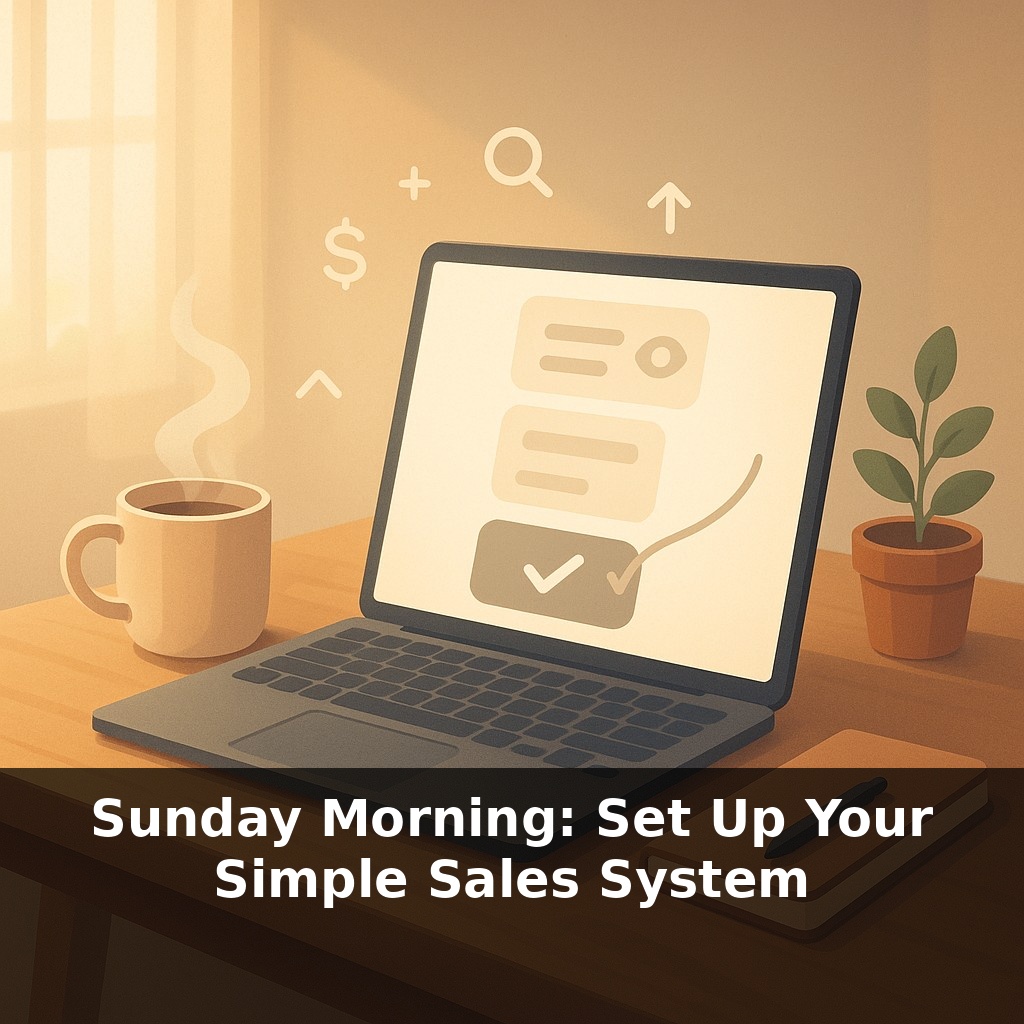
About half of your future customers will quietly decide whether to trust you before you ever speak a word to them. Now picture a sleepy Sunday morning: one page on your laptop, one simple path to “yes.” No ads dashboard, no funnel maze—just a calm, repeatable way for money to find you.
70–80% of your future buyers will quietly investigate you online before they ever reply to your email or DM. That means your “Sunday system” isn’t just about getting attention—it’s about being ready when attention shows up.
This week, you’re going to assemble a tiny, sturdy sales setup you can run in the margins of a full life: one clear offer, one place to send people, one way to follow up, one way to take payment. Think of it less like “launching” and more like laying down train tracks: simple, straight, and built for repeat trips.
Instead of juggling five social platforms or obsessing over a perfect website, you’ll choose the smallest set of steps that can turn a stranger who discovers you today into a paying customer within days—not months. By the end, you’ll have a system you can test next Sunday, improve the Sunday after, and scale only once it’s actually working.
Most people will tinker with logos and color palettes for weeks before they ever create a way for money to actually change hands. You’re going to invert that. This Sunday isn’t about “brand polishing”; it’s about building a tiny assembly line that can quietly move a stranger from first touch to paid outcome. We’ll zoom in on just three pressure points: how people first encounter you, what they see in the first 5 seconds when they click, and what happens in the first 24 hours after they raise their hand. Treat today like adjusting the burners on a stove: small dials, big impact on what actually cooks.
Most founders start by asking, “Which tools do I need?” A better question is, “What is the minimum series of moments a stranger must experience to feel ready to buy from me?” Tools just sit underneath those moments.
Think of your system as four linked scenes in a short film:
**Scene 1: The First Glance (Traffic) Goal: spark enough curiosity that a stranger chooses *you* over another tab.**
Pick one primary source of attention that fits your reality right now. A few options, each with a simple, repeatable move:
- Existing network: one weekly value email or LinkedIn post that ends with a relevant invitation. - Communities: contribute 15 minutes/day answering specific questions in 1–2 groups where your buyers already hang out, then offer a resource or quick call. - Search-style content: one detailed “how to solve X without Y” article or video per month, each pointing to your next step.
The test for this scene: can you calmly describe in one sentence how new people typically discover you?
---
**Scene 2: The First 5 Seconds (Landing) Goal: show “I see your problem” before “here’s who I am.”**
Instead of a general “about me” page, create a focused landing section that:
- Names the situation they’re in (“Struggling to ____ despite trying ____?”) - States the outcome of working with you in plain language - Offers one clear next action: “Get the 10‑minute checklist” or “Book a 20‑minute mapping call”
Use the top of this page to answer the silent question in their head: “Is this for someone like me, dealing with this *now*?”
---
**Scene 3: The First Signal (Hand Raise) Goal: make it effortless to say, ‘I’m interested.’**
Choose one main mechanism:
- Short form (3–4 fields) for a resource or waitlist - Simple calendar link for a brief call - “Reply with X” CTA in an email or DM
Your rule: no step here should feel heavier than ordering takeout on your phone.
---
**Scene 4: The First 24 Hours (Response) Goal: turn a vague interest into a concrete next step.**
Pre‑decide what happens when someone raises their hand:
- An auto‑sent resource plus a personal note template you can customize in 2 minutes - A brief questionnaire that helps you qualify and prepare - A calendar link with 2–3 narrow time windows
Your aim isn’t to impress; it’s to be the most responsive, least confusing option in their inbox that day.
Your challenge this week: Map and build these four scenes using only tools you can learn in under an hour each. By next Sunday, you should be able to trace, step by step, how a stranger from your chosen channel could realistically become your next customer.
A freelancer designing brand kits uses Instagram DMs as her “front door.” Once a week, she posts a short carousel breaking down a real client transformation. Slide 5 always says, “Want this for your brand? DM ‘kit’ for the walkthrough.” That keyword triggers a saved reply with a link to a single-page overview and a 15‑minute consult calendar. The whole chain is light enough to run between other commitments, yet specific enough that by the time someone books, they already understand the ballpark price and outcome.
A career coach leans on one monthly Zoom workshop promoted in two LinkedIn posts and one targeted message to past colleagues. Attendees see a single slide at the end with a URL that leads to a stripped‑down page: a one‑paragraph offer, a 3‑question form, and two time slots. Because the path is so narrow, she can spot exactly where people stall—sometimes it’s just one confusing question—and adjust the next month’s run without rebuilding everything.
AI will quietly sit inside each step of your system: suggesting subject lines that match a lead’s mood, drafting replies based on past conversations, even spotting patterns in who buys when. Treat it like a sous‑chef, not a replacement: let it prep ingredients—research, drafts, summaries—while you handle taste and timing. As voice search grows and buying shifts into chats, the founders who win will be those who keep the core journey human, but let software handle the repetition.
Treat this week like seasoning a new recipe: adjust portions, taste, adjust again. Watch where people pause, click away, or suddenly lean in; those tiny reactions are clues to refine language, steps, even timing. Over a few Sundays, you’ll stop guessing and start steering, because your system’s behavior will quietly teach you how it wants to grow.
Start with this tiny habit: When you sit down with your Sunday coffee, open your calendar and type the name of just ONE person you’d genuinely like to work with into a 15-minute slot this week. In that same moment, add two words next to their name: either “check-in” or “invite,” so you know the exact purpose of that touchpoint. Close the calendar and you’re done for the day—no outreach, no overthinking, just one clear, scheduled sales moment anchored in your simple system.