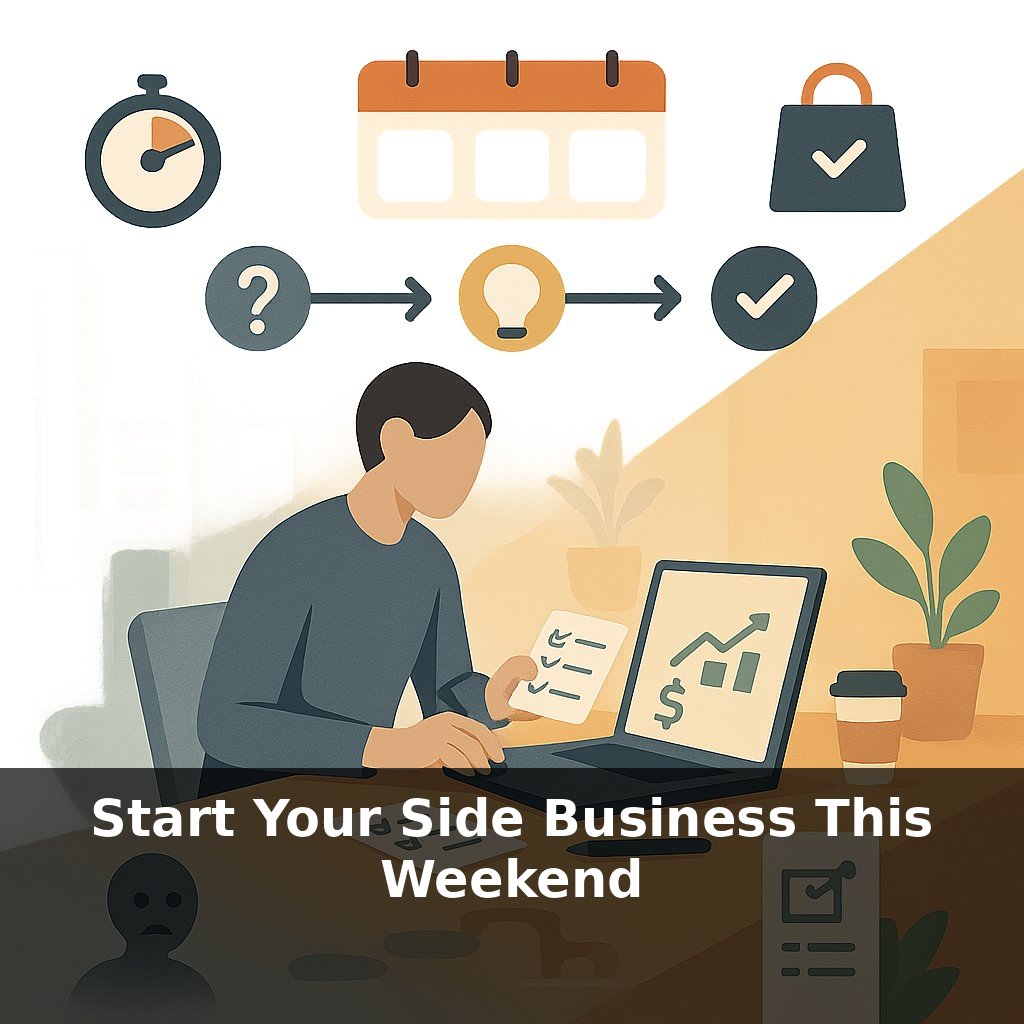
Most side businesses don’t fail because the idea is bad—they fail because the founder quietly builds in the dark for months. It’s Saturday evening. One scrappy offer, posted before you go to bed, could teach you more than the last six months of “getting ready.”
Tonight isn’t about finishing your “real” product. It’s about stripping your idea down until only the part someone would actually pay for is left—and then testing *that* before midnight. Think tiny, not timid. Instead of a full course, you’re serving one precise bite: a single landing page, one service package, a pre-order form, or a paid beta with just 3–5 spots. Set a clear promise (“I help X do Y in Z days”), a specific price, and one simple way to say yes. That’s your minimum viable offer. The win isn’t revenue yet; it’s data. If 50 people see it and 0 click, that’s a signal. If 10 see it and 2 buy, that’s a stronger one. Your job over the next hour is to define what you’re offering, who it’s for, and how they can pay you—no logos, no automation, no polish. Just a real offer, in the wild, before the weekend ends.
Your minimum offer doesn’t have to be clever; it has to be *testable*. That means choosing numbers up front so tomorrow’s results are unambiguous. For example, you might decide: “I’ll share this offer with 30 people tonight. Success is 3 replies, 1 paid.” Or: “I’ll spend $20 on simple ads; if I get 10 clicks and 1 preorder, I keep going.” By fixing a tiny “budget” of time, money, and people—say 60 minutes, $25, and 25 eyeballs—you protect yourself from endless tweaking. You’re not chasing vibes; you’re running a small experiment with a clear pass/fail line you can learn from.
Skip the fantasy of “someday when it’s ready.” Tonight you’re going to borrow a page from founders who got proof *fast*—sometimes before they had anything built.
Start by deciding **one core outcome** your offer delivers, but sharpen it with a constraint. “Career coaching” is vague; “rewrite your resume and LinkedIn in 72 hours so you can apply to 5 jobs next week” is sharp. Make the outcome *measurable* and *time-bound* so someone can quickly judge, “Is this for me, right now?”
Next, pick a **specific segment**, not “anyone who…” but “12 busy parents in my kids’ school WhatsApp group” or “20 designers in the local Slack community.” Concrete groups make it easier to choose examples, language, and price. If your audience is “remote software engineers with 5–10 years’ experience,” say that. You’re not excluding everyone else; you’re choosing who you’ll learn from first.
Now constrain **scope** so you can actually deliver. Look at your idea and strip it down using three filters:
1. What can I fulfill **this month** with tools I already know? 2. What can be done **1:1 or manually** before I automate? 3. What can fit into a **fixed container** (e.g., 45-minute call, 7-day sprint, 3-session package)?
Write the smallest version that still respects your time. For example: - “3 strategy calls over 10 days to map your first digital product” - “Done-for-you Notion system set up in 5 business days for one freelancer” - “One custom meal plan + grocery list delivered within 24 hours”
Add hard caps: “Only 5 spots at $120 each this week,” or “I take 2 clients at a time at $350 per project.” Limits do three things: they protect your schedule, create urgency, and keep failure affordable. If nobody buys 2 slots, that’s a cheap lesson; if 10 people want in, you’ve just discovered demand *and* a reason to raise prices next round.
Finally, decide a **simple delivery mechanic**. Tonight, avoid complex stacks. Use: - One communication channel (Zoom or phone) - One file format (Google Doc, PDF, Loom video) - One payment method (PayPal link, Stripe link, or bank transfer)
This constraint forces clarity. If you can’t describe what happens after someone pays in 3–4 bullet points, the offer is still too fuzzy.
Look at how small some now-huge businesses started. Airbnb didn’t launch with thousands of listings; it started with one page for one weekend event and three paying guests. Dropbox didn’t code a complex syncing engine first; they used a 3‑minute walkthrough to see if anyone even *wanted* what they had in mind. That’s the spirit you’re using tonight—except you’ll tighten it even more.
To make this concrete, try shaping an offer in one of three formats:
1) **Fast outcome service** “I’ll build you a simple portfolio site in 48 hours for $180. I only take 2 clients per weekend.”
2) **Tiny product** “Notion template pack for freelancers to track invoices and leads. $29 for lifetime access, first 15 buyers get a 15‑minute setup call.”
3) **Paid test group** “4‑week accountability circle for new managers, Thursdays 7–8 PM. Max 6 people at $60 each; we’ll solve one leadership challenge per week.”
Notice the pattern: a clear result, a defined container, a real price, and a specific cap. Your turn: draft three variants like this, then pick one to ship.
As cycles shrink, the skill isn’t just launching a minimum offer, it’s **running many small bets well**. AI tools now let solo founders spin up 3–5 variations of headlines, pricing tiers, or onboarding flows in an evening and A/B test them with 50–100 visitors using low‑cost ads. Treat each test like a micro‑trial: set a clear hypothesis, a numeric target (e.g., “5 paid signups in 7 days”), and a strict stop‑rule so you don’t keep propping up weak ideas out of sunk‑cost guilt.
Post tonight’s version, then set a simple checkpoint: in 7 days, review views, clicks, and replies. If fewer than 20 people saw it, your next move is distribution; if 20+ saw it and 0 responded, adjust the promise; if even 1–2 buy, improve delivery before chasing more. Your challenge this week: ship one tiny improvement every evening.