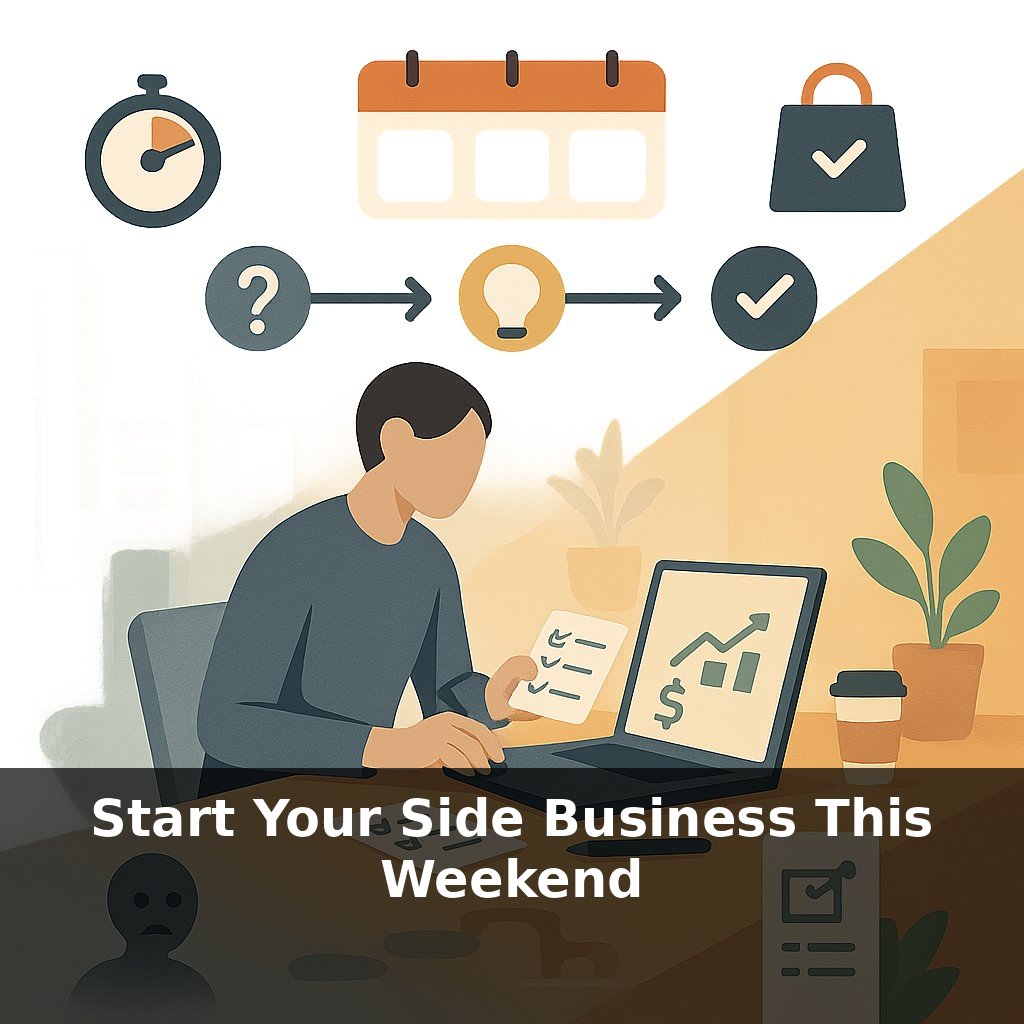
You can test a business idea in a single afternoon—without writing a line of code or buying a single product. Enter a scenario where you find a simple landing page: no app, no inventory, just a promise. The real question isn’t “Can I build this?” It’s “Will anyone click the button to pay?”
Most people stop at that first simple page. This afternoon, you’ll go one step further: collecting real signals of intent. Not likes. Not “sounds cool.” Actions.
Think of this as a tiny lab experiment on your idea. You’re not guessing what people might do; you’re giving them a small, safe chance to actually do it—click, reserve, or join a waitlist tied to a clear offer.
We’ll focus on three fast tools: a pre-order style “coming soon” option (no payment needed yet, but with pricing visible), a stripped-down form that asks two or three sharp questions, and a single traffic source that can send at least 50 visitors in a day—through your existing audience, a community, or low-budget ads.
By evening, you should know whether strangers lean in, hesitate, or walk away—before you commit your next weekend to building anything.
Now you’ll turn that tiny experiment into numbers you can trust. Set a clear target before you start: for example, “Out of 100 visitors, I want at least 5 to hit the pre-order button or join the waitlist.” That’s a 5% conversion rate. If you’re using two ideas, split traffic—50 clicks each—and compare which offer wins. Track three things: how many people visited, how many clicked, and how many answered your short questions. With even 30–50 visits this afternoon, you’ll see patterns: a dead stop, a mild signal, or a strong pull you should double down on next.
A 5% target gives you a simple “yes/no” threshold, but you can squeeze much more insight out of this tiny test.
First, classify responses into three levels of commitment:
- Level 1: Soft interest – clicks on your main button, but no form completed. - Level 2: Qualified interest – button click + form answers, but no reply when you follow up. - Level 3: Engaged interest – form answers + they respond to a follow-up email or DM.
If you get 100 visitors and 7 people click (7%), that’s promising. But if only 1 person answers your follow-up, your real signal is closer to 1%. Track each level separately. A pattern like 10% clicks, 6% forms, 4% replies is far stronger than 10% clicks, 1% forms, 0 replies—even if the top-line click rate looks similar.
Next, analyze which parts of your offer are doing the work. Look at three elements:
1) Headline: If you run a low-effort A/B headline test (50 visitors each) and Version A converts at 2% while Version B hits 8%, your idea probably isn’t the problem—your framing was. 2) Price: Try listing two price points on your page (e.g., $19 and $49 options). If 80% of clicks go to $49, you may have underpriced your value. 3) Segment: Add one multiple-choice question (e.g., “What best describes you?”). If you see 12% conversion from freelancers and 1% from small agencies, you’ve found your starting niche.
Treat today’s numbers as a directional signal, not a verdict. With 40 visits, 3 button clicks (7.5%), and 2 thoughtful replies (5%), you’ve earned the right to design a slightly deeper test. With 80 visits and zero clicks, assume the offer is off, not that “no one wants this.” Change one major variable—problem statement, audience, or promise—and re-run.
Finally, validate that people care enough to be inconvenienced. Send a short message to every Level 2 and 3 lead: ask for a 10–15 minute call, or propose a paid early-bird deal (for example, $10 to reserve a $40 product). If out of 5 replies, 3 book a call and 1 pre-commits with payment details, that beats 50 casual sign-ups with no follow-through.
Your goal by the end of this afternoon: move at least 3–5 people into real conversations or pre-commitments. Those are the seeds of a business, not just a spike in clicks.
A 3-minute Dropbox demo video reportedly jumped their beta list from about 5,000 to 75,000 sign-ups in a single night—not because the product was finished, but because the pitch was concrete and the action was clear. You can do the same on a tiny scale.
Example 1: You’re testing a $39/month accountability group for new freelancers. You post a short “coming soon” offer inside a 3,000-member Slack. 120 people view it, 9 click to “reserve a spot,” and 4 agree to a quick call. On those calls, 3 say they’d pay if it included weekly hot seats. You update the offer and rerun it in a similar community. This time, 150 views → 18 clicks → 7 call bookings. That’s a sharp upward signal.
Example 2: You’re considering a $60 home-cooked-meals subscription. You run $40 of local ads and get 220 visitors, 2 clicks, and zero replies. The next afternoon, you narrow the pitch to “busy new parents,” cap delivery at two neighborhoods, and test a $90 white-glove version. Now 160 visitors yield 14 clicks and 5 reply “yes” to a paid trial.
Real-time validation will push you to tighten your ideas faster. Instead of celebrating a “good” click-through rate, you’ll compare tests: 150 visits + 3 calls booked vs 90 visits + 5 deposits. As tools automate setup, your edge comes from sharper questions: Which of 3 pains should you test first? Which of 2 prices reveals more urgency? Treat each tiny campaign as a decision engine: if it doesn’t change what you do tomorrow, the test was too vague.
Your next step is to turn today’s data into a clear bet. If 3 of 10 calls end with “email me when it’s live,” draft a one-page roadmap and set a $200 micro-budget for the next test. If 0 of 10 show up, archive this version and write a sharper offer in 30 minutes. Either way, your progress is now measured in decisions, not dreams.
Try this experiment: Before you build anything, message 10 people in your target audience this exact question: “I’m considering a super simple version of [your idea] that would do only these 2–3 things: [list them]. If it were ready today, would you PayPal/Venmo me $X to get access next week?” Keep a simple tally: how many say “yes” and actually send money vs. how many say “sounds cool, keep me posted.” If at least 3 people pay, schedule 1 call with each to ask what absolutely must be in the first version; if nobody pays, tweak the offer (price, problem, or feature set) and run the same test with 10 new people.