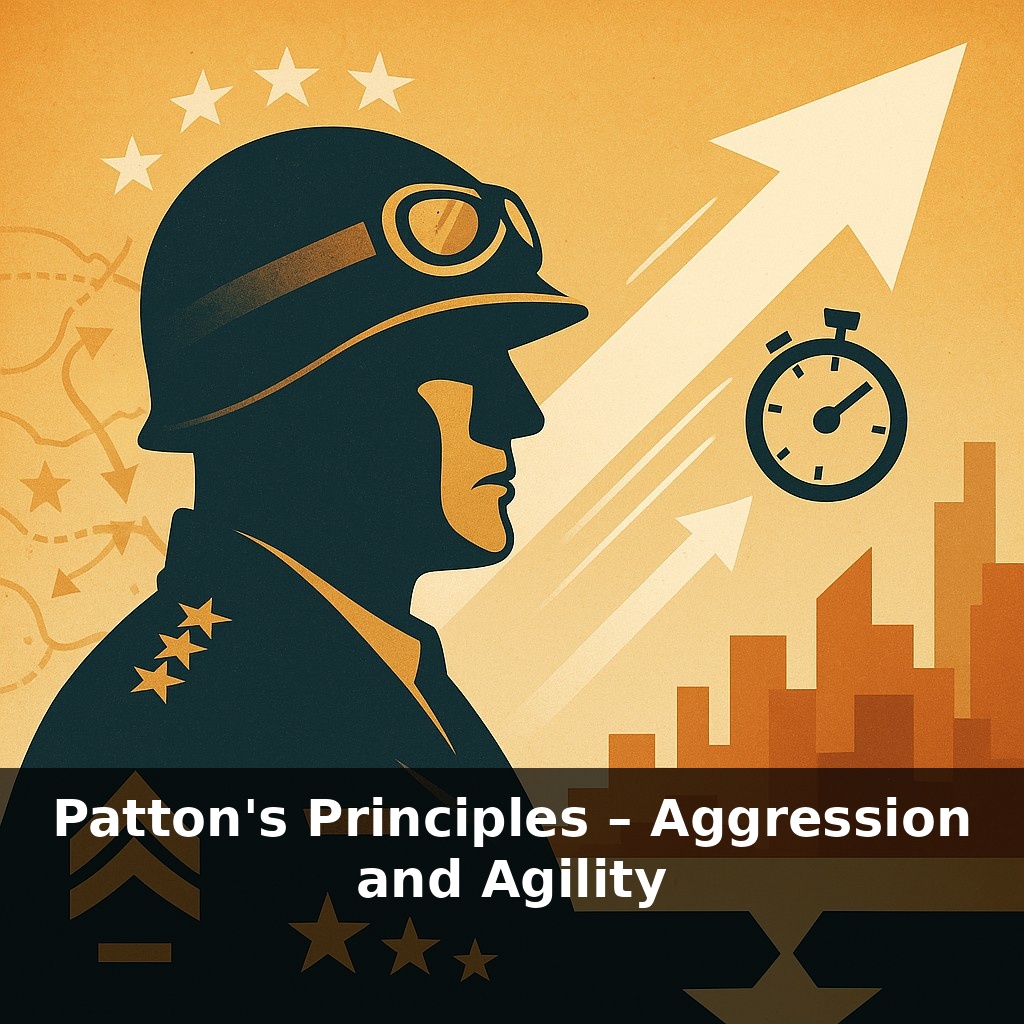
Patton's Principles – Aggression and Agility
📝 Transcript
“A good plan, violently executed now, is better than a perfect plan next week.” Patton said that in a warzone—yet today, thousands of top CEOs quietly agree. So here’s the puzzle: why do so many smart leaders still move slowly, even when speed clearly wins?
Most leaders don’t lose because they lack data or options—they lose in the space between knowing and moving. That gap is where opportunities decay, competitors slip past, and teams quietly disengage. Patton solved that gap with two commitments: move first, and be ready to pivot fast. Modern high performers do something similar: they treat initiatives less like fragile masterpieces and more like working prototypes on the shop floor, meant to be hammered, adjusted, and shipped.
Crucially, aggression here isn’t about recklessness or ego; it’s about refusing to let uncertainty become a hiding place. Agility isn’t chaos; it’s disciplined flexibility under clear intent. When you combine the two, your organization stops waiting for “the right moment” and starts creating it—by acting quickly, learning loudly, and adjusting in motion, instead of on the sidelines.
Patton proved that tempo is a weapon, not a byproduct. His 3rd Army didn’t just move fast—they were designed to move fast: lean supply lines, decentralized authority, and clear commander’s intent so units could advance without waiting for permission. Modern data backs this structure. IBM’s CEO study and McKinsey’s 24‑hour decision gap both point to the same pattern: organizations that wire speed into their systems outperform those that rely on heroic, one‑off pushes. It’s the difference between occasionally sprinting and building a body that can sprint on demand, without tearing something every time you accelerate.
Patton’s real edge wasn’t just that he moved faster; it was *how* he structured reality so that speed was the natural outcome. He treated constraints—fuel, roads, weather, politics—as design inputs, not excuses. That’s a transferable mindset: instead of asking “How do we go faster?” high‑leverage leaders ask, “What must be true in our system so that going faster is the default?”
In practice, that starts with clarity at the top and freedom at the edges. Patton was ruthless about intent—everyone knew the direction of advance and the priority objectives—but flexible about methods. Modern equivalents show up in organizations that state a few non‑negotiable goals, then let teams choose tools, tactics, and sequencing. A product group might be locked on “double activation in 90 days,” but free to ship three small releases, run ten experiments, and cut low‑value features without waiting for a steering committee.
The second layer is logistics. Patton’s 48‑hour supply posture has a modern twin: ensuring teams have the “fuel” to move without pausing for permission, budget cycles, or endless dependencies. In software, that could mean self‑service data platforms, pre‑approved cloud resources, and access to user panels. In healthcare, it might be standardized order sets, rapid‑response staffing pools, and standing protocols that can be activated instantly. You’re engineering away the slowest 10% of your recurring bottlenecks so the other 90% can flow.
Third, Patton accepted that forward units would sometimes be wrong—but almost never paralyzed. Leaders who mirror this bias don’t punish every misstep; they punish unexamined stagnation. They distinguish between reversible and irreversible moves, green‑lighting swift, local decisions where the downside is limited and learning is fast.
Finally, there’s rhythm. High‑tempo organizations establish recurring moments to reorient—daily huddles, weekly portfolio reviews, short “after‑action” debriefs. These aren’t performative status updates; they’re micro‑course corrections that keep aggression pointed in the right direction instead of drifting into noise. Over weeks and months, that steady cadence of small, aligned adjustments compounds into the kind of outsized progress that looks, from the outside, like audacity.
Think of how Netflix handled its shift from DVDs to streaming. They didn’t wait for a perfect model; they launched a rough streaming product while the DVD business was still strong, then iterated hard as data came in. The “aggression” was entering a space that threatened their own core; the “agility” was their willingness to refactor pricing, content strategy, and even technology stack multiple times without clinging to the original playbook.
On a smaller scale, consider a mid‑size manufacturer piloting a new line. One plant commits to a three‑month “rapid lane”: tiny batch sizes, daily schedule tweaks, and permission to reconfigure workstations on the fly. Another plant keeps its classic quarterly planning cycle. Same market, similar talent—yet the rapid lane surfaces process improvements and product variants weeks sooner, giving sales something concrete to test while the slower plant is still aligning stakeholders.
Your challenge this week: pick one initiative and create a “Patton lane” for it—fewer approvals, tighter feedback, shorter planning horizons—and compare outcomes.
Patton’s playbook hints at where leadership is heading: toward systems that default to forward motion, but can bend without breaking. As AI and automation handle more sensing and forecasting, the frontier shifts from “seeing sooner” to “committing sooner.” The edge won’t be who has the most data, but who pre‑decides thresholds for action. Think less traffic‑light bureaucracy, more well‑marked roundabout where movement is expected and brief hesitation is the exception.
Treat this as an ongoing navigation problem, not a single charge forward. The leaders who compound advantage aren’t louder or braver; they quietly turn “try, notice, adjust” into a shared reflex. Over time, that habit sketches an internal map: where friction lives, where flow lives, and where a small, timely shove can move the whole system.
Here’s your challenge this week: For the next 5 workdays, pick one decision each morning that you’ve been hesitating on and give yourself a strict 10-minute limit to decide and move, following Patton’s “a good plan violently executed now is better than a perfect plan next week.” Each afternoon, choose one obstacle you hit that day and deliberately “attack the flanks” by trying a non-obvious workaround (different person, different tool, or different sequence) instead of pushing the same way harder. By Friday, list the three fastest wins you created from this aggressive, agile approach and commit to repeating those exact behaviors next week at a larger scale.
From this course
Strategic Minds: Lessons from World War Generals
7 episodesUnlock all episodes
Full access to 7 episodes and everything on OwlUp.
Subscribe — $1.99/monthLess than a coffee ☕ · Cancel anytime