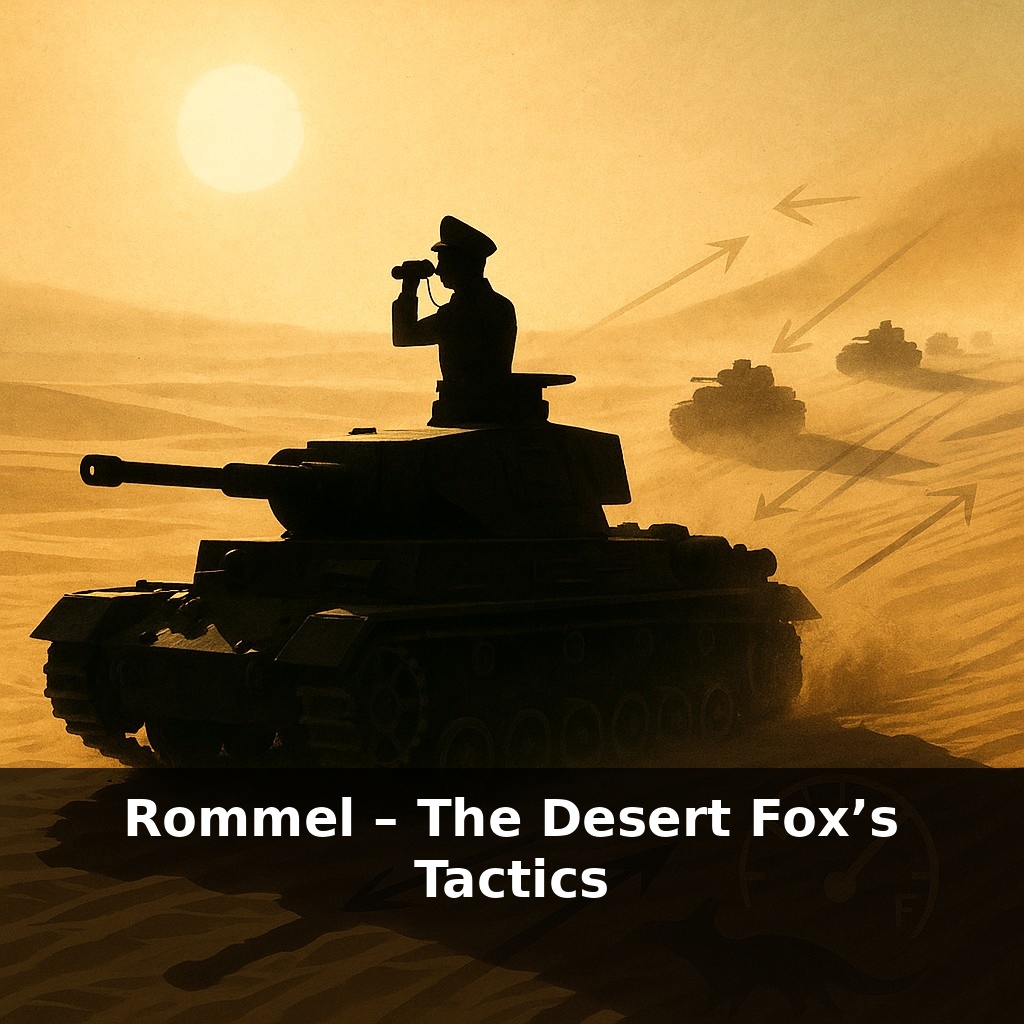
Rommel won battles while running on barely a third of the fuel his enemy enjoyed. In the burning North African desert, his tanks were often running on fumes—yet advancing. How does a commander turn scarcity into momentum, and confusion into a weapon more powerful than steel?
Rommel’s real advantage wasn’t just daring raids; it was how he *designed* decisions. He stripped plans down to their essentials: clear intent, a few critical priorities, and brutal simplicity in execution. His orders were short enough to fit on a single page, but sharp enough that subordinates instantly knew what mattered when radios failed, dust storms hit, or the enemy did something unexpected. In business terms, he built a system where teams could “move first, explain later,” because the shared objective was unmistakable. Instead of trying to control every move, he controlled the *rules of movement*: who could decide what, how quickly, and with which constraints. That meant when opportunities surfaced at the edges—an exposed flank, a vulnerable depot—someone on the ground was already authorized to strike, without waiting for permission from a distant map table.
Rommel had another constraint modern leaders will recognize: his “team” wasn’t uniform. Units spoke different languages, had mismatched equipment, and came with conflicting doctrines and egos. Yet he still had to coordinate armor, infantry, artillery, and air support at high speed. Rather than chase perfect alignment, he focused on making his system resilient to misalignment: interchangeable supply solutions, overlapping fields of responsibility, and plans that could survive partial failure. In a fast market, your teams, tools, and data will never line up perfectly either—so the question shifts from “How do I fix that?” to “How do I win anyway?”
Rommel’s real magic showed up when the original plan started to rot on contact with reality—which in the desert happened fast. Sandstorms grounded aircraft, convoys got stalled, and Allied counter-moves opened and closed windows of opportunity in hours. Instead of rewriting the plan each time, he pre-loaded his units with options: branches, sequels, and “if-this-then-that” pathways that could be activated locally. Orders came with built‑in escape hatches: if fuel drops below X, shift to defensive line Y; if British armor appears here, don’t stand and fight—slide around it and hit the supply echelons.
In modern terms, he didn’t think in single campaigns; he thought in modular plays that could be re‑combined. A planned frontal pressure might suddenly become a feint if reconnaissance found a softer target elsewhere. Subordinates didn’t see this as chaos; they saw it as a menu. Their job was to match what they saw on the ground to one of the pre‑authorized moves and execute fast.
That speed was anchored in logistics, but not in the lazy sense of “just get more stuff.” Rommel treated every kilometer like a cost line. Shortening the front, using captured depots, and choosing where to *not* fight were all ways of buying back fuel and time. He moved repair shops, medical units, and fuel dumps forward the moment a foothold was gained, turning yesterday’s risk into today’s base of operations.
Notice the pattern: he constantly traded one kind of risk for another—material, positional, informational—rather than trying to minimize risk overall. A cautious commander might hoard reserves near the port; Rommel pushed them closer to the edge, accepting vulnerability in the rear to increase striking power at the front. It’s similar to a tech team migrating a critical service to a new architecture step by step: you deliberately expose a narrow slice to more danger so the whole system can evolve faster.
For you, this translates into designing moves that *expect* partial failure, pre‑authorizing responses, and deciding in advance which risks you’re actually willing to increase in order to gain agility where it matters most.
Rommel’s campaigns offer a useful pattern for modern product teams facing noisy, shifting markets. Think of a startup rolling out a new feature in multiple countries: instead of one global launch plan, they pre‑load several “plays.” If early data in one region shows strong adoption but high churn, they can instantly switch that region to a retention‑focused playbook—tweaked onboarding, tighter messaging, targeted support—without rewriting strategy from scratch.
You see similar thinking at companies like Amazon: small, independent teams own services, but operate inside a shared intent and clear constraints. When traffic spikes unexpectedly, local teams don’t ask permission to scale, degrade gracefully, or shed nonessential features; those moves are already agreed upon.
Your equivalent of Rommel’s branches and sequels might be a set of release modes—“experiment,” “harvest,” “defend”—each with preset rules for budget, staffing, and acceptable risk, so teams can pivot mode in hours, not quarters.
As decision loops shrink, the “Desert Fox” lesson shifts from maps to dashboards. Tomorrow’s edge won’t come from owning more data, but from being first to *re-route* when that data contradicts your plan. Think less fortress, more pop-up network: small units, plugged into live feeds, able to swarm, fade, and re-form elsewhere. The hard part for leaders won’t be sensing change—it will be surrendering enough control that their teams can pounce before the moment closes.
Your real leverage isn’t in writing smarter plans, but in shaping how your people *adapt* when those plans warp. Rommel’s edge came from treating every move as reversible, every position as provisional. In your world, that might mean designing projects like modular bridges: sections you can reinforce, reroute, or even remove without collapsing the span.
Here’s your challenge this week: Pick one upcoming “battleground” in your life (a project, negotiation, or decision) and, Rommel‑style, plan a rapid flanking move instead of a frontal assault—list exactly *three* unconventional angles you’ll use to approach it (different stakeholders, timing, or tools). Then, by the end of today, execute just **one** of those flanking moves at “Rommel speed”: give yourself a strict 60-minute window to act decisively with the resources already at hand, no new prep. Finally, before you go to bed, do a quick after‑action review Rommel would respect: in 5 bullet points, note what surprised you, where speed helped or hurt, and one concrete adjustment you’ll make for your next “operation.”