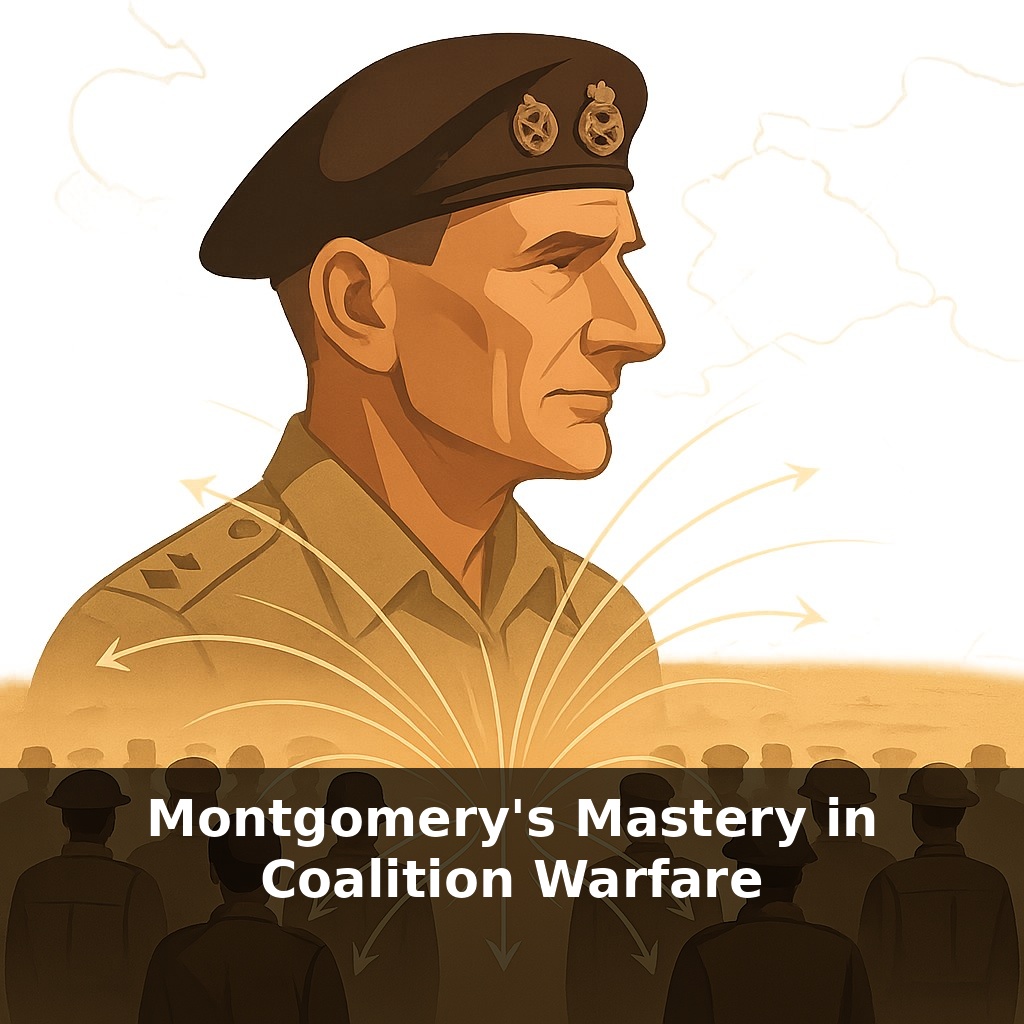
“‘The first duty of a commander is to create one mind out of many.’ Montgomery lived by that idea. On one day in North Africa, he briefed roughly a thousand allied officers face‑to‑face. In a war of steel and fire, his real weapon was shared understanding.”
Montgomery’s genius in coalition warfare was less about brilliance in a tent and more about discipline in the mundane. He obsessed over who reports to whom, who decides what, and how those decisions travel. To modern leaders used to agile chaos, that can sound suffocating—yet his structure *enabled* agility instead of killing it.
Monty knew every nation arrived with its own politics, pride, and scars. So he invested heavily in what we’d now call “interoperability of people”: liaison officers who actually had influence, standardised formats for plans, and a ruthless insistence that everyone could restate the mission in plain language.
Think of it like carefully version‑controlling a complex software project: different teams, different coding styles, one stable main branch. Montgomery’s “branch” was a phased, flexible design that let national contingents plug in without losing their identity—or breaking the build.
Montgomery’s real differentiator wasn’t just *what* he decided, but *how* he made decisions travel across cultures, egos, and time zones before time zones mattered. He treated clarity like a scarce resource that had to be manufactured and distributed deliberately. In today’s terms, he built a communication “supply chain”: briefings were factories, liaison channels were logistics, and written orders were warehouses of intent leaders could draw from under stress. This also meant he constantly translated between political aims and battlefield actions—turning vague national caveats into concrete limits planners could actually use.
Montgomery built this “communication supply chain” in three layers: intent, architecture, and rehearsal.
First, intent. He stripped his guidance down to a few non‑negotiables: the purpose, the main effort, and what success looked like in concrete terms. In Normandy, that meant hammering home that the job was not a glamorous dash to Paris but the slower, bloodier task of destroying German combat power west of the Seine. Subordinate plans could vary wildly, but they were judged against that yardstick. This let national commanders argue about *how* while staying aligned on *why*.
Second, architecture. Monty was obsessive about who could decide, and over what. He pushed for a single ground commander in Northwest Europe because he knew that divided authority would quickly turn into competing national agendas on the battlefield. Yet inside that unified top layer, he deliberately created “decision pockets” where U.S., British, and Canadian leaders could act without asking permission every time the situation shifted. His diagrams of command were less about boxes and arrows and more about carving out zones of autonomy with clear edges.
Third, rehearsal. Montgomery treated major operations like complex product launches: you don’t just ship; you run simulations, red‑team the plan, and walk through what happens when things go wrong. Before El Alamein and again before Overlord, he insisted on run‑throughs that forced logisticians, airmen, and ground commanders to solve problems together *before* the shooting started. These weren’t stage shows; they were stress tests for the relationships themselves. Friction in a rehearsal was cheaper than friction under fire.
Crucially, he understood that allies listened for different reasons. Americans wanted evidence the plan was bold enough; smaller nations wanted assurance they weren’t expendable; political leaders wanted plausible progress they could defend at home. Monty tailored both his language and his metrics of success to those audiences, then fed that back into the field: divisional commanders knew not just the tactical scheme, but the political story they were serving.
For modern leaders, the transferable lesson is ruthless alignment without cultural flattening. You don’t win by making everyone think the same; you win by making different thinkers pull in the same direction.
Montgomery’s habits map cleanly to modern, messy work. In a global product launch, for instance, his “intent, architecture, rehearsal” rhythm might look like this: the CPO reduces strategy to three crisp priorities everyone can quote; the org chart is tuned so country GMs know exactly where they can localise pricing or features without re‑approvals; then cross‑functional “table‑top” drills walk leaders through a botched release, a regulatory surprise, or a supply‑chain shock—before it happens live.
A distributed engineering org can steal the same playbook. Leadership sets a single, measurable campaign goal (e.g., “halve incident frequency in 90 days”), then defines which decisions stay at team level and which must be escalated. Instead of endless syncs, you convene short, scenario‑based war‑games: “An outage hits APAC at 3 a.m.—who speaks to customers, who rolls back, who informs legal?”
In sports terms, Monty behaved less like a star striker and more like a coach designing plays that let every national “club” win while the league table still favoured the alliance.
Montgomery hints at a future where leaders act less as controllers and more as *protocol designers*. As AI tools forecast risks and suggest courses of action, the real leverage shifts to shaping how diverse actors talk, trade data, and resolve conflicts under pressure. Think less about writing the perfect playbook and more about designing a “rules engine” for collaboration that can survive bad data, clashing incentives, and sudden shocks. The test won’t be elegance, but resilience.
Montgomery’s quiet warning to us: confusion scales faster than ambition. As teams span time zones and tech stacks, the premium isn’t on louder vision but cleaner interfaces between people. Your challenge this week: map one critical project as if you were handing it to an ally with different incentives—then fix every place your intent would likely be misread.