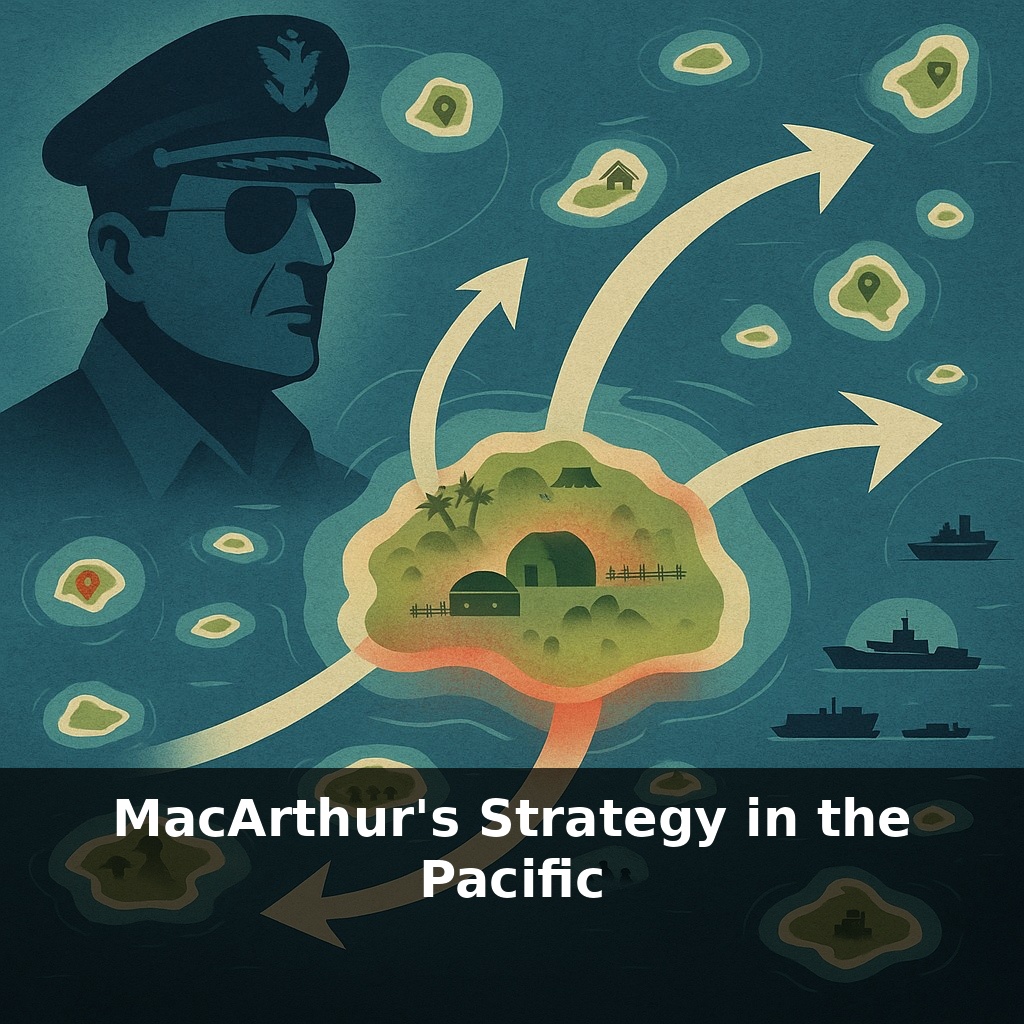
A hundred thousand enemy soldiers…who never fire a shot at you. In this episode, we drop into the Pacific war where one choice about which island *not* to attack locks a massive force in place—and shows how skipping battles can sometimes win campaigns faster than fighting them.
MacArthur’s real genius wasn’t just avoiding bad fights; it was redefining what “winning territory” even meant. In business terms, he stopped thinking like a company obsessed with opening a store in every city and started thinking like a platform builder: control the key hubs, and the network bends to you.
By 1945, he was directing more than a million people across a battlespace the size of the continental U.S., yet his campaign moved with the coherence of a single, well-run product roadmap. Instead of grinding forward mile by mile, he plotted a series of decisive “installations”: seize one airfield, one port, one chokepoint that made the next three moves easier and cheaper.
In this episode, we’ll dissect how he chose those points, how he synchronized land, sea, and air like cross-functional teams, and how his disciplined restraint became a source of speed.
MacArthur wasn’t just plotting dots on a map; he was constantly asking, “What’s the next move that makes *everything* else cheaper, faster, or unnecessary?” That meant weighing politics, morale, and symbolism alongside range circles for aircraft and fuel limits for ships. Retaking the Philippines wasn’t only a military objective; it was a promise to millions under occupation and a signal to allies watching U.S. resolve. Each advance had to satisfy Washington, reassure partners, and stretch Japanese logistics—while keeping his own supply lines from snapping.
MacArthur’s method started with a blunt constraint: he never had enough of anything—ships, planes, engineers, or time—to “clear the map.” So his staff learned to rate every potential target by one question: *How much future leverage does this buy per unit of cost and risk?* Not “Can we take it?” but “If we take it, what suddenly becomes easier—or pointless—for the enemy?”
In practice, that meant three filters for each move:
First, *reach*. Could bombers from this point hit the next objective and the enemy’s supply arteries? This turned obscure places—like remote strips in New Guinea—into high-priority objectives simply because they extended the radius from which he could apply pressure. His planners obsessed over flight ranges and shipping distances the way modern teams obsess over latency or user friction numbers.
Second, *redundancy*. Was there a cheaper, less defended place that gave almost the same advantage? This is why Rabaul stayed encircled instead of assaulted: once nearby airfields and waters were controlled, storming the fortress added prestige, not real capability. The key discipline was refusing “trophy targets” that didn’t change the math of the campaign.
Third, *integration*. Every step had to exploit what other commands were doing. While Nimitz drove across the Central Pacific, MacArthur’s advances in the southwest stretched Japanese logistics in a different direction, forcing them to defend too many fronts with too few ships and aircraft. His gains were timed so the enemy’s attempts to reinforce one crisis only worsened another.
Inside his headquarters, this translated into planning cycles that looked strikingly modern. Intelligence, operations, logistics, and political advisers war-gamed alternatives, then cut options that were “individually attractive but collectively incoherent.” A beautiful tactical victory that didn’t open follow-on moves was treated as wasteful.
MacArthur’s real edge was accepting that velocity came less from moving faster tactically and more from *compounding positional advantage*—each choice creating a cheaper, safer menu of next steps than the one before.
Modern product strategy offers a clean parallel. Netflix didn’t try to dominate every country at once; it focused on markets that unlocked favorable licensing deals, data density, and local partners. Each launch was judged by how much it improved future options—better recommendation models, stronger negotiation leverage, smoother rollouts elsewhere—rather than how “impressive” the flag on the map looked.
You can see the same pattern in how Stripe chose which countries and features to support. It often prioritized places where regulations, developer ecosystems, and banking partners combined to create outsized downstream value. One carefully chosen integration could enable dozens of future products; another, equally difficult build might create a dead end. The discipline was saying no to shiny but low-leverage requests.
You can also practice this personally: pick projects based not on effort or prestige, but on how many skill “doors” each one will unlock for you over the next two years.
MacArthur’s real lesson is that strategy lives in your calendar and budget, not in slogans. In business or public policy, that means asking: which “islands” in your roadmap, talent plan, or regulatory agenda quietly reshape everything that comes after? Notice how today’s decisions either widen or narrow your options two moves ahead. Your challenge this week: map three current initiatives to the *future moves* they unlock—or block—and adjust one priority based on what you find.
MacArthur’s deeper message: treat your effort like a finite fleet. Every meeting, feature, or hire either extends your “range” or strands you on a pretty but useless shore. Instead of chasing every opportunity, curate a handful of moves that quietly reroute the whole map—more like rewiring a city’s subway than adding one more flashy station.
Try this experiment: Take a current big goal and split it into two “campaigns” inspired by MacArthur—your “New Guinea” (the hard, direct grind) and your “Island Hopping” (the clever bypass). For one week, handle half your tasks the “New Guinea way” (tackle the toughest, most obvious obstacle head‑on) and the other half the “Island Hopping way” (skip the toughest obstacle and find a shorter path to the same result—like delegating, automating, or changing the sequence). At the end of the week, compare which campaign moved you farther with less cost in time, stress, and energy, and decide which strategy deserves to be your main “theater of operations” going forward.