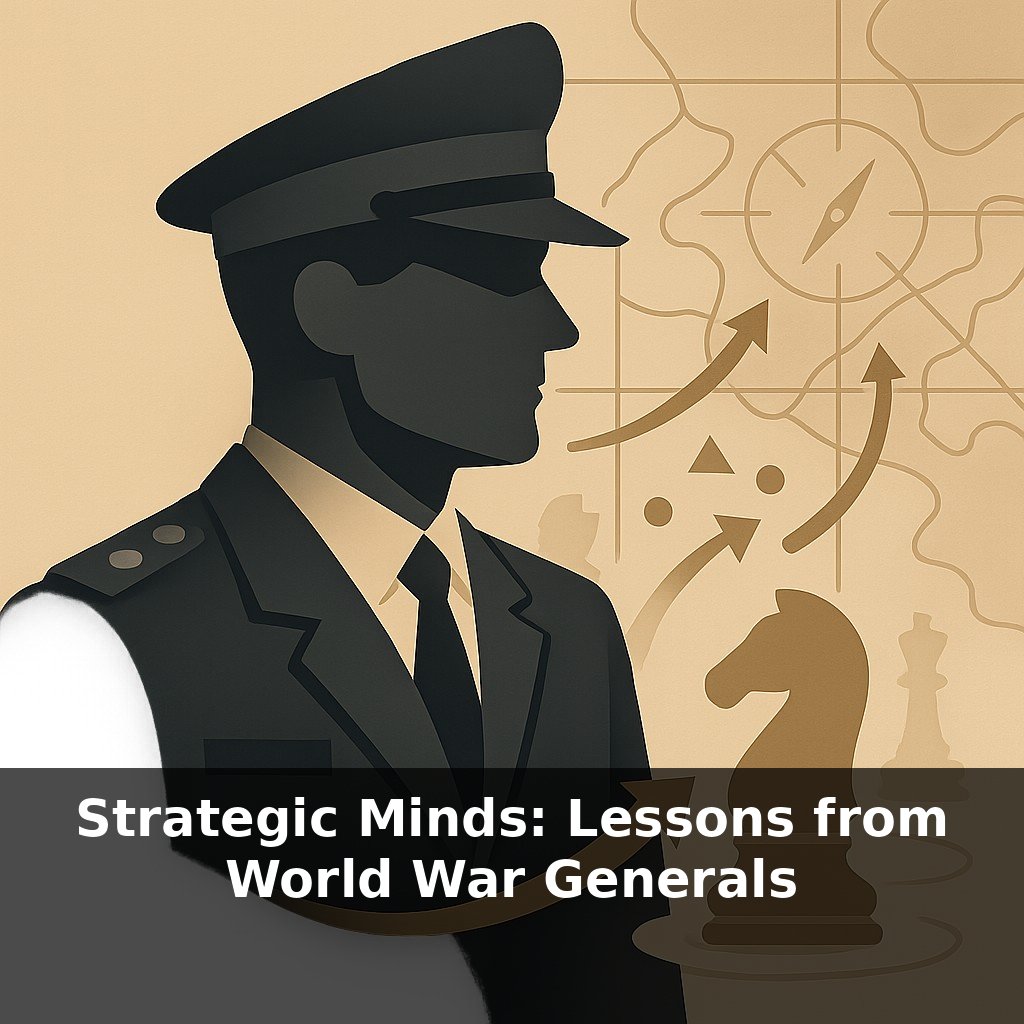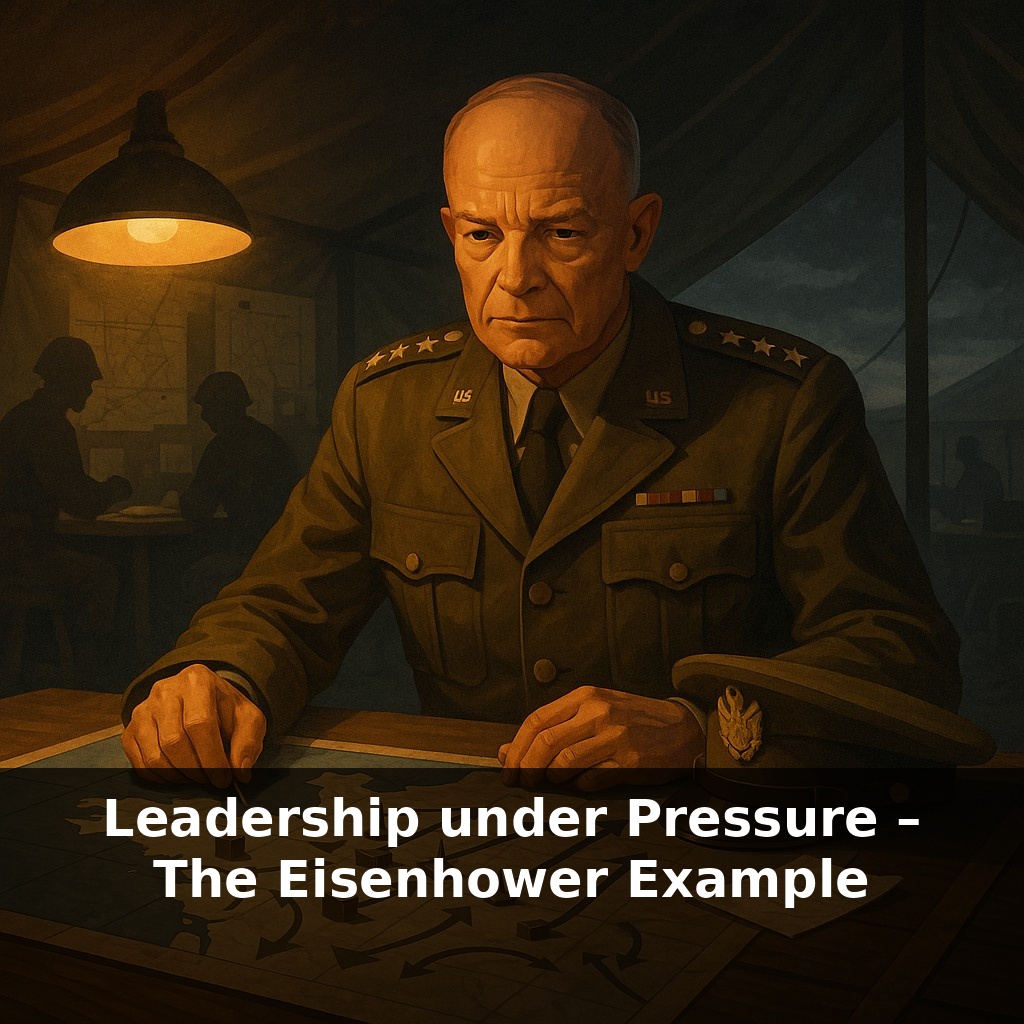
Under a gray French sky, one man quietly authorized the largest coordinated gamble of the century—knowing a single word from him could send tens of thousands to their deaths or back to their bunks. And he did it after barely sleeping, with a voice that sounded almost…relaxed.
He wasn’t relaxed, of course. On a table nearby lay a folded slip of paper taking full, personal blame if the invasion failed. Eisenhower had written it alone, in pencil, then put it in his wallet and gone back to work. That tiny, private act reveals more about crisis leadership than any stirring speech.
Most of us won’t command armies, but we do face our own “weather windows”: a product launch with half-broken data, a restructuring decision with incomplete forecasts, a career move that can’t wait for certainty. In those moments, the fantasy is that a truly great leader feels sure. Eisenhower shows the opposite: he felt the weight, planned obsessively, listened widely—and then accepted that the final leap would always be his to own. The question isn’t how to avoid that pressure; it’s how to be ready to stand inside it without flinching.
Eisenhower didn’t just “rise to the occasion” on one dramatic night; he built a system that could absorb chaos long before the first landing craft moved. Months of war-gaming, conflicting intelligence, and inter-allied arguments forced him to turn ambiguity into structure: clear objectives, simple priorities, and a rhythm of consultation and decision. Think of a product roadmap that must keep shifting as markets change, yet still give teams something solid to row toward. Underneath the famous calm was a leader who treated planning not as a binder, but as a living mechanism for thinking under fire.
Eisenhower’s real genius under pressure wasn’t a single bold call; it was how he arranged the chessboard so that when the brutal, time-compressed choice arrived, he wasn’t starting from zero.
First, he separated *planning* from *plans*. In the months before the invasion, his staff kept rewriting landing timetables, deception schemes, and logistics flows as new intelligence arrived. Crucially, Eisenhower encouraged this churn instead of treating change as failure. The point was not to freeze a perfect document; it was to rehearse how the team would think when everything shifted at once. By the time the weather turned ugly in early June, they were used to rapid revision without panic.
Second, he cultivated what you might call “disciplined disagreement.” Inside his command room, meteorologists argued over cloud ceilings, admirals over tides, generals over airborne drops. Eisenhower didn’t rush to shut this down. He wanted the clash—*then* a commitment. Once the decision was made, debate ended and execution began. That rhythm—intense divergence, then unified action—is missing in many modern teams, where either no one truly challenges assumptions or the argument never really stops.
Third, he made responsibility visible and specific. Before key meetings he was clear about who would recommend, who would execute, and what he alone would decide. That clarity did two things: it freed subordinates to speak bluntly without feeling they had to “pre-sell” him, and it prevented him from pretending that a collective process diluted his personal accountability.
A single analogy helps here: think of a well-run software incident response. The best SRE teams don’t improvise roles while the site is down; they’ve pre-assigned an incident commander, communication channel, and rollback paths. During the outage they argue hard about root cause, but there is one person who ultimately says “ship it” or “revert”—and owns that call.
Under extreme pressure, Eisenhower’s structure didn’t remove uncertainty. It reduced the number of things that *also* had to be figured out in the moment. What remained—the irreducible risk—he accepted as the leader’s burden, not a flaw in the system he built.
At Amazon during peak holiday traffic, S-team leaders don’t wait for servers to melt before rehearsing stress. Months prior, they run “game days” where engineers deliberately break systems, forcing teams to diagnose and recover under time pressure. The code matters, but the real asset is a shared reflex: who speaks, who decides, how fast information moves. By the time real incidents hit, they’re not inventing rituals; they’re executing practiced ones.
You can see a similar pattern in an NBA team with a veteran point guard. The playbook is huge, but in the final 30 seconds, the leader is scanning matchups, timeouts, and momentum, then calling a simple set everyone knows cold. Preparation narrowed options in advance, so the on-court choice is sharp instead of frantic.
Use that lens on your own team: where are you still improvising roles in crunch moments, and where have you quietly built habits that let you focus on the truly hard calls rather than the mechanics around them?
Future implications
Under AI-augmented pressure, Eisenhower’s pattern scales. Leaders won’t just stare at dashboards; they’ll shape questions, then let models spin thousands of “what-then” branches before choosing a path. Think less lone hero, more conductor cueing different sections of an orchestra as the tempo jumps. As climate shocks and cyber incidents stack and overlap, advantage shifts to teams that pre-negotiate how human judgment and machine simulation interact—*before* the sirens start wailing.
Your challenge this week: pick one upcoming high-stakes moment and script it Eisenhower-style. Before it hits, define roles, invite one hard objection, and write a two-sentence note taking full ownership for the outcome. You don’t have to share it—but carry it. Leaders grow faster when they quietly rehearse the weight they’re willing to bear.