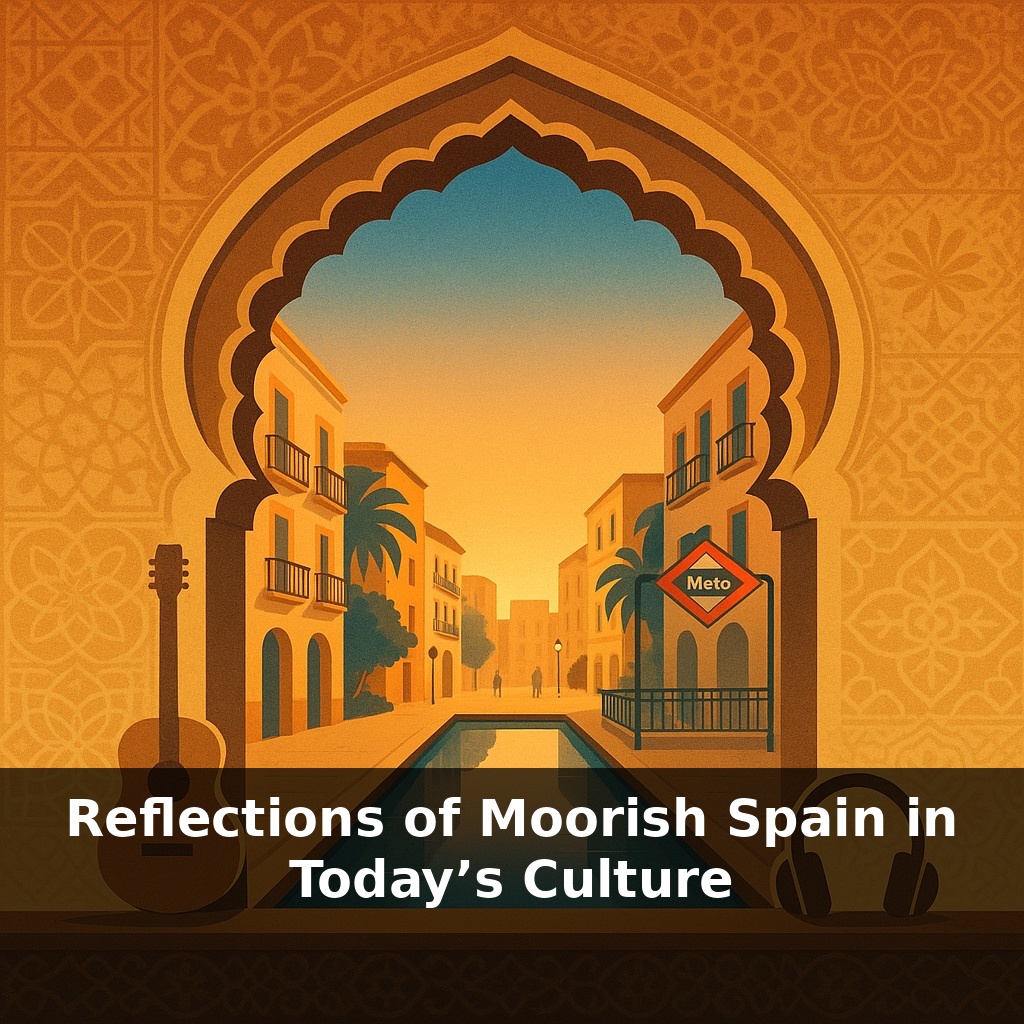
Arabic shapes about 1 in 12 Spanish words, yet many Spanish speakers don’t realize they’re speaking a little bit of Moorish history every day. From train stations to late‑night guitar solos, traces of al‑Andalus keep slipping into modern life—quiet, constant, and hiding in plain sight.
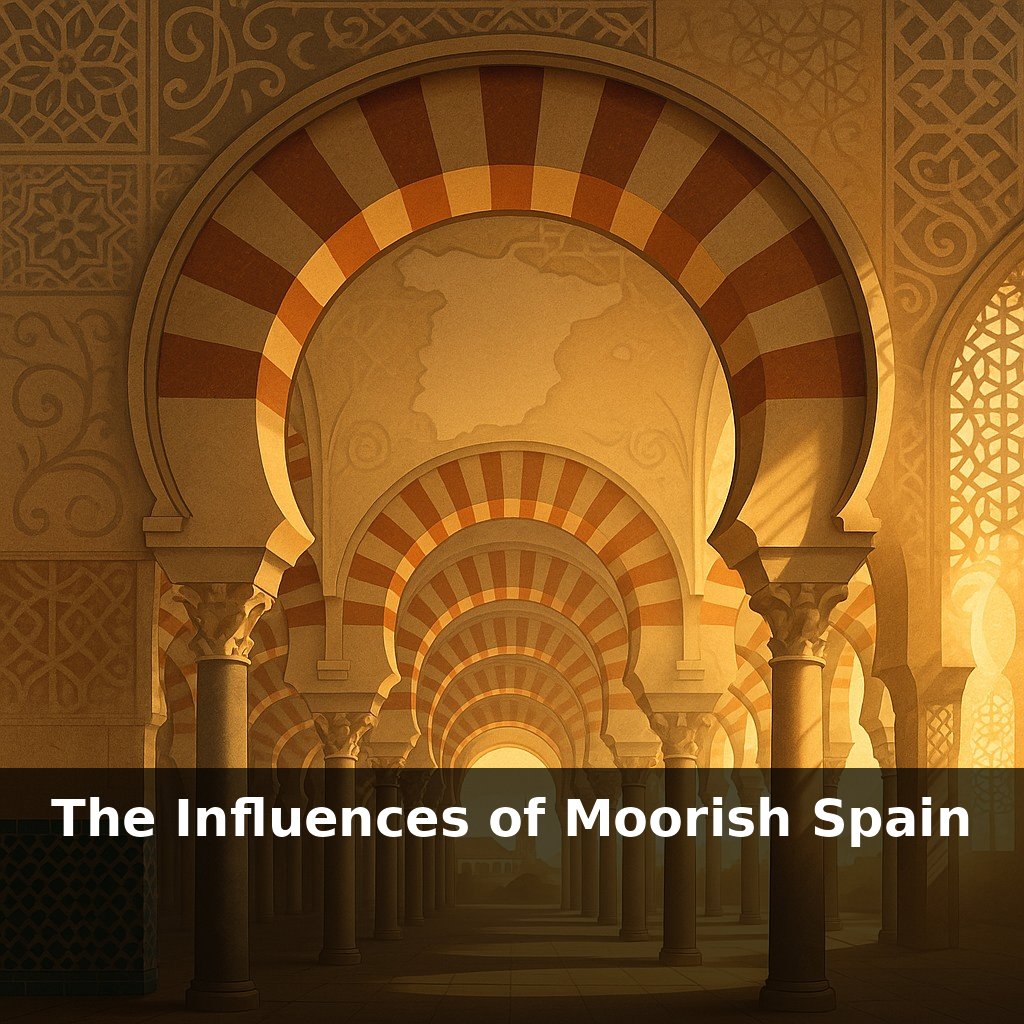
Walk through any Spanish city and you’ll see echoes of Moorish Spain doing quiet work in the background. A metro stop framed by a pointed arch, a courtyard cooled by a long, narrow pool, a pop song slipping into a scale that sounds suddenly “Eastern” to your ear. None of these are museum pieces; they’re active design choices, performance styles and habits of thinking that reach back to al‑Andalus while speaking the language of the present. Modern architects borrow geometric tile patterns to solve problems of light and shade; guitarists lean on centuries‑old modal turns to shape new genres; even diplomats invoke medieval coexistence when framing twenty‑first‑century dialogues between Europe and the Muslim world. In this episode, we follow those living threads—through music, buildings and global conversations—to see how a “past” civilization keeps shaping current ones.
Step into a tapas bar, a train concourse, or a streaming playlist, and you’ll meet the same quiet source dressed in new clothes. A chart-topping reggaeton track leans on a familiar Phrygian twist; a civic center’s façade borrows the rhythm of interlacing brick; a tourism ad sells “sunset in Granada” as shorthand for romance and sophistication. Yet these choices aren’t just aesthetic flourishes. They reflect how cities brand themselves, how musicians market “Spanishness,” and how institutions curate heritage—selecting some Andalusi threads while leaving others on the cutting-room floor.
Step onto a Madrid platform and you might wait for your train under a brick horseshoe arch, then spend the ride scrolling past drone shots of the Alhambra in a tourism reel, soundtrack leaning into a familiar “Arabic‑sounding” hook. What feels like pure present tense is really a layered remix of older Andalusi choices, updated for concrete, fiber optics and TikTok.
Music is one of the clearest laboratories for this remix. Flamenco’s Phrygian flavor now slips into film scores, video‑game soundtracks and global pop collabs—from Rosalía’s early work to crossover projects with North African rappers. Producers sample palmas (hand‑clapping patterns) or melismatic vocal lines the way hip‑hop once mined soul records, turning local memory into exportable atmosphere. The same scalar color that once marked a neighborhood patio performance now signals “intensity” or “mystery” to a worldwide audience that may never have heard the word “Andalusi.”
Architecture performs a parallel trick in brick and steel. Those Neo‑Mudejar stations and bullrings trained generations to read pointed arches, patterned brick and tile bands as “authentically Spanish,” not “foreign.” Contemporary architects push that further: cultural centers in Seville or Córdoba might hide high‑tech climate systems behind latticework that riffs on historic screens, filtering both sunlight and identity. The form carries an old story; the function solves twenty‑first‑century problems of heat, crowd flow and sustainability.
Digital culture adds another layer. The Alhambra’s position among the most‑visited virtual tours shows how a once‑regional palace now works like a global interface: classrooms in Jakarta or Toronto “walk through” stucco inscriptions and courtyards as part of lessons on art, empire or religious diversity. Heritage becomes a clickable resource that teachers, activists and tourism boards can all quote for different agendas.
Diplomacy and politics draw on the same reservoir, but with higher stakes. European and North African leaders invoke al‑Andalus in speeches about migration, interfaith dialogue or counter‑extremism, sometimes spotlighting convivencia, sometimes warning with episodes of conflict. Like an open‑source codebase, this past is continuously forked, patched and redeployed—its functions redefined by whoever compiles it into their story of what Spain, Europe or “the West” should be today.
Open a Spanish cookbook and you’ll meet another Andalusi echo: techniques like slow braising with spices, layering sweet with savory, or finishing dishes with citrus and nuts trace back to kitchens that once blended Maghrebi, Jewish and Iberian habits into something new. Contemporary chefs in Madrid or Los Angeles borrow those logics for tasting menus that pair preserved lemon with local seafood or drizzle orange‑blossom syrups over regional desserts, selling “modern Mediterranean” while quietly extending an older experiment in fusion.
Street culture runs a similar update. Urban muralists in Seville or Granada weave Kufic‑inspired block lettering into graffiti, not as pastiche but as a visual shorthand for a plural, border‑crossing city. Fashion labels lift lattice motifs into laser‑cut leather or 3D‑printed jewelry, treating historic ornament like open‑source design files. Think of it as an architectural font set designers can call up and retype into clothing, logos or stage sets whenever they want their work to whisper “southern, intricate, connected” without saying a word.
Moorish echoes may soon shift from backdrop to toolkit. As VR reconstructions and AI pattern‑generators mature, students could “walk” through rebuilt cities while designers live‑edit light, water and sound, testing how historic logics handle rising heat or dense tourism. The New European Bauhaus hints at this: labs mining Andalusi geometry for low‑energy facades or shade canopies that cool plazas like passive AC. In diplomacy, invoking Al‑Andalus might work less as slogan, more as shared R&D brief for a warmer, more mobile Mediterranean.
Today’s culture keeps treating Andalusi traces less like ruins and more like plugins: drop‑in modules for sound, shade, story or soft power. As climate, migration and identity debates heat up, those plugins could evolve into full frameworks—testing how a borderland past might script fairer cities, calmer negotiations and new, shared playlists for the Mediterranean future.
Here’s your challenge this week: choose one everyday habit (like your morning coffee, a playlist, or a recipe) and “Moorish‑ify” it using something you learned from the episode—try cooking a dish with saffron and almonds, listening to Andalusian/Maghrebi music, or reading a short poem by Ibn Hazm or Ibn Arabi. Sometime this week, spend 20 focused minutes tracing where that element came from (for example: coffee routes, oud rhythms in flamenco, or Arabic loanwords in Spanish) using at least two sources beyond the podcast. Before the week ends, share what you discovered with one other person—in a quick voice note, message, or over a meal—and explicitly connect it back to how Moorish Spain still shows up in today’s culture.