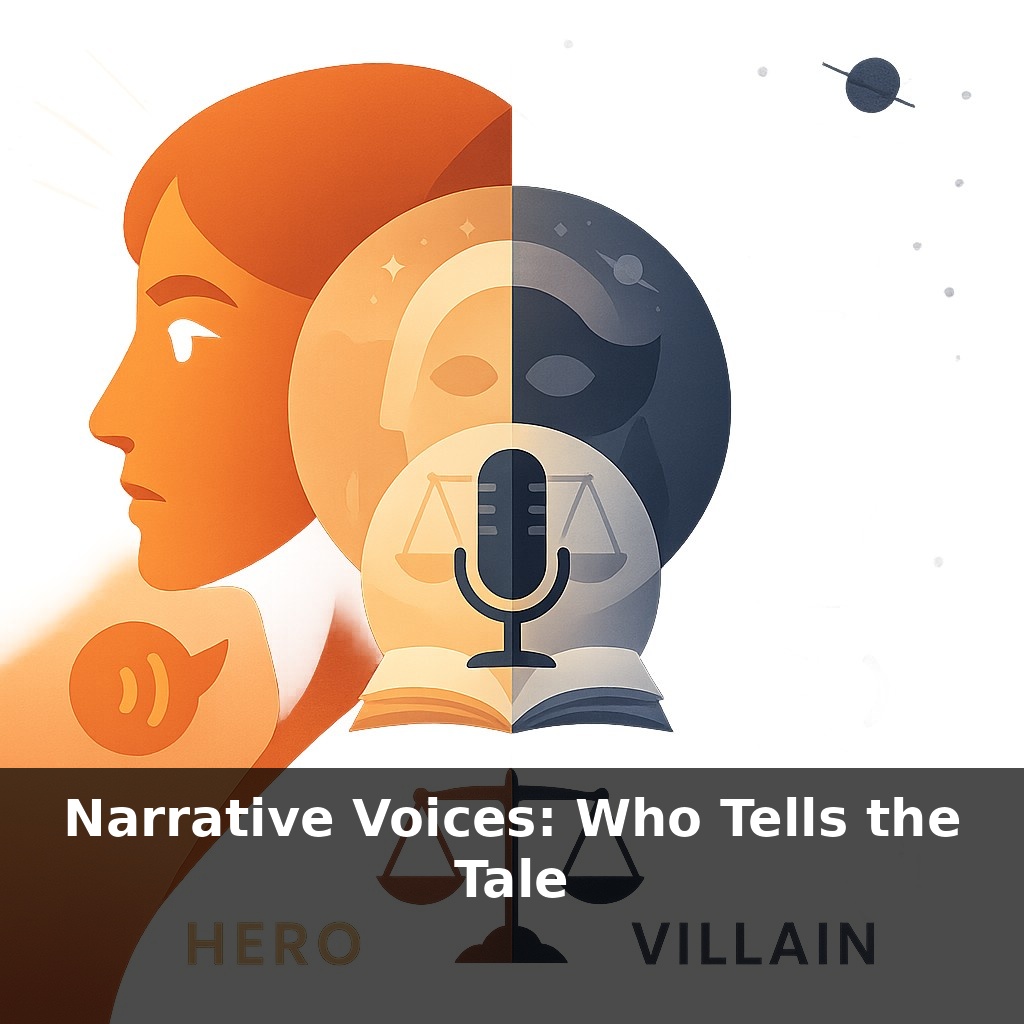
A single change in who tells a story can flip a villain into a hero—without touching the plot. In one study, fans watched the same sci‑fi saga twice: once through the hero’s eyes, once through the villain’s. Their sympathy swung sharply, even though every event stayed identical.
A courtroom drama where the accused tells the story feels radically different from one narrated by the judge—same evidence, different verdict in your head. That’s the quiet power of narrative voice: it decides whose inner world you’re renting for the length of the story. This voice isn’t just a grammatical choice; it’s a persona the writer builds, an “implied author” that may be wiser, crueler, or more naïve than the real person at the keyboard. That crafted presence decides what gets spotlighted and what stays offstage. In first‑person, you’re trapped inside one skull, noticing only what that character cares about. In third‑person limited, you hover just above a single shoulder. With multiple narrators, the story becomes a negotiation, as you keep revising your loyalties. Across media—from novels to games to VR—who speaks to you quietly instructs you how to feel about everything that follows.
Voice doesn’t just filter events; it quietly rearranges the moral furniture of the entire story. A child like Scout in *To Kill a Mockingbird* can walk past brutal injustice and report it with disarming simplicity, forcing you to read the horror between the lines. A coolly detached observer, narrating the same scenes, might invite judgment instead of heartbreak. Researchers see similar shifts in other media: second‑person framing in VR, for instance, has been linked to higher reported empathy than third‑person recaps of identical scenarios. And when fans retell a famous space opera from the villain’s viewpoint, audience guilt and loyalty often move with the camera of the voice.
When you choose who speaks, you’re also choosing what can never be said on the page. That’s the hidden cost of every viewpoint: each gains intensity by sacrificing reach.
Consider third‑person omniscient. On paper it offers everything—any mind, any place, any time. In practice, it works best when it behaves like a disciplined tour guide, not a teleporting ghost. Classic omniscient narrators (think Austen or Tolstoy) don’t just hop between heads at random; they carry a recognizable sensibility, a consistent humor or severity. That tonal through‑line is part of what critics call the “implied author”: you sense a coherent intelligence arranging the tour, even when the camera roams. Without that unifying flavor, omniscience turns into noise—readers feel disoriented rather than enlightened.
Then there’s unreliability, which many writers treat as a gimmick—until it breaks their story. A narrator becomes compellingly unreliable not because they lie once, but because the text teaches you to read around them. Contradictions build slowly. Side characters react oddly. Physical details refuse to match the narrator’s claims. The joy is in the gap between what’s asserted and what you, as a careful reader, can infer. The trick is fairness: the clues must be present, even if subtle, or the eventual reveal feels like cheating.
Multiple narrators raise a different craft problem: how do you keep the story from turning into a stack of diary entries with identical voices? One solution is to assign each narrator a distinct domain of expertise and emotional bias. The cop notices procedure and threat; the activist notices systems and symbols; the child notices textures and unfairness. Their chapters don’t just retell the same moment; they expose how different minds carve different stories out of the same raw event.
A useful test here works like a good software stress‑test: if you can swap your narrators’ lines without anything breaking, then your voices aren’t yet doing real narrative work. The more a story would collapse under that swap, the more your chosen tellers are shaping meaning, not just relaying plot.
A practical way to feel how narrators reshape a story is to “re‑plate” the same scene three ways, like a chef testing presentations for one dish. Start with a neutral event: a late train, a lost phone, a surprise promotion. In one draft, let a perfectionist tell it; in another, someone who lives paycheck to paycheck; in a third, a bored teenager. Don’t change what happens—only what they notice and how they justify it. You’ll see that the plot is the same “meal,” but the experience changes with each plate: one version tastes like tragedy, another like farce, another like relief. You can push this further by switching mediums. Try writing a short text‑message thread about the event, then a police report, then a nostalgic blog post ten years later. Each form pressures the “speaker” into different habits of honesty, emphasis, and omission, revealing how context and time can quietly tilt the story’s moral weight.
Future implications
As platforms evolve, “who speaks” may become a sliding setting rather than a fixed choice. Think of a streaming app that lets you watch the same episode from a side‑character’s commentary track, or a news article that can retell events through a local witness, a policymaker, or an algorithmic summary. In classrooms, students might compare these toggled tellings the way we now compare sources, training themselves to treat every voice as partial, purposeful, and open to challenge.
As you experiment, notice how your “who” choice can carry quiet politics: whose fears get foregrounded, whose labor stays invisible, whose jokes land. It’s less about picking the fanciest lens and more about matching teller to truth. Your challenge this week: rewrite a real news item twice, from two clashing voices, and see which details migrate or vanish.