Why You're Busy But Not Productive: The Efficiency Trap
📝 Transcript
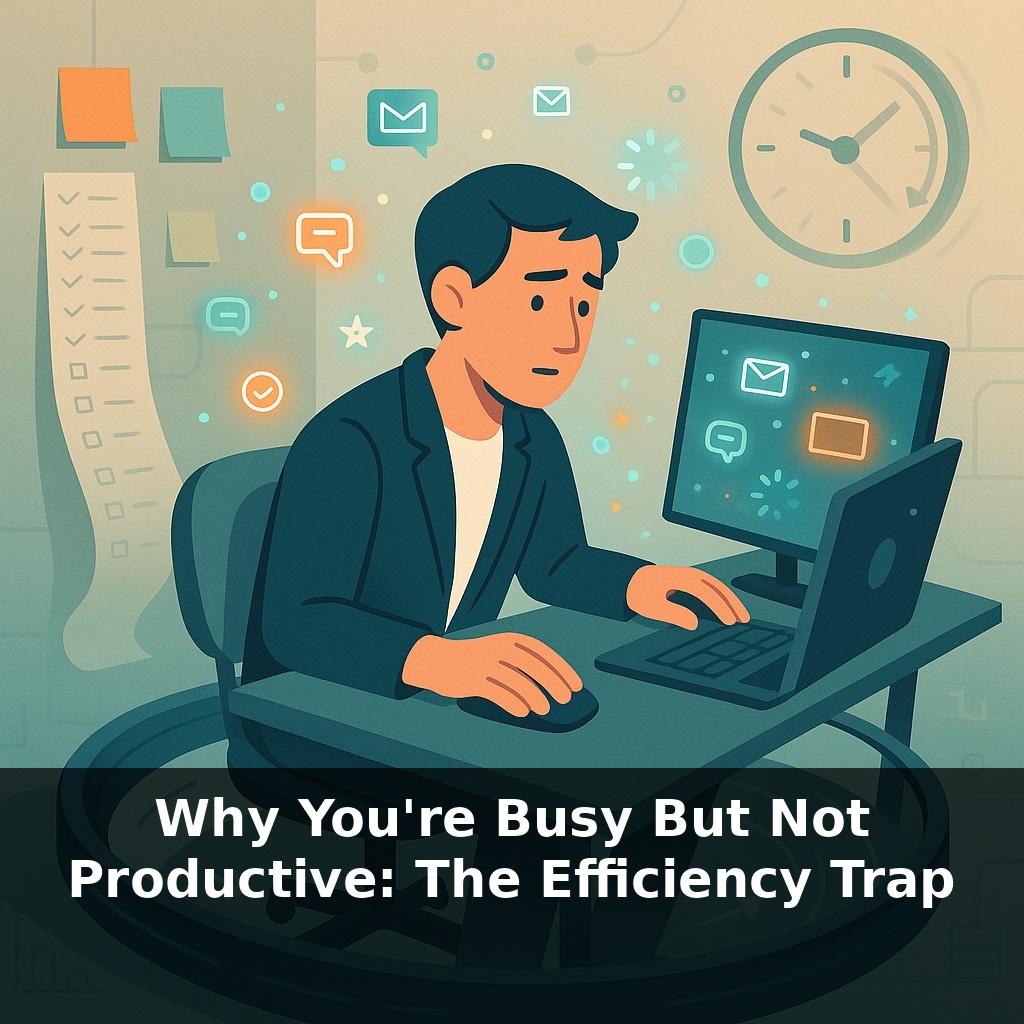
You probably checked email or chat in the last few minutes—and so did nearly everyone else at work. Yet, when the day ends, your to‑do list hasn’t shrunk, it’s mutated. You were constantly in motion, but nothing important moved. How does that happen, day after day?
Most people respond by trying to move faster: tighter schedules, more apps, more color‑coded categories. It feels responsible—like turning up the treadmill speed when you’re not sweating enough. But that’s the core of the efficiency trap: when progress feels slow, we instinctively optimize the visible, easy‑to‑measure parts of our work instead of questioning whether we’re pushing in the right direction at all. Modern tools quietly nudge this along. Notifications, shared docs, and project boards slice your attention into smaller and smaller fragments, rewarding you with tiny hits of “done” while the work that actually changes your trajectory waits in the background. The real problem isn’t a lack of effort; it’s that your effort is being constantly auctioned off to the most urgent bidder, not the most meaningful one.
The research is blunt: on average, knowledge workers slice their attention every six minutes to check communication, and multitasking can wipe out up to 40% of their output. That means on a day when you feel “on,” almost half your effort might silently evaporate into context switching. Add to that the 2.6 hours a day many people spend inside their inbox, and you’re left with a thin margin for anything deep, strategic, or career‑defining. It’s like running a powerful computer with dozens of background apps stealing processing power—technically “busy,” but painfully slow when it’s time to do something that actually matters.
Most people assume the fix is better organization: tighter calendars, cleaner project boards, faster replies. That’s local efficiency—polishing the parts you can see—while a different question quietly decides your results: “What are the few moves that actually change the outcome?”
This is the difference between efficiency and effectiveness. Efficiency lives inside tasks: how quickly you can clear a queue, how many items you can close. Effectiveness lives above tasks: which outcomes matter this quarter, what must be true in three years, what only you can contribute. When you don’t answer those questions explicitly, the environment answers for you. The loudest request, the freshest notification, the most recent meeting all become your de‑facto priorities.
Organizations fall into this too. Teams measure activity because it’s easy—tickets closed, messages sent, hours in meetings. But the work that matters most is often lumpy, slow, and hard to count: designing a better process, debugging a strategy, mentoring someone until they can own a whole area. That kind of work looks “unproductive” day‑to‑day because it doesn’t generate a steady stream of visible wins.
This is where the efficiency trap tightens. When you feel pressure to prove value, you gravitate toward the kind of work that generates quick proof: status updates, quick assists, minor optimizations. You get instant social validation, but little structural progress. Over time, your role drifts toward “general helper” instead of “owner of critical results.” It feels generous and hardworking; it’s also how careers plateau.
Look at the Microsoft Japan trial: a shorter week forced constraint. With less time, teams had to ask, “Which meetings genuinely move the business?” Cutting 58% of them didn’t just free hours; it forced a shift from “attend” to “decide,” from “discuss” to “ship.” Constraint can be clarifying like that.
The paradox: to become genuinely productive, you often have to look less busy. Longer stretches of uninterrupted focus. Fewer simultaneous projects. Slower response times. More time spent deciding what not to do at all. It can feel risky—until you realize that staying always available mostly proves you’re always interruptible, not always essential.
Think about the last month: which single thing you shipped or decided actually changed something measurable—revenue, risk, user behavior, your own leverage? That’s the level where effectiveness lives. A staff engineer who quietly redesigns an onboarding flow that cuts support tickets by 30% might “produce” far fewer visible artifacts than the teammate fixing minor bugs all week, but the impact curve is completely different. Same for a manager who spends two intense afternoons clarifying priorities and expectations so their team stops thrashing; their calendar looks deceptively empty, yet throughput jumps.
This is why senior people often look calm while juniors look slammed: the job shifts from doing more to choosing better. One carefully‑made decision can retire a hundred micro‑tasks. Your future promotions, opportunities, and bargaining power are disproportionately tied to those few, chunky contributions that change the system, not to how many times your status light says “active.”
Your challenge this week: pick one ongoing responsibility and ask, “What outcome is this actually supposed to improve?” Then: 1. Write that outcome in a single sentence. 2. List every recurring activity tied to it. 3. For each activity, ask: “If I stopped doing this for a month, what would break?” 4. Ruthlessly downgrade, batch, or delegate anything where the honest answer is “very little” or “nothing noticeable.”
The goal isn’t to abandon responsibilities; it’s to carve out visible space for one piece of work with asymmetric upside—something that, if it succeeds, meaningfully bends the curve for you or your team. By the end of the week, you should have at least one block on your calendar that’s protected not for “getting through things,” but for advancing that one defining outcome.
As AI absorbs repetitive tasks, advantage shifts to people who pick valuable problems, not people who stay “busy.” Think of it like a band: software can now keep perfect rhythm, but only humans can choose which songs are worth playing. Teams that reward clear outcomes over visible hustle will attract those “composers.” Others will drown in dashboards and status checks, burning out top performers. Over time, your promotability will hinge less on volume of output and more on discernment.
Treat your calendar like a playlist, not a dumping ground. Each block is a track you’ve chosen, not random background noise. When you notice a day filled with “filler songs,” that’s a cue to remix: swap in one bold, unfinished idea, one conversation that scares you a little, one problem nobody owns yet. That’s where quiet busyness turns into visible momentum.
To go deeper, here are 3 next steps: (1) Block off a 25-minute “deep work sprint” today using the free website [www.tomato-timer.com](https://tomato-timer.com), and during that sprint do ONLY one “high-leverage” task you’ve been postponing (no email, no Slack, phone in another room). (2) Skim chapters 1–3 of Oliver Burkeman’s *Four Thousand Weeks* and then open your calendar to explicitly schedule one “good-enough” deadline this week where you’ll stop polishing a task even if it’s not perfect. (3) Install the browser extension “RescueTime” or “Clockify,” let it track you for the rest of today, and tonight compare where your time actually went versus the 3 most important outcomes you wanted—use that gap to decide one entire category of low-value tasks you’ll deliberately drop or delegate tomorrow.
From this course
The Productivity System: Work Less, Achieve More
8 episodesUnlock all episodes
Full access to 8 episodes and everything on OwlUp.
Subscribe — $1.99/monthLess than a coffee ☕ · Cancel anytime