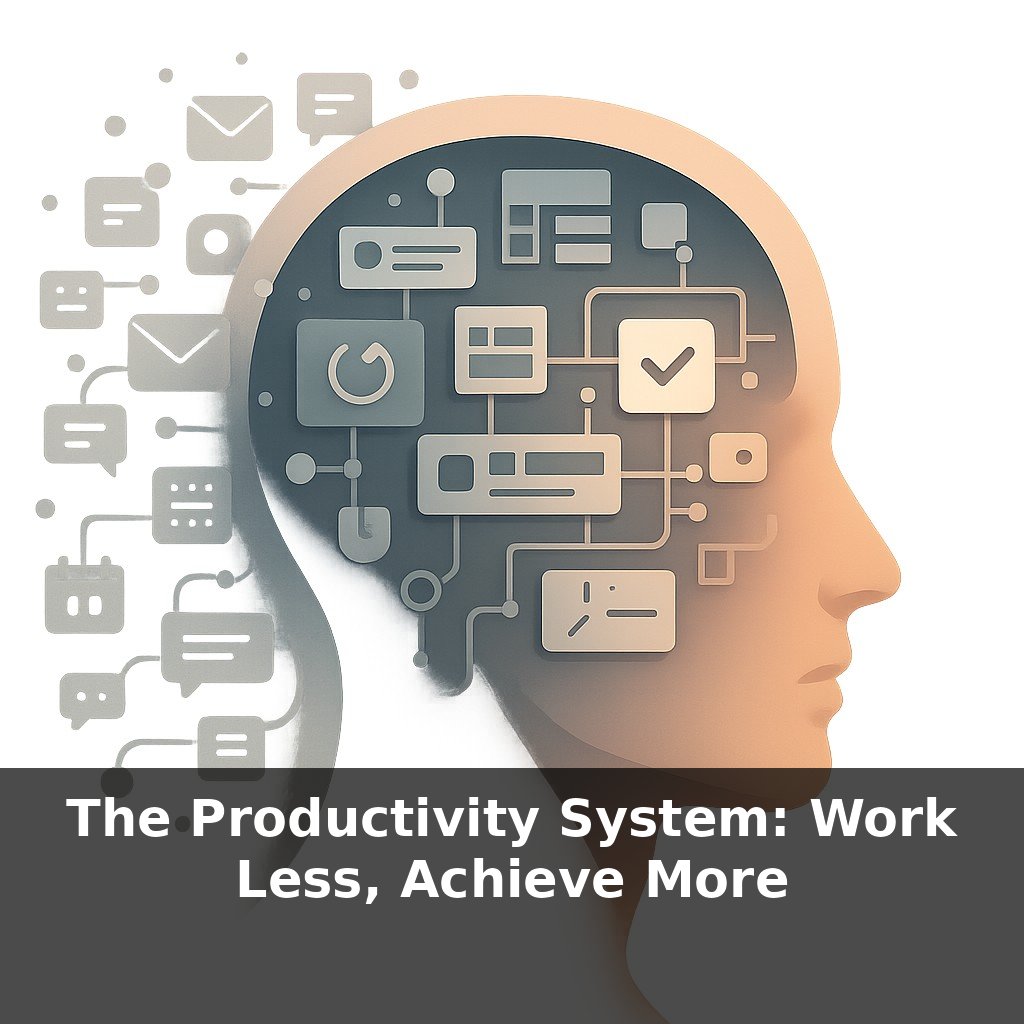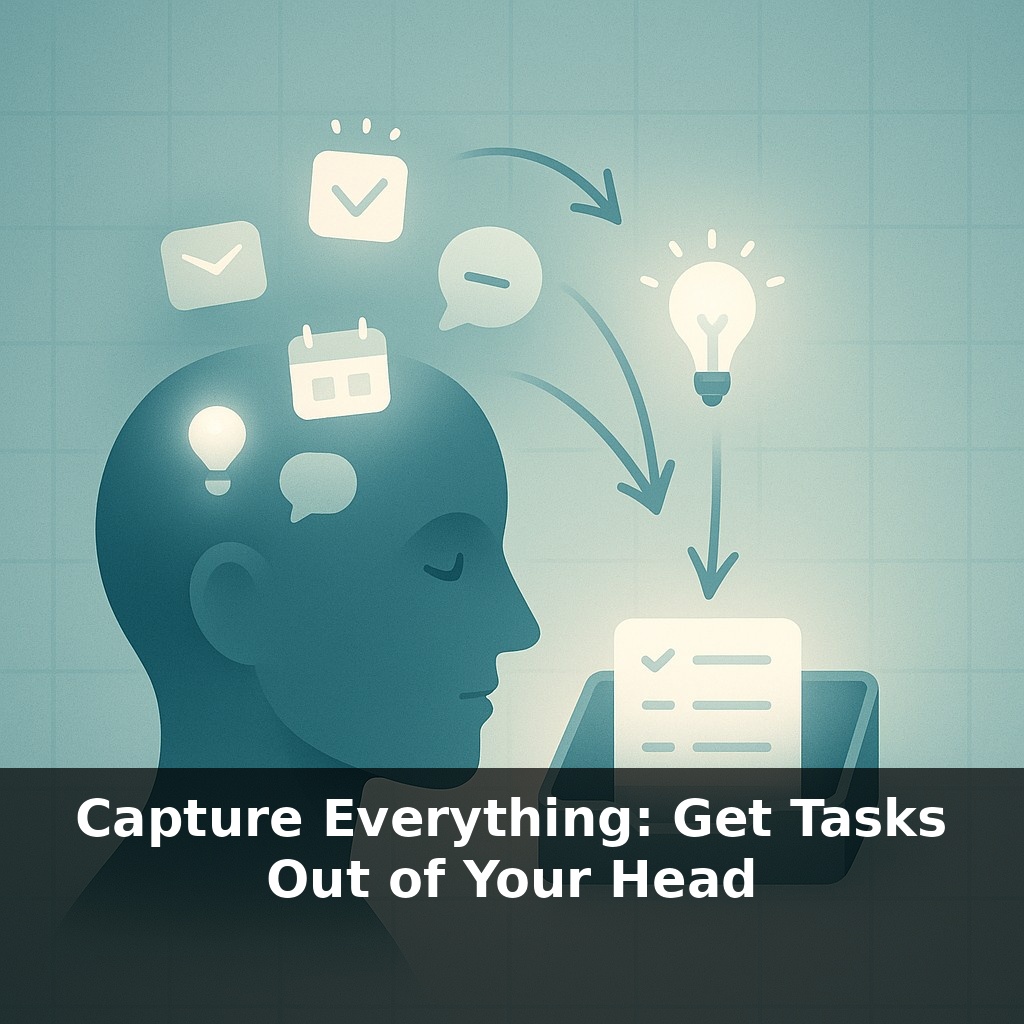
“Your brain can only juggle about four things at once—after that, it starts dropping balls. You’re walking to a meeting, trying not to spill coffee, when a brilliant idea pops up… then vanishes. This episode asks a simple question: where do your best ideas go when your brain’s full?”
You already know your mind has limits; now we shift to what to do about it. Think about how many places your commitments currently live: scattered across email threads, half-finished docs, chat messages, your calendar, your head. No single place shows “everything that’s on your plate,” so your brain keeps running a low-level background scan: Don’t forget this. Don’t drop that. That constant, silent monitoring is what quietly drains your energy before you’ve even started real work. In this episode, we’ll treat “capture” as a practical skill, not a personality trait. You’ll see how people like Richard Branson use simple note-taking to keep big, complex projects moving—and why your system doesn’t need to be pretty, only reliable. We’ll explore how to design a capture habit that fits your actual day, not your ideal one.
Most people treat capture like a stationery problem—“If I just find the perfect app or notebook, I’ll be organised.” In reality, it’s closer to infrastructure design: you’re building the set of “inboxes” where every loose task, idea, and commitment lands before it’s sorted. That means looking at your actual day: the hallway conversations, the Slack pings, the drive-home thoughts that never touch your formal tools. High performers don’t remember more; they intercept more. In this episode, we’ll map your real input streams, choose the minimum number of capture points you can trust, and script tiny, repeatable moves for each moment your brain says, “Don’t forget this.”
Most people try to “do productivity” by sheer willpower: focus harder, remember more, power through. Capture flips that: instead of trying to be a superhero brain, you design tiny moves that prevent your brain from being the bottleneck.
Start with a simple distinction: your day has *moments of input* and *moments of processing*. Capture only cares about input. It’s not about deciding “Is this important?” or “When will I do it?”—that’s processing. Capture just answers: “Did this land somewhere I trust?” The moment you mix those two, you hesitate, overthink, and usually do nothing.
So the skill is: notice the micro-second when something tugs at your attention—“Oh, I should…”, “Don’t forget…”, “That could be useful…”—and respond with a reflex, not a debate. Think of it like a keyboard shortcut for your mind: stimulus → same tiny action every time.
Concrete example: a senior manager I worked with was constantly ambushed in corridors: “Can you review this deck?”, “We need your input on X.” Her old pattern was nodding, mentally flagging it, then losing track. We added one rule: any live ask gets typed into a single notes app with three pieces of info: name, keyword, date. That’s it. No organising in the moment. Within two weeks, her “I dropped the ball” apologies basically disappeared, not because she worked more hours, but because fewer commitments evaporated.
The medium you use is far less important than how *frictionless* it is at the exact moment you need it. Friction is anything that makes you think twice: Face ID that fails, a notebook buried in your bag, a voice app that feels awkward in a quiet office. Remove enough friction and capture becomes as automatic as checking your phone when it buzzes.
This is where many systems die: they’re optimised for *someday*, not for the messy, interrupt-driven reality of your job. A beautiful app that’s three taps away will lose to the ugly sticky note that’s in reach during a tense call.
One useful test: can you reliably capture in under ten seconds, *without* leaving the conversation, tab, or room you’re in? If not, you’ll skip it exactly when you need it most—during high-stakes, high-distraction moments.
Finally, notice that capture isn’t just for “tasks.” It’s for half-formed ideas, questions to ask your manager, feedback you want to give, patterns you spot in your team. Leaders who seem “strategic” often just have a habit of catching faint signals before they fade, then revisiting them later when there’s time to think.
A product lead I coached kept losing critical follow-ups from cross-functional standups. We built one tiny rule: every time someone said her name followed by a verb—“Can you…”, “Will you…”—she hit a keyboard shortcut that opened a quick note and typed three words: person + verb + topic. Later, in her processing time, those shorthand lines became proper tasks. Within a month, she’d stopped dropping handoffs, and her peers started describing her as “weirdly on top of everything,” even though her workload hadn’t changed.
Another client, a new manager, used a different trigger: emotional spikes. Any time something annoyed, excited, or worried him in a meeting, he quietly wrote a 1–2 word tag (“hiring bottleneck”, “onboarding confusion”) in a running log. Those tags turned into agenda items for his weekly 1:1s and retro discussions, surfacing patterns he previously only felt as “vague friction.”
Think of this as building tiny “if-then” rules for your day—pre-decided moves that turn fleeting moments into future leverage.
Your future self will live in a world where *almost nothing* relies on you remembering it. Meetings will auto-generate follow-ups, apps will scrape action items from chats, and sensors will notice patterns you’d miss—like a coach replaying game footage you didn’t know to save.
The real skill won’t be collecting more; it’ll be deciding what deserves a “permanent slot” in your system—and what should vanish. Designing those filters now is how you stay in control when everything can be captured by default.
Over time, you’ll start noticing *which* notes keep paying rent: the ones that turn into decisions, projects, or shifts in how you work. Treat those like highlighted tracks in a playlist, not just clutter in a library. Your challenge this week: watch which captures you reopen most—they’re quiet signals about where your work and career actually want to go next.