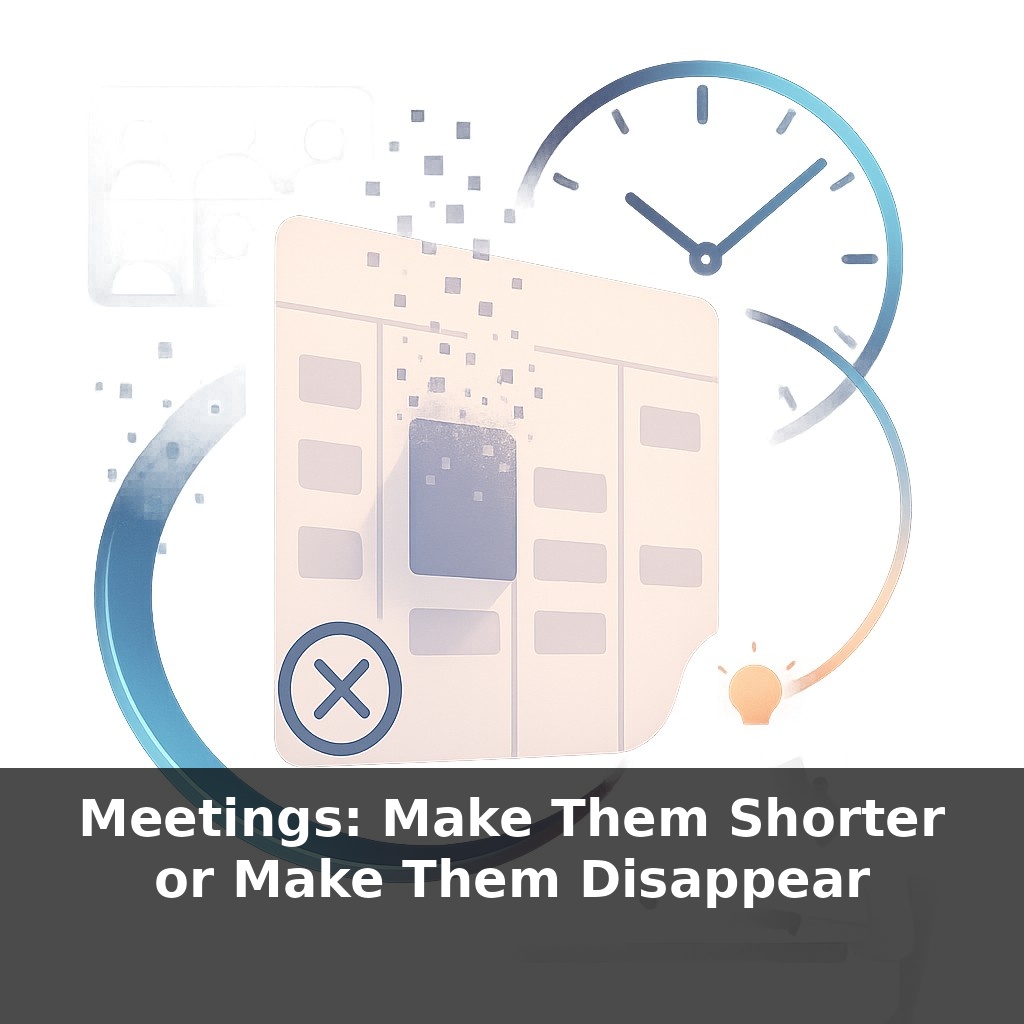
Right now, as you listen, there’s a decent chance a meeting is on your calendar that doesn’t need to exist. Atlassian found knowledge workers lose roughly a full workweek every month to useless meetings. So here’s the question: what if the most productive meeting is the one you cancel?
Here’s the twist: the problem isn’t just how *many* meetings you have—it’s how casually they get created. One vague calendar invite can quietly turn into a weekly time tax for ten people. No one really decides to spend a chunk of their week this way; it just… accretes, like digital dust on your schedule. And because everyone’s calendar already looks crowded, we answer complexity with the laziest possible move: “Let’s book 30 minutes.”
But research on high-performing teams points in a different direction. They treat meetings like scarce budget, not default behavior. They make ruthless choices about *which* conversations deserve live time, *who* truly needs to be there, and *when* real-time discussion beats async updates. This shift—from automatic acceptance to deliberate design—is where your calendar (and your brain) start to breathe again.
So how do you know which meetings deserve to survive? A useful clue: meetings are a *tool*, not a ritual. The best ones do what no document, dashboard, or message could do just as well. They create real-time momentum—unblocking decisions, resolving tension, or aligning people on something genuinely ambiguous. Everything else is a candidate for redesign or deletion.
Think of your week like a playlist: a few intentional “live sessions” are worth keeping; the rest of the noise can be turned into on-demand tracks you consume when it actually fits your flow, not when a random invite dictates it.
Here’s where things get interesting: when teams start questioning meetings, they usually jump straight to “shorter.” But the research suggests a better framing: start with “should this be a meeting *at all*?” and only then worry about how long it is.
A practical way to do that is to separate meetings into three buckets:
1) Decision / design sessions 2) Relationship / alignment time 3) Status and information transfer
Bucket 3 is where most waste hides. If the goal is “update,” a live session is rarely the most efficient tool. That’s why so many companies see big gains just by attacking this category.
Shopify’s calendar purge is a good example: they didn’t just shave 5 minutes off everything; they deleted recurring status calls, moved updates into tools, and forced every new meeting to justify itself. MIT Sloan’s work on meeting-free days points to the same pattern: once people have large, protected focus blocks, they discover many updates work better as short written briefs, quick Loom videos, or dashboard comments.
To make this concrete, flip the usual question. Instead of, “Who should we invite?” ask, “What is the *minimum* number of people who must be here for this to work?” That’s the spirit behind Amazon’s “two-pizza team” rule. Fewer people means faster turns, clearer ownership, and less chance that half the room is silently doing other work.
Then, time-box with intent. Don’t default to 30 or 60 minutes. Decide the smallest block that forces focus: 12 minutes to choose between two options; 20 minutes to draft the first version together. For thorny topics, schedule multiple short passes rather than one sprawling meeting that drifts.
The common fear is that this kills collaboration. In practice, it often sharpens it: async tools carry the routine load, while the remaining meetings feel more like live problem-solving sessions than calendar obligations. It’s less about becoming “anti-meeting,” more about earning the right to gather people’s attention.
At one software firm, managers noticed that weekly “check-in” calls produced the same three outcomes: one person talked, a few nodded, and everyone else quietly caught up on other work. They ran an experiment: for a month, all check-ins became written updates in a shared doc. The only live meetings allowed were ones that had a single, clearly named decision at the top. By week three, something interesting happened—people began commenting directly in the doc with questions, risks, and alternatives *before* any call was needed. Many “meetings” were solved in the margins.
Use your own workday as a test bed. Take just one recurring meeting and treat it like a prototype: • First week, turn it into a shared note where people add updates asynchronously. • Second week, allow a short live huddle only if at least two people comment, “We need to talk this through.” • Third week, compare: Did decisions slow down, or did the noise just get quieter?
Your calendar might be your most powerful performance review—and it doesn’t even know your job description. As tools get smarter, the “where did my week go?” mystery won’t be left to gut feel. Expect dashboards that show how much attention you’ve invested in strategy, craft, or mentoring, like a personal time portfolio. Meeting slots will compete against deep-work “positions,” and leaders who can re-balance that portfolio on the fly will quietly pull ahead in both results and retention.
Your challenge this week: cancel just one recurring meeting and replace it with a clear async ritual—same day, same time window, but via a shared doc or channel. Treat it like swapping one app on your home screen. If it works, you’ve freed a slot permanently; if it fails, you’ve learned where live discussion truly adds irreplaceable value.