About a quarter of people who *think* they’re disorganized actually have plenty of tools—calendars, apps, notebooks—but no single moment each week that ties it all together. You’re racing, you’re busy, and still feeling behind. How can doing less, once a week, make everything work better?
A weekly review is where your past week stops being a blur and starts becoming data. Not the cold, spreadsheet kind—more like a highlight reel with director’s commentary. What actually moved the needle? Where did your time disappear? Which “urgent” things weren’t really? This isn’t about judging yourself; it’s about finally seeing the patterns that your busy days hide.
Neuroscience research suggests that when you deliberately replay and label experiences, your brain strengthens the circuits you want to use again. In career terms, that means you’re not just having “one more exhausting week at work”—you’re extracting lessons from each one. Over time, those lessons compound like interest: tiny adjustments in how you plan, say yes, say no, and recover start to add up into something that feels very different from just “trying to keep up.”
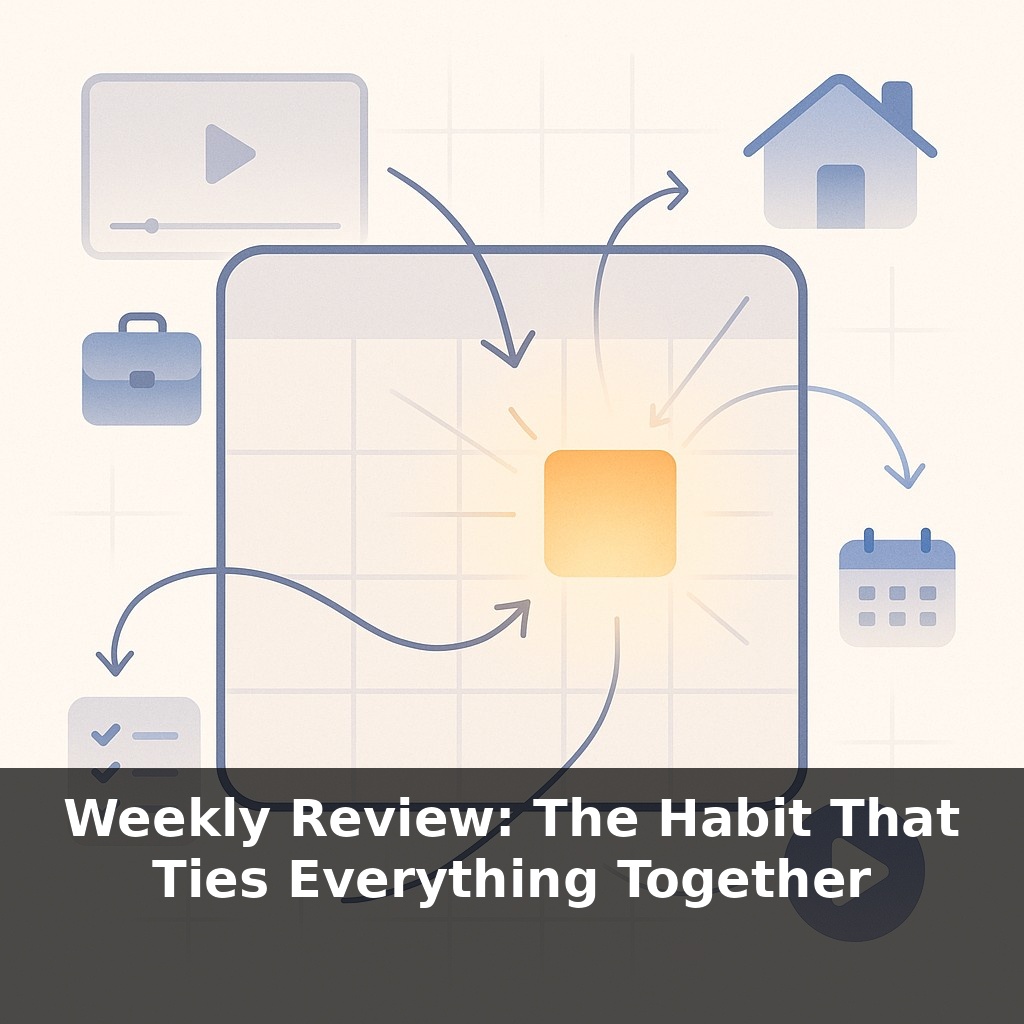
Some people do this intuitively with scraps of paper, calendar scribbles, or quick notes in a phone, but the power comes when you turn that into a consistent, end-of-week ritual. Think less “productivity hack,” more like your personal staff meeting with yourself: you’re the strategist, the project manager, and the ops team in one room, looking at how the week actually unfolded. Instead of letting tasks, ideas, and worries swirl around like unsorted emails, you give each one a folder: keep, delegate, delete, or schedule. Over time, that meeting becomes the anchor that steadies a chaotic workload.
If you strip away all the apps, books, and systems, a weekly review really comes down to answering three questions, in order:
1. What actually happened? 2. What does it mean? 3. What will I do differently next week?
Most people skip straight to question three—or never get to it at all. They bolt from a chaotic Friday into an optimistic Monday with nothing in between. The review creates that missing “bridge” where you can look at your work like an outsider for a moment instead of just being stuck inside it.
Question one is about evidence. Open your calendar, task manager, notebook, and even your sent email or chat history. You’re not trying to remember the week from scratch; you’re reconstructing it from traces. What work moved forward? What stalled? Where did you get interrupted? Which commitments did you make off the cuff? This is also where you capture loose ends: ideas scribbled in margins, favors you agreed to, follow-ups that live only in someone else’s inbox. You’re pulling all of that into a single, trusted place.
Question two is where reflection turns raw data into insight. For each project or theme, you ask: Why did this go the way it did? Was I blocked by other people, by unclear scope, by my own procrastination, or by unrealistic planning? What energized me, and what drained me? Behavioral research on habit change suggests that naming these patterns—“I underestimate deep work by 50%” or “I say yes when I’m tired at 4 p.m.”—makes it far more likely you’ll change them. This is also the moment to notice wins, not just failures. Which decisions paid off? Where did a boundary you set actually hold?
Question three is the payoff. Now you look ahead seven days, but with the benefit of what you just learned. You right-size your commitments instead of repeating the same overstuffed plan. You intentionally schedule recovery time after heavy meetings. You move important but quiet work (strategy docs, thinking time, learning) into actual calendar slots. You decide in advance which tasks you’re willing to drop if the week goes sideways.
Treat this like a weekly software update for your working life: you’re patching bugs, closing vulnerabilities, and shipping a slightly better version of how you operate, one release at a time.
At Microsoft, some engineering teams run a lightweight “Friday shiproom” just for themselves: 25 minutes to scan bugs closed, features shipped, and surprises from the week. One manager noticed the same type of outage cropping up every few Fridays; that pattern, only obvious in review, led to a simple checklist that cut incidents for the quarter. Individual contributors can borrow that logic. A designer might flip through the week’s Figma files and Slack threads, then jot one sentence per project: “Where did I actually move things forward?” A salesperson could review their calendar and pipeline, mark three conversations that felt promising, and decide which ones deserve focused follow-up on Monday.
Like rebalancing an investment portfolio, the review isn’t glamorous in the moment, but it prevents your effort from drifting into low-return work. Over a month or two, you start spotting overexposed areas (too many reactive tasks) and neglected ones (relationship-building, learning) and quietly shift where your time “capital” goes.
A subtle shift is coming: reviews will move from static rituals to living feedback loops. As tools quietly summarize patterns across months, you’ll start to see second‑order effects—how certain meetings correlate with later creativity, or which collaborations reliably spike stress. Teams might even earn “reflection budgets” the way they get training funds, trading an hour of output now for fewer fires later. Over time, your review becomes less a rear‑view mirror and more a dashboard for steering your career.
Over time, the review stops being “another task” and becomes a kind of personal lab session: you’re running weekly experiments on how you work, then tweaking the variables. You might try shortening meetings, shifting creative work earlier, or batching decisions. Some weeks will flop; that’s signal, not failure—a clearer map of how you actually do your best work.
Start with this tiny habit: When you close your laptop at the end of the day, say out loud, “Inbox, calendar, capture,” and then open just one of them for 60 seconds. Glance at your email and star one message you’ll handle in your next weekly review, or peek at your calendar and circle one day this week for your review, or look at your capture list and put a single checkmark next to one item you’ll clarify later. That’s it—one starred email, one circled day, or one checked capture. This keeps the weekly review alive in your mind without turning it into a big, overwhelming project.