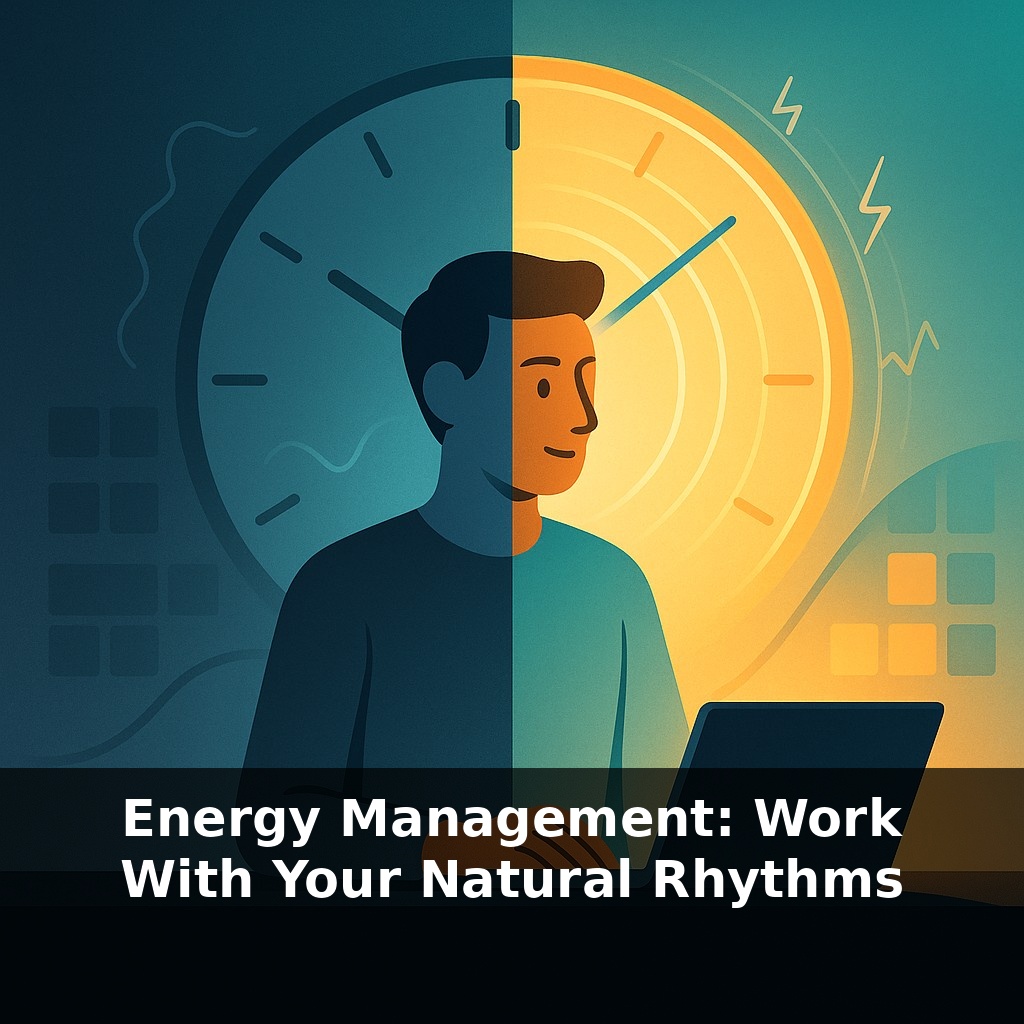
Right now, your brain might be working against the clock on your wall. Most people hit their mental peak not at nine a.m. meetings, but a bit later—right when many calendars are already packed. So here’s the twist: your schedule may be optimized for time, not for energy.
Most people plan their day around tasks and meetings, not around when their brain can actually deliver its best work. Yet your body is running a precise internal program whether you acknowledge it or not. For example, your alertness, reaction time, and accuracy can swing by 20–30 % across a single day—without your workload changing at all. That swing is the difference between cruising through a hard problem in 40 minutes… or grinding on it for 2 hours and still feeling stuck. Organizations that respect this see real gains: some teams that redesigned work around “high-focus blocks” cut project timelines by days, without adding headcount or hours. In this episode, you’ll learn how to spot your own energy pattern, plug your most important work into the right windows, and defend those windows in a normal, meeting-filled job.
Here’s where this becomes practical. Across a full week, those daily swings add up to hours of hidden capacity. Someone who routinely tackles deep work when they’re at 70 % instead of 95 % might be losing the equivalent of half a workday every week—20+ hours a month—just to poor timing. On team level, that compounds: in a group of 8, misaligned schedules can quietly erase the impact of one full person. The goal isn’t to chase perfection, but to move your most important 60–90 minutes closer to your natural high points and push low-stakes work toward the dips. Small shifts here create outsized returns.
Most people never measure their energy; they just notice when they’re “tired.” To work with your biology instead of against it, you need real data on how your mind behaves over a typical day.
Start with the two main levers you can actually use: when you start demanding work, and how long you push before a break. Across large samples, performance tends to cluster in 90–120 minute bursts. That’s why 3 straight hours of “focus time” often feel great for the first 75–90 minutes and then quietly skid into rereading the same sentence. In one office pilot I ran, developers logged perceived focus on a 1–5 scale every 30 minutes. Their average score dropped from 4.2 in the first 90 minutes of a coding block to 2.7 in the next 60—yet they still “felt” productive because they stayed in the chair. When we capped sessions at 90 minutes and forced a 10–15 minute break, defect rates fell by about 18 % over six weeks, with no extra hours.
A simple pattern tends to emerge if you track yourself for 5–10 workdays:
- One “prime” block of 60–120 minutes - One secondary block that’s decent but not stellar - 2–4 lighter stretches where you handle email, coordination, or admin with minimal friction
What changes everything is deliberately attaching the right type of task to each block. Think in three categories, and give each a score from 1–3 based on how much brainpower it demands:
1) Creation / problem-solving (3): design, strategy, complex coding, writing from scratch 2) Analysis / decisions (2): reviewing proposals, code review, planning, tough emails 3) Processing / maintenance (1): inbox, status updates, simple forms, routine reporting
If you map your last week and see that “3-level” work regularly lands in your lowest-energy stretches, you’ve located an invisible tax on every project you care about.
This isn’t just personal. In one 50-person support team, leaders moved training and policy changes into agents’ natural “medium” window (late morning) and reserved the first hour of shifts for simple tickets. Average handling time for complex cases dropped from 28 to 21 minutes—a 25 % improvement—without hiring or overtime.
At a large marketing agency I worked with, copywriters logged their work in 15-minute increments for 2 weeks. One writer found her “3-level” tasks were scattered across 6–7 tiny chunks per day. After regrouping them into a single 90-minute block at 10:30 a.m. and a 60-minute block at 3:30 p.m., her weekly draft output went from 4 to 6 high-quality pieces—a 50 % gain—without extending her hours.
A software team did something similar but at team scale. They color-coded calendar events for 30 people: red for “3-level,” yellow for “2-level,” green for “1-level.” In the first pass, red work was squeezed between meetings, often in 20–40 minute fragments. They reclaimed just one 90-minute red block and one 45-minute yellow block per person per day. Over a quarter, they shipped 3 major features instead of their usual 2 and cut bugs in new releases by 22 %.
Think of it like upgrading your operating system: same hardware, same 8-hour day, but smarter task placement yields visibly better throughput.
A 5 % shift in *when* you do existing work can yield outsized gains. One firm used wearable data to stagger start times by just 30 minutes; voluntary overtime fell 18 % and deadline slip-ups dropped 12 % in a quarter. Another team moved complex client calls 90 minutes later in the day and saw customer satisfaction scores rise from 4.1 to 4.6/5. Treat timing experiments like A/B tests: adjust one variable per week, log 2–3 metrics, and keep only changes that improve results by at least 10 %.
Treat this as infrastructure, not a perk. Once you see the pattern, formalize it: add two 90-minute “do not disturb” blocks to your calendar, stack 3–5 high-stakes tasks there, and protect them for 30 days. Teams that codified this into norms—e.g., no meetings before 10:30—often report 15–25 % faster delivery on priority work.
Before next week, ask yourself: When during the last few days did I feel naturally “switched on” and focused (time of day, type of task, environment), and how could I deliberately block the next 60 minutes this week for one important, brain-heavy task in that same window? Looking at my typical afternoon slump, which specific low-energy tasks from my current to‑do list (like email, admin, or routine updates) could I intentionally move into that dip instead of wasting my best hours on them? If my body had a say in my calendar, what’s one concrete boundary I’d set for the next 7 days—such as no meetings before 10am, a 10‑minute walk between back‑to‑back calls, or a tech‑free wind‑down after 9pm—and what might I need to say “no” or “not now” to in order to honor it?