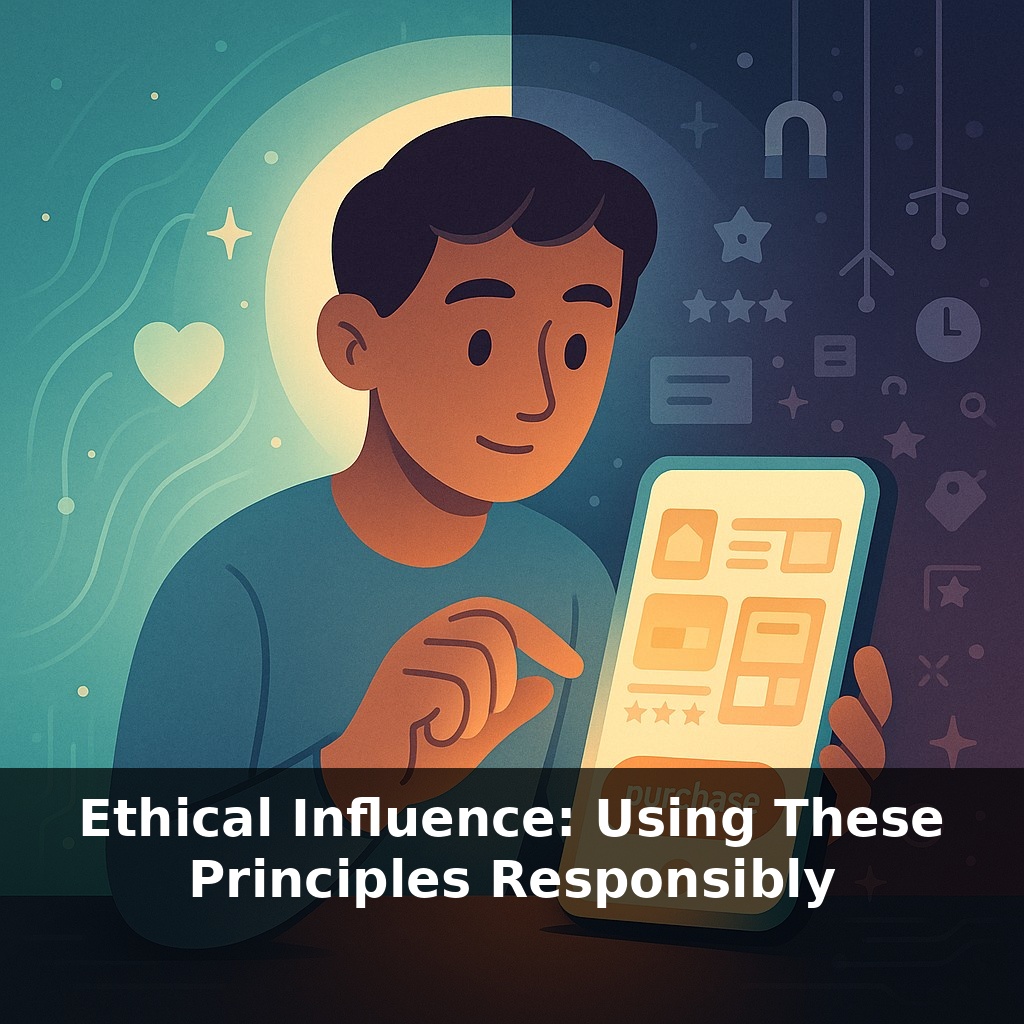
About a third of what you buy online isn’t your idea—it’s your feed’s. A “last room left” banner, a disappearing discount, a flood of five‑star reviews… In each moment, someone is steering your choice. The real twist is this: the same tools can either protect you—or quietly exploit you.
Nearly 40 % of what people buy online is nudged by algorithms—yet most of us couldn’t explain how those systems “decided” what to show us. That gap between power and understanding is exactly where ethics lives. It’s not the scarcity banner or the glowing review that makes influence dangerous; it’s what we’re not told about how and why they appear.
In close relationships, we run similar “algorithms” in our heads: we remember what gifts worked, which jokes softened conflict, which favors earned a yes. Over time, we build quiet playbooks for getting what we want. The question isn’t whether we influence each other—you can’t opt out of that—it’s whether we’re doing it in a way we’d be proud to admit out loud, especially if the other person could see the “source code” behind our moves.
Sometimes what feels like “chemistry” is really a pattern you’ve trained in someone else—like always cheering extra loudly when they agree with you, or going quiet when they push back. Over time, those little reinforcements stack up, and the other person starts predicting you the way a streaming app predicts your next show. The tricky part is that our motives are rarely pure or evil; they’re mixed. You might push a partner to rest more because you care about their health—and because you secretly want more time together. Ethical influence starts by admitting those mixed motives to yourself first.
Here’s the strange part: most people can sense when they’re being pushed, but almost no one can articulate *how* they want to be persuaded. That’s where good intentions quietly go off‑track. You might think, “I just want them to be happy,” while using pressure that actually shrinks their choices.
A useful way to navigate this is to borrow three questions from modern persuasion research and apply them to your next important conversation:
**1. Would they still say yes if they knew everything I know?** This is the informed‑consent test. Are you leaving out details that might reasonably change their mind—like how stressed you’ll be if they agree, or how much you personally gain? Withholding isn’t always lying, but it *does* tilt the playing field. In close relationships, that tilt quickly turns into mistrust.
**2. Could I describe my approach out loud without feeling slimy?** This is the transparency test. Saying, “I’ll compliment them a lot first so they feel bad saying no,” lands very differently from, “I’ll explain why this matters to me and then ask what they need to feel comfortable.” The words you’d use to describe your plan are often more honest than the story you tell yourself about your motives.
**3. Are the benefits roughly balanced—or am I loading the dice in my favor?** This is the benefit‑alignment test. It’s not about perfect symmetry; sometimes one person gives more, sometimes less. The ethical red flag is when you routinely end up ahead while the other person routinely eats the cost: you get flexibility, they get exhaustion; you get certainty, they get less freedom.
A simple rule of thumb: if you’d be embarrassed to have your strategy screenshotted and texted to them, you’re probably drifting into manipulation.
Think of it like seasoning a dish: a pinch of social proof (“Others found this helpful”), a dash of urgency (“This timing would really help me”), a clear statement of your stake (“Here’s why this matters to me”). Used openly and in moderation, those elements can deepen trust instead of corroding it.
Ethical influence isn’t about never nudging; it’s about nudging in ways you’d be comfortable *being* on the receiving end of, especially on your worst, most depleted day.
Think of these three tests like running quality checks on small, everyday moves. Say you want your partner to join a weekend trip with your friends. - Informed‑consent check: you mention that the cabin is cozy and cheap—but also that it’s a 5‑hour drive and your friends can be intense. You’re not “forgetting” the parts that might make them hesitate. - Transparency check: instead of love‑bombing them all week then springing the ask, you say, “I know I’ve been hoping you’ll say yes, so tell me honestly what would make this feel good for you too.” - Benefit‑alignment check: if the drive drains them, maybe you agree that next weekend’s plans are fully their call.
In a friendship, you might use these same checks when asking for a favor: “Here’s exactly how much time it’ll take; here’s what I’ve already tried; if it’s a no, we’re still good.” Paradoxically, pressure usually shrinks real yeses; clarity often grows them.
A strange twist is coming: soon, you won’t just *consume* nudges—you’ll be asked to design them. You’ll choose default options at work, decide how “sticky” your app’s notifications are, or set rules for your kids’ devices. Tiny design choices will quietly steer real behavior, like placing healthy food at eye level or routing people through the casino floor.
Your challenge this week: spot one place you control a choice for others—and adjust it so their long‑term interest clearly wins, even if your short‑term convenience doesn’t.
When in doubt, zoom out: ask how your pattern would look if replayed over a year, not a day. Tiny pushes, like rounding up at checkout, add up—toward either trust or quiet resentment. The more power or data you hold, the gentler your hand should be. That asymmetry is where “just clever design” quietly turns into a rigged game.
Here’s your challenge this week: Choose one real decision you need others to say “yes” to (like getting team buy-in on a new process, encouraging a client to try a different approach, or asking your manager for a change in priorities) and deliberately apply **two ethical influence principles** from the episode—such as transparency about your intent and offering a genuine, no-pressure opt‑out. Before you make the ask, rewrite your message so it clearly states your motive, the honest pros and cons, and exactly what “no” would look like without penalty. Then, after the conversation, rate yourself from 1–10 on how well you avoided manipulation (no hiding info, no guilt-tripping, no fake scarcity) and adjust one thing you’ll do differently in your next influence attempt.