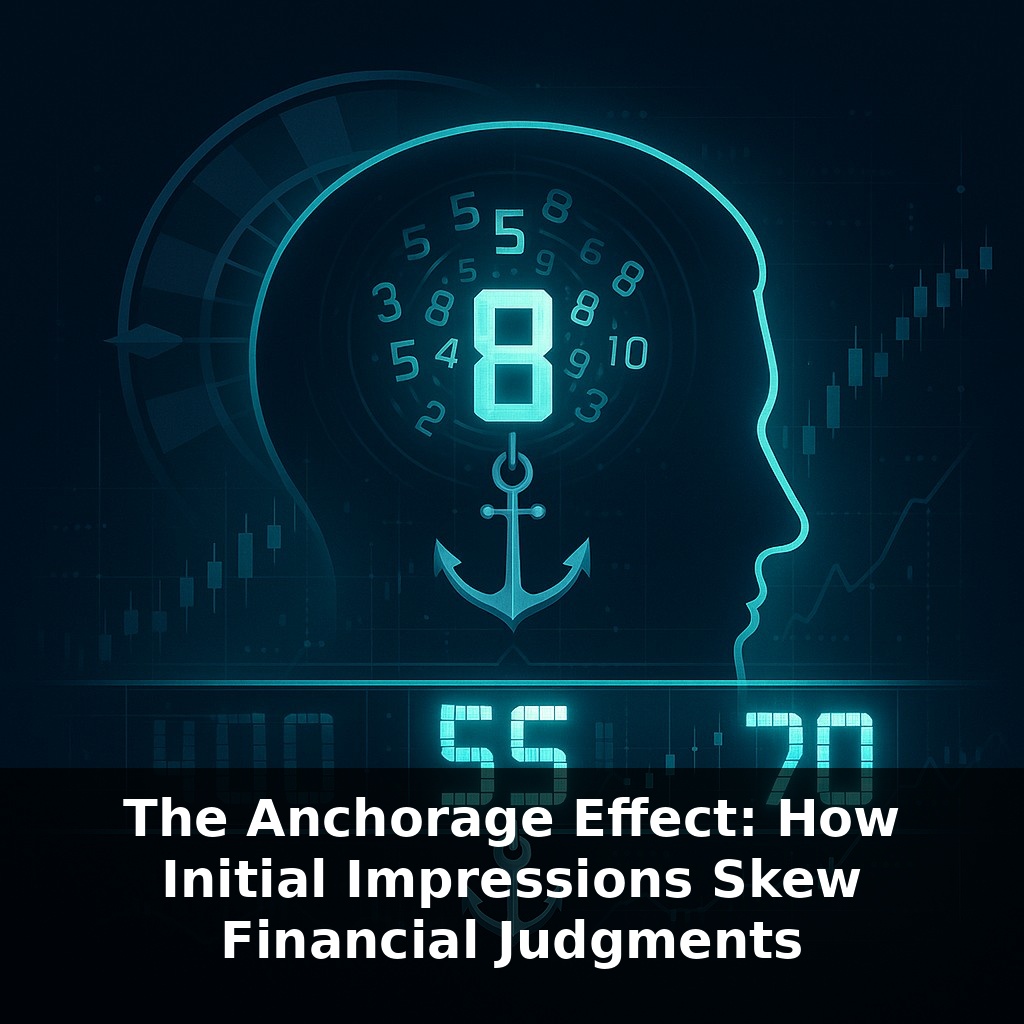
A random spin of a wheel once changed people’s guesses about African countries in the UN by almost twice as much. Now, jump to a salary meeting, a home showing, a hot new stock. In each case, one number quietly appears first—then everything you think bends around it.
A tech IPO opens at $40. By lunch, it’s trading at $55. To most people, it now “feels” expensive—because $40 is stuck in their head as what it’s “really” worth. But someone who first notices the stock at $70 and sees it “on sale” at $55 feels the opposite tug. Same business, same cash flows, radically different judgments—because the first number each person saw quietly framed everything that followed.
This pull shows up everywhere money moves. Founders agonize over the first valuation term sheet. Homebuyers obsess over the original list price, even after inspections reveal costly issues. Employees fixate on a starting salary and then negotiate every future raise from that point, compounding the effect for decades. Spotting where that first number sneaks in—and how much gravity it has on your thinking—is the first step toward taking that power back.
We like to think we “do our own research” and reach independent views on value. But in practice, we mostly react to whatever number shows up first and then hunt for reasons it might be right. That’s why sticker prices, list prices, “suggested donations,” and “compare at” tags exist at all—they’re psychological scaffolding for your eventual decision. In financial settings, those scaffolds often arrive long before you notice them: default contribution rates in your 401(k), a robo-advisor’s suggested risk level, the “most popular” plan on a pricing page, even the first Zestimate you see before touring houses.
In the lab, anchoring looks almost comical. Spin a wheel, flash a random number, and suddenly people’s guesses about African UN membership move from 25% to 45%. Or tell students to write down the last two digits of their Social Security number; those with “80–99” then bid up to 346% more for the same bottle of wine than those with “00–19.” The numbers are meaningless, yet they still tug.
What matters for your money is that the same mechanism shows up when the numbers aren’t random at all.
Consider real estate. In a Stanford/MIT field experiment, simply listing a house 10% above its estimated market value raised final sale prices by roughly 4%. Nothing about the brick, wiring, or neighborhood changed. What changed was the first serious number buyers saw. Even after tours, inspections, and comps, their offers still orbited that initial figure.
Or take fund investing. Analyses of mutual-fund flows show investors cling to the price they paid. When a fund drops below that level, they hold on about 30% longer than investors who started at a lower purchase price, even when fundamentals look the same. The original price becomes a psychological “break-even line,” warping sell decisions and tax outcomes.
Regulators see this too. The U.K. Competition & Markets Authority pushed retailers to display unit prices clearly, and to rein in manipulative “was-price” discounts. If your eye hits “WAS £5, NOW £3” first, your brain reflexively compares everything to £5, not to what competing products actually cost per 100g.
Anchors don’t have to be explicit numbers. A story like “this sector always bounces back” can set a mental reference point for what a “normal” price or return should be. Crypto framed as “digital gold,” or a startup pitched as “the next Amazon,” quietly suggests a scale of potential that colors every subsequent spreadsheet you build.
And expertise doesn’t grant immunity. Professional investors, corporate CFOs, and seasoned negotiators all show strong anchoring in experiments—even when they know that’s what’s being tested. Awareness can blunt the effect, but it rarely removes it. The practical goal isn’t to become anchor-free; it’s to learn to spot when someone else chose the “A” your entire financial orchestra is now tuning to—and to decide whether you want to retune or walk away.
A recruiter floats “$120k–$130k” before you share your expectations. Many candidates instantly narrow their own range to that band, even if market data would support $150k. A better move: walk in with three numbers already researched—your walk-away minimum, fair-market target, and stretch goal—so their first figure competes with an anchor of your own.
In public markets, watch how “all‑time high” quietly becomes a reference point. A stock sitting 30% below that peak can feel “cheap,” even if the prior high was driven by a one‑off mania. A more disciplined anchor is forward cash flow or required return, not a historical price that happened to clear once.
Artists know how powerful the “first number” is. At a gallery, a few very expensive pieces can make mid‑priced works feel reasonable by comparison, even if you’d have balked at those same prices in isolation. Many SaaS pricing pages mimic this trick with an eye‑watering “enterprise” tier that makes the middle option feel safe.
When prices float in AR glasses or metaverse malls, first numbers won’t just sit on a screen; they’ll shape the whole scene around them. A luxury “shell” storefront, glowing badges, or scarcity cues can turn a merely high price into the apparent center of gravity. Think of it like setting the baseline tempo in a fitness class: everything else feels too slow or too fast by comparison. Expect smarter tools to surface neutral yardsticks—like inflation and risk—before you ever see a “deal.”
Anchors won’t vanish, but you can choose which ones to trust. Let data, not drama, set your baseline—like using a trail map instead of following random footprints. Over time, notice which “first numbers” consistently steer you wrong. Treat them as red flags, not guideposts, and your financial choices start to reflect your goals instead of someone else’s script.
Here's your challenge this week: Pick ONE upcoming money decision (like evaluating an investment, choosing a credit card, or deciding on a big purchase) and force yourself to ignore the first number you see—intro APR, “was $299, now $149,” “average 8% annual return,” or “only $50/month.” Before you look at any advertised or “suggested” figures again, set your own anchor: decide in advance what *you* think is a reasonable price, interest rate, or return based on at least two independent sources (e.g., a competitor’s offer and a neutral comparison site). Then, compare your pre-set anchor to the marketed number and either walk away or renegotiate if the gap is big. At the end of the day, rate on a 1–10 scale how much your own anchor—not the first number you saw—actually drove your decision.