Why Change Fails: The Science of Habit
📝 Transcript
About half of what you’ll do today, you won’t actually decide to do. You’ll just… do it. Walking into the kitchen. Opening a familiar app. Saying “yes” when you meant “not this time.” The mystery isn’t why change is hard. It’s why our autopilot keeps winning.
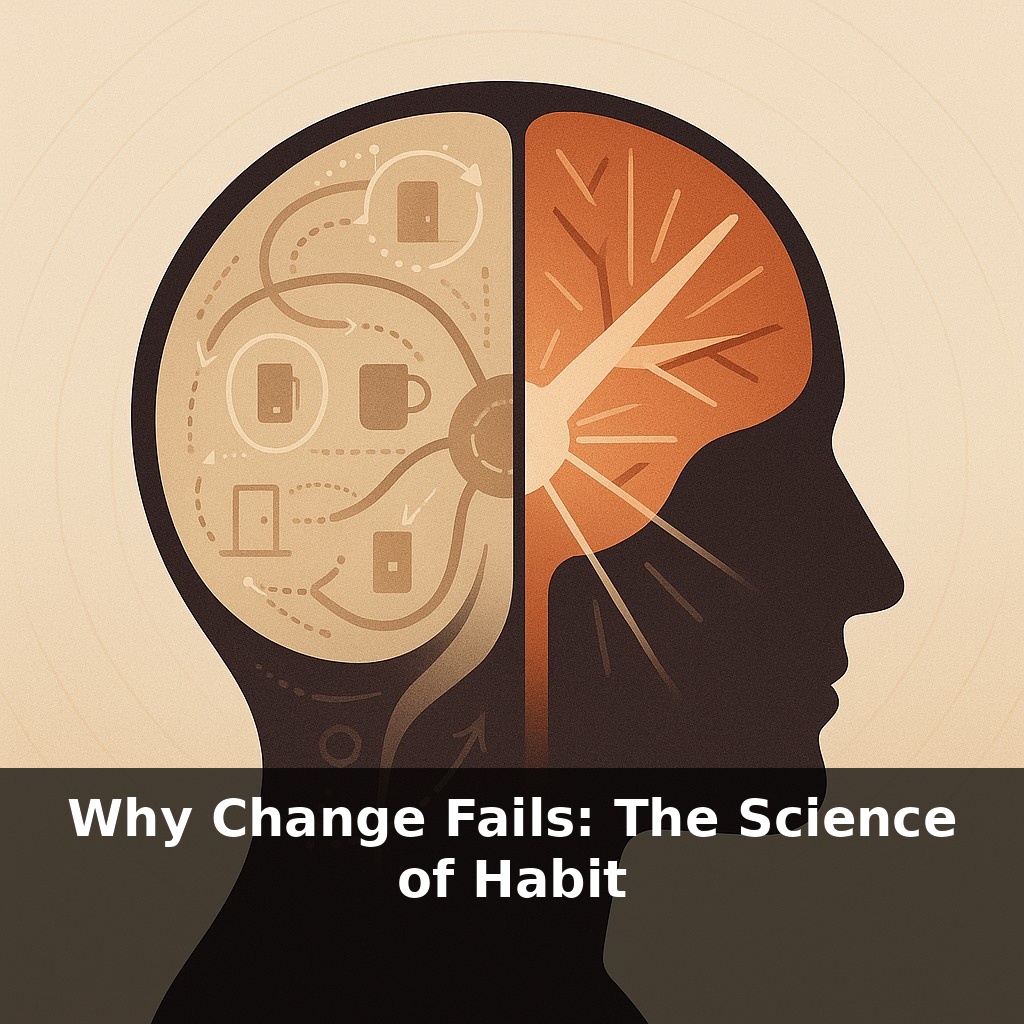
That quiet conflict between your plans and your patterns isn’t a personal flaw; it’s your brain doing exactly what it was designed to do. Deep inside, the basal ganglia is constantly looking for ways to save energy by turning repeated actions into fast, bundled routines. Over time, your brain “chunks” the steps of getting ready for bed, checking your phone, or reaching for a snack, so they fire off with minimal effort or awareness. That’s efficient, but there’s a catch: these neural shortcuts don’t care whether the routine serves your long‑term goals, only that it has worked consistently in the past. So when you announce a big change—new diet, new schedule, new leadership style—you’re not starting on a blank slate. You’re walking into territory where older, faster circuits already have the home‑field advantage.
That home‑field advantage shows up in how much of life runs on repeat: studies suggest 40–45% of what you do each day is habitual, triggered more by where you are and what’s around you than by what you intend. Environmental cues quietly nudge old patterns online: the glow of your phone at night, the meeting room where you always defer, the colleague who brings pastries. Change fails so often not because goals are weak, but because contexts stay the same. Your brain sees the familiar setting and fires the familiar script, even while you’re busy promising yourself you’ll do it differently “this time.”
Change collapses so often because we aim it at the wrong layer. We try to upgrade “motivation” while leaving the underlying loops untouched: cue → routine → reward. The cue is whatever reliably precedes the behavior, the routine is what you actually do, and the reward is the felt payoff your brain tags as “worth repeating”—relief, stimulation, comfort, closure.
Most resolutions attack only the routine: “Don’t snack at night.” “Stop checking email in bed.” But if the cue (10 p.m. on the couch; phone on the nightstand) and the reward (soothing boredom; numbing stress) stay intact, your older loop keeps winning. It’s not that you lack discipline; it’s that you’re trying to run new software on unchanged settings.
Three findings from habit research matter here:
First, timing. That “21 days” rule is folklore. In Lally’s study, simple habits like drinking water with lunch automated in about 66 days on average, but some people needed nearly 8 months. Early slips didn’t ruin the process; consistency over the long arc did the heavy lifting. Change fails when people interpret a bad week as proof it “didn’t work,” instead of data on where the loop is fragile.
Second, context. Neal and Wood showed that when people were moved out of their usual environments, many “bad habits” simply vanished—without extra willpower. The loop wasn’t powered by desire alone; it was wired into place, time, people, and objects. Keep those constant and your brain keeps re‑booting the same script.
Third, competition, not erasure. Old circuits don’t get deleted; they get outcompeted. Think of a scar: the tissue is still there, but most days you don’t notice it unless something irritates it. Under stress, though, dormant loops flare back up. That’s why you can “fall back” into a pattern you haven’t practiced in years the moment you’re tired, overwhelmed, or back in the old setting.
Effective change, then, is less about heroic self‑control and more about strategic redesign. You don’t just vow, “I’ll exercise more.” You decide: which cue will trigger it (alarm, calendar alert, walking through the front door), which specific routine you’ll default to, and what immediate reward will make your brain say, “Let’s do that again.” When people build change at this granular level—and give it enough repetitions in stable contexts—the failure rate looks very different from that mid‑February cliff.
A leader I coached kept “forgetting” to give her team feedback. She didn’t lack courage; her loop was simple: cue—end of meeting, routine—rushing to the next task, reward—feeling productive. We didn’t ask her to “be more intentional.” We inserted a tiny competing loop: when the meeting timer hit zero, she’d ask one question—“What did we learn?”—before anyone stood up. The cue stayed, the routine shifted, the reward became visible progress and appreciation. Within two months, her team described her as “way more present,” though she’d only added 3–4 minutes per meeting.
You can do the same with personal change. Want to read more? Instead of “I’ll read at night,” tie it to a precise cue: mug hits the table at breakfast, phone stays in another room, book opens for five pages. The reward isn’t “becoming well‑read”; it’s the micro‑pleasure of a calmer start to the day. Like adjusting seasoning in a dish, you’re not rebuilding your life—just tweaking the conditions so the desired pattern becomes the easiest thing to repeat.
Most resolutions don’t die from lack of desire; they die from poor architecture. We redesign goals but leave the daily micro‑structures untouched—who we’re with, what’s on our screens, how our spaces are arranged. As sensing tech spreadsBuilding on this understanding of habit dynamics, your calendar, watch, and even car could start “collaborating” to surface just‑in‑time prompts, like a smart thermostat quietly rebalancing the climate. Your challenge this week: pick one stubborn pattern and change only the setting around it, not your effort.
So the real leverage isn’t in “trying harder,” it’s in quietly tilting the floor under your feet. Treat your day like a kitchen you’re constantly rearranging: what sits on the counter gets used, what’s buried in the back rarely does. The more you experiment with placement—of tools, people, prompts—the more your future behavior starts to feel like the natural next step.
To go deeper, here are 3 next steps: 1) Install a habit-tracking app like Streaks or Habitify and set up **one specific “friction-reduced” habit** the episode mentioned (e.g., putting your running shoes by the door to support an automatic morning walk); let the app remind you daily and review the streak graph tonight. 2) Grab a copy of **“Atomic Habits” by James Clear** or **“Good Habits, Bad Habits” by Wendy Wood**, and read just the chapter on **cue–routine–reward** so you can map one current “failure to change” to that loop before bed. 3) Use a website blocker like **Freedom** or **StayFocusd** to create a 25-minute “no-distraction window” tomorrow, dedicated solely to setting up your environment for the new habit (laying out objects, pre-loading apps, or arranging your space exactly as the podcast described for making habits more automatic).
Unlock all episodes
Full access to 8 episodes and everything on OwlUp.
Subscribe — $1.99/monthLess than a coffee ☕ · Cancel anytime