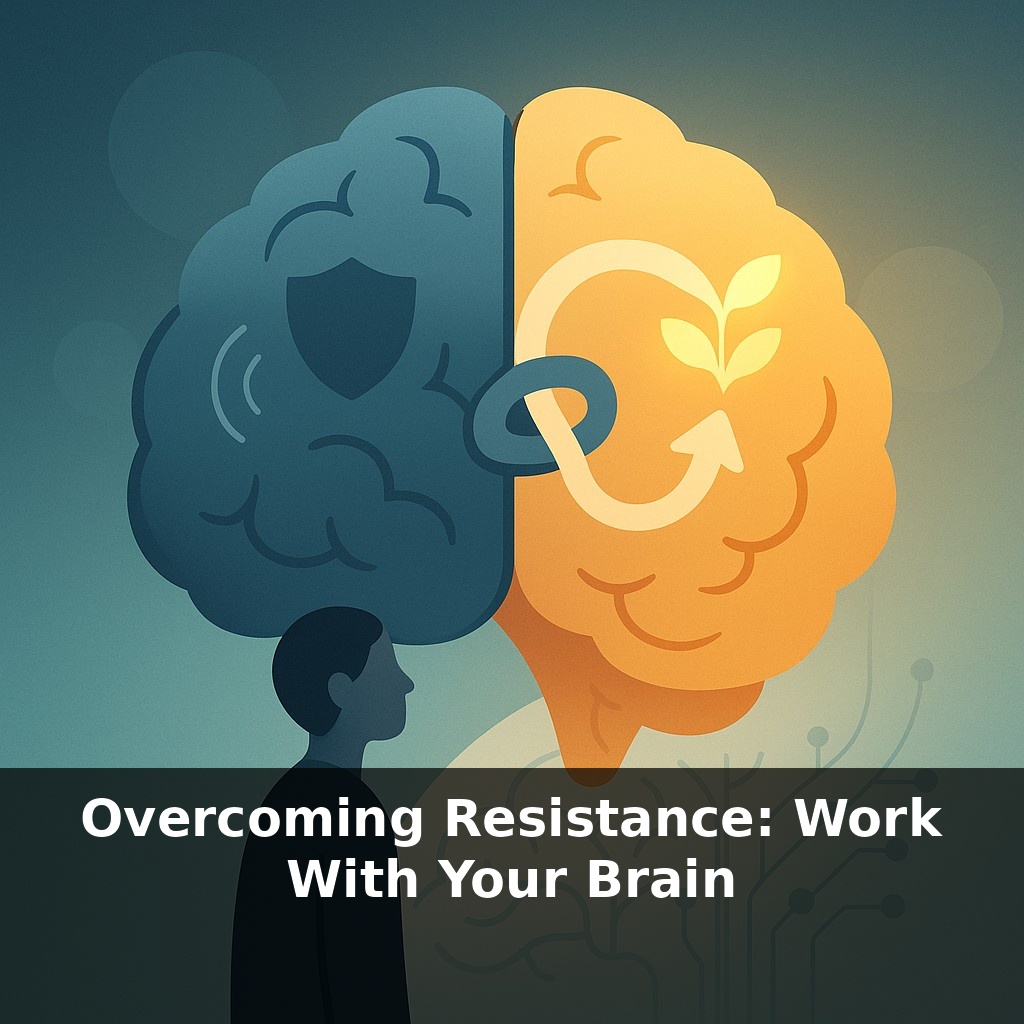
Right now, your brain is quietly fighting your best plans. A Cornell study found that when life swerves even a bit more than we expect, the brain’s threat alarms flare. You decide to start a new habit… and your own wiring treats it like danger. Why would a “better you” feel unsafe?
So when you “resist” change, you’re not just being difficult—you’re watching a safety system do its job a little too well. The same networks that help you cross a busy street or spot a bad deal also flag anything uncertain, even if you rationally want it. This is why sheer willpower or pep talks feel like pushing a locked door: you’re arguing with a security guard who only speaks the language of prediction and reward.
The way through isn’t brute force; it’s speaking that language better. Reduce the sense of social risk, give your brain small, winnable experiments, and pair them with rewarding emotion. Models like SCARF help you lower “this might hurt me” signals in relationships and at work. Tools like WOOP and “If–Then” planning quietly preload better choices into your autopilot. And mindfulness trains you to notice the alarm without instantly obeying it—turning resistance from a brick wall into a caution sign you can walk past.
Your brain also keeps a private “odds calculator,” constantly estimating: *How likely is this to work—and is it worth the effort?* When a change feels vague, huge, or far away, that calculator quietly rates it as a bad bet. That’s when scrolling your phone or sticking to old routines suddenly feels strangely reasonable. Add in past failures, and your brain updates the odds even further against you. Mindfulness helps you catch this in real time; WOOP and If–Then plans give your brain crisp, low-risk moves so the next step feels less like a gamble and more like placing a tiny, smart bet on yourself.
When change *still* feels heavy, even after you’ve broken it down, you’re usually bumping into one of two systems: your brain’s error detector and its energy accountant.
First, the error detector. Neuroscientists call it “prediction error”: the gap between what you expected and what’s actually happening. When that gap gets big enough, the amygdala lights up and quietly tags the situation as “handle with care.” That’s why a new workflow, role, or routine often feels disproportionately tense: your brain isn’t mad at the change—it’s reacting to how *surprising* it is.
You can use this to your advantage. Instead of swinging from 0 to 100, make changes just different enough to be interesting but not so different that they trip the alarm. Think of adjusting a recipe: you don’t replace every ingredient at once; you tweak one or two, taste, then adjust again. This “progressive mismatch” keeps prediction errors small and tolerable while you collect little wins that update your internal model: “This new way isn’t dangerous; it’s workable.”
Then there’s the energy accountant. Every shift has an invisible “metabolic price tag.” Your brain prefers routines because they’re cheap to run. New behaviors feel tiring not because you’re weak, but because they’re literally more expensive—at first. Neuroplasticity is the discount mechanism: with repetition, neural pathways become faster and more efficient, lowering the cost.
Here’s the twist: the accountant doesn’t only track physical effort; it tracks emotional load too. Social tension, unclear expectations, or fear of evaluation can multiply the perceived cost of a change, even if the behavior itself is simple. This is where things like psychological safety and clear norms matter more than inspirational slogans. Reduce ambiguity, and you reduce “interest rates” on effort.
Mindfulness threads through both systems. Noticing “oh, my chest is tight; my brain’s flagging this as risky” gives you a tiny gap to choose a smaller step, ask a clarifying question, or renegotiate a deadline—instead of defaulting to avoidance. Over time, that repeated choice teaches your prediction system that discomfort is data, not danger, and teaches your energy accountant that effort can lead to reliable, rewarding outcomes.
You can see this most clearly in two places: feedback and “starting over.”
In feedback, the size and style matter more than the content. A 2% tweak like “add one clearer example” usually slips past your alarm; a 40% demand like “this whole deck needs rethinking by tomorrow” often triggers shutdown. Leaders who know this stack changes: first, clarify the *one* outcome that matters, then layer specifics only after the first adjustment lands. The work may still be big, but your brain experiences it as a series of solvable puzzles, not a referendum on your worth.
“Starting over” shows the energy accountant at work. Notice how you can tidy one drawer after work but avoid “organize the house.” People who succeed here quietly rename the project. Instead of “get fit,” it becomes “walk to the farther coffee shop three times this week.” The goal hasn’t shrunk; the *entry ticket* has. Once in motion, neuroplasticity and curiosity do more of the lifting than raw willpower.
As change cycles speed up, brain-savvy design will quietly shape your day. Workflows may adapt like smart thermostats—detecting “cognitive drafts” where plans keep stalling, then nudging you toward easier on-ramps. Wearables could flag rising stress before a hard conversation and suggest a 90‑second reset, much like a navigation app offering a calmer route. Teams might treat meetings as live experiments in attention: shortening, splitting, or reordering them based on real‑time focus data instead of tradition.
Change becomes less about fixing yourself and more about running smarter “brain experiments.” Treat each tweak like adjusting a recipe on low heat: note what simmers, what burns, what unexpectedly tastes better. Over time, those micro‑adjustments add up to a kitchen that matches how you actually live, not how you think you’re “supposed” to be.
Here’s your challenge this week: Pick one “brick wall” task you’ve been resisting and set a 10-minute timer to do only the *first 2%* of it (for example, just opening the document, naming the file, and listing three bullet points you already know). Before you start, say out loud the sentence your brain usually throws at you (like “This has to be perfect” or “I’m so behind”) and deliberately replace it with “I’m just doing the first 2%.” When the timer ends, you must stop, then quickly rate your resistance before and after on a 1–10 scale. Do this once a day for the next 5 days with the *same* task, and watch how your resistance score shifts.