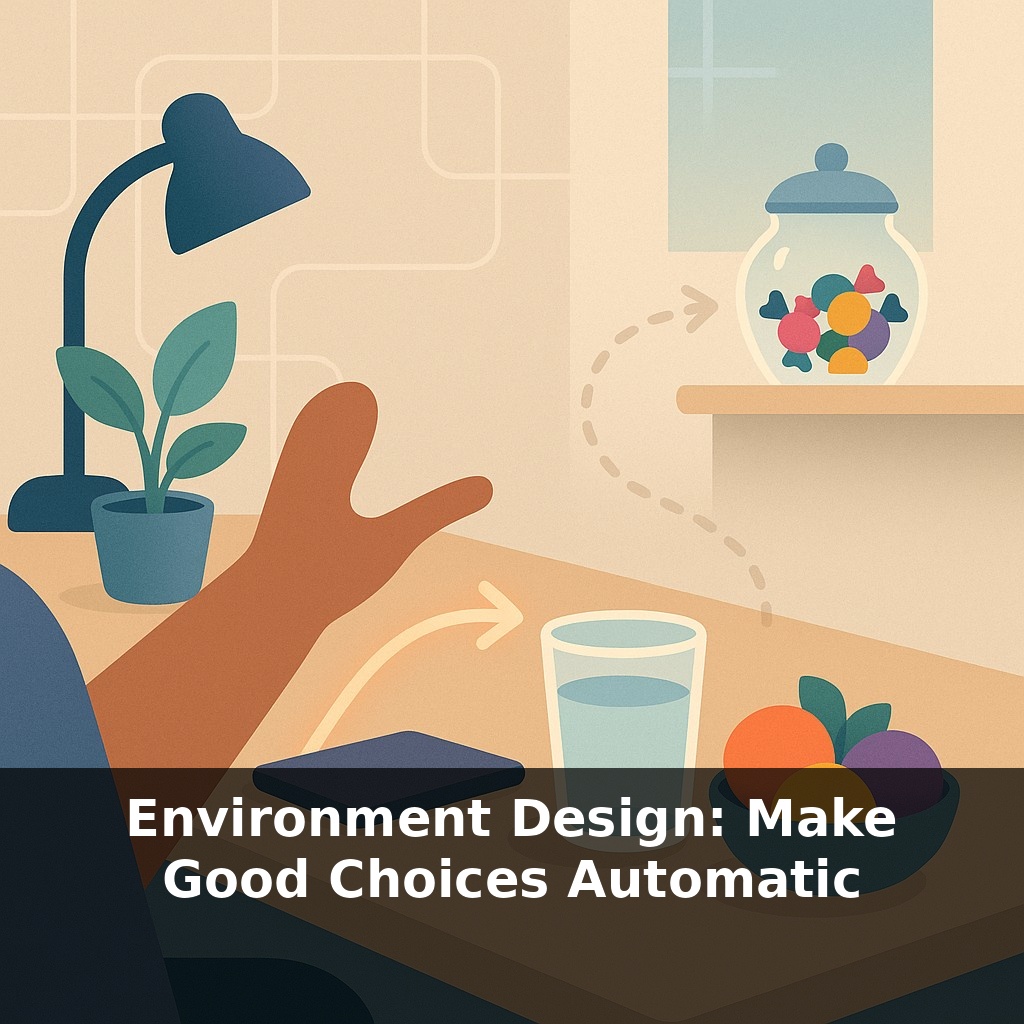
A candy bowl moved just a few steps farther away led Google employees to skip millions of calories in under two months. Same people. Same candy. Different outcome. In this episode, we’ll explore how tiny shifts in your surroundings quietly rewrite your daily decisions.
If tiny shifts can quietly steer choices at Google, airports, and school cafeterias, what happens when you turn that same precision on your own life? Most people try to change by cranking up motivation or discipline; environment design skips that fight entirely. It assumes you’ll be tired, rushed, or distracted—and sets things up so you still default to the behavior you want.
You’re already living inside dozens of “invisible scripts”: where your phone sleeps at night, what’s on your desk, which apps sit on your home screen, what’s within arm’s reach when you’re stressed. Each of these is a silent vote for a future action.
In this episode, we’ll map the four main levers of environment design—placement, visibility, friction, and defaults—and you’ll learn how to quietly re‑wire your kitchen, workspace, and phone so that better choices happen almost on autopilot.
Most people treat behavior change like a willpower contest, then quietly blame themselves when it collapses on a stressful Tuesday. But in real life, it’s the cluttered counter that “decides” you’ll order takeout, the open laptop tab that “chooses” your next distraction, the buzzing phone that “wins” your focus. Before we tweak any levers, it helps to zoom out and notice where your current setup is already nudging you—toward late‑night scrolling, rushed breakfasts, or skipped workouts. In the next part, we’ll dissect one ordinary day and expose the subtle cues currently running the show.
Think of your day as a sequence of “micro crossroads.” You don’t consciously debate most of them: you just reach, tap, open, or click. Environment design works because those micro crossroads are highly predictable. You wake up roughly the same way, walk through the same rooms, open the same apps, hit the same energy dips. That repetition is your leverage.
Start with where your hands actually go. Morning: do they reach for a phone, a glass of water, coffee, or your laptop? Commute or transition to work: do they grab headphones, a podcast app, or social media? Late afternoon: do they drift toward snacks, your inbox, or a news site? Every frequent reach is a design opportunity, and almost all of them are driven by what’s closest or most obvious.
Next, map your “default screens.” Not philosophically—literally. What’s on your phone’s first screen? Which tabs are already open when you sit down to work? What lives on your desktop, dock, or bookmarks bar? These aren’t neutral; they are pre‑loaded choices. A social app on your home screen is a standing invitation. A book app or language tool in that same spot is a different invitation.
Then look for pockets of friction you’ve accidentally put in front of things you say you care about. If your running shoes are buried in a closet, your budget sheet takes six clicks to open, or your notes app is hidden in a folder, you’ve quietly made your stated priorities harder than their competitors. Meanwhile, streaming, scrolling, and snacking are likely sitting on the red carpet.
It’s tempting to overhaul everything at once, but the research suggests you’ll get more mileage by hitting a few “high‑traffic junctions” than tweaking twenty low‑impact corners. Those junctions are moments where you’re tired, rushed, or in between tasks: first 30 minutes after waking, first 15 minutes at your desk, mid‑afternoon slump, and the hour before bed.
In each of these windows, ask one question: “What does my current setup make the easiest thing to do?” Don’t judge the answer; just get specific. That specificity is what will let you re‑arrange things later so that the easiest action is also the one you’re actually proud of.
Open your fridge door. The top shelf practically nominates tonight’s dinner: leftovers, sauces, or whatever’s been staring at you all week. Now picture that same shelf holding pre‑chopped vegetables, washed berries, or ready‑to‑heat meals. You haven’t become more “disciplined”—you’ve just quietly reassigned the starring role.
At work, the equivalent is your “landing zone.” If the first thing you see is email, you’ll start the day reacting. Shift a single document, and your first 10 minutes tilt toward focused output instead of inbox whack‑a‑mole. One manager I coached stopped checking messages before 10 a.m. simply by placing a printed “one thing” task list on her keyboard each night; she physically moved it to touch her laptop in the morning, and her hands followed the script.
The same pattern shows up on your phone. A meditation app set as your alarm turns waking up into a one‑tap path to three quiet minutes—unless you let social apps share that front row and compete for the first swipe.
Future implications stretch beyond where you put your snacks and apps. Offices might rearrange layouts based on anonymized movement data, so deep‑work zones feel like quiet side streets and chat areas feel like lively town squares. Cities could tune lighting, signage, and public benches to guide safer routes home. The risk: if only companies control the controls, your “choices” may quietly serve their goals more than yours. Expect growing pressure for opt‑outs, audit trails, and visible “who decided this?” labels on major defaults.
You don’t need a full renovation—start with one crowded “intersection” in your day and rearrange it like a bookshelf, putting what you want to reach for within easy grasp. Over time, these small edits add up like compound interest. The open question is how far you’re willing to go: what if your future feels different simply because the room does?
Try this experiment: Tonight, set up a “frictionless morning” by putting your running shoes, socks, and a filled water bottle right by your bedroom door, and placing your phone (with your alarm set) across the room next to them. Hide your evening junk snack in the hardest-to-reach cabinet and put a bowl of washed fruit or nuts in its spot on the counter. Tomorrow morning, when the alarm goes off, notice how likely you are to put on the shoes and step outside before checking email or social media. Do this for three mornings in a row and simply observe: Does changing where things live in your space make the healthy choice feel more automatic?