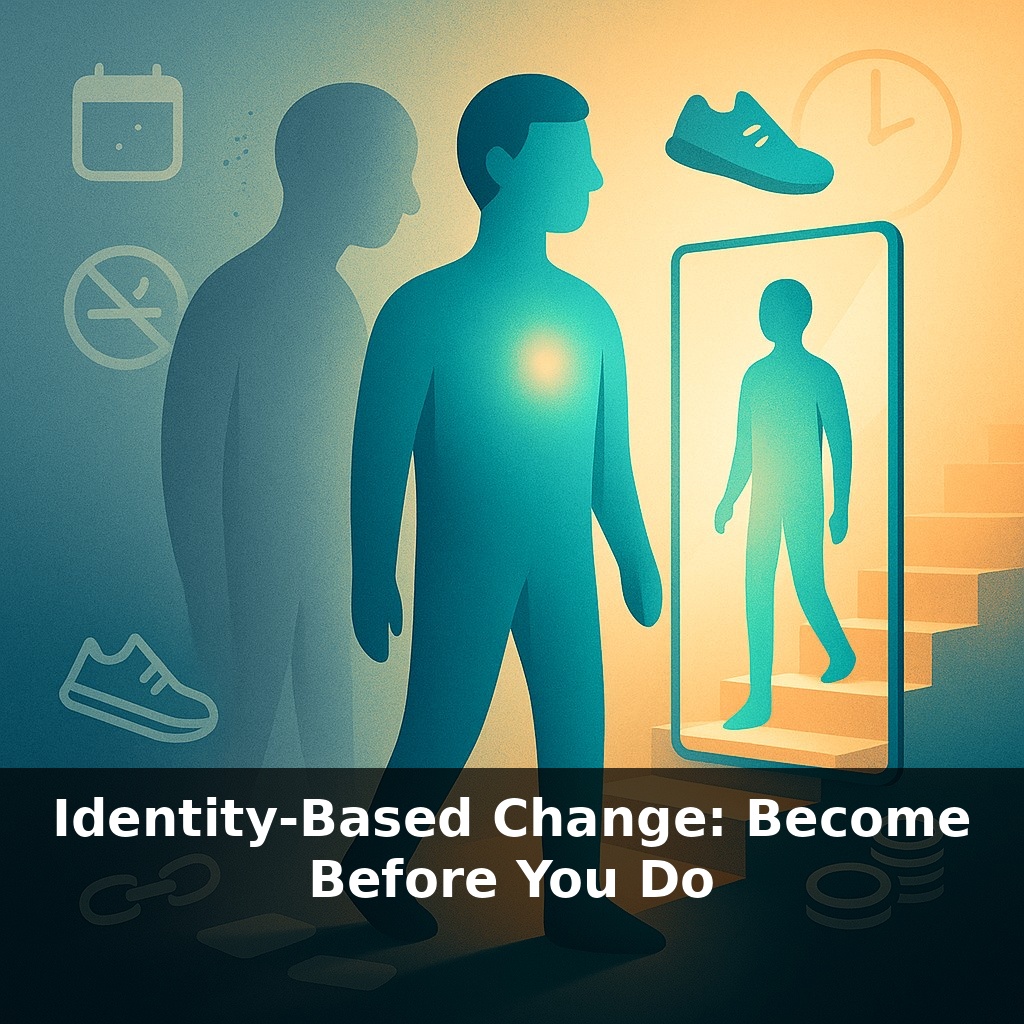
About nine out of ten New Year’s resolutions quietly die before spring, yet many of those people genuinely wanted to change. A runner buys shoes but never runs. A “non-smoker” still reaches for a lighter. How can our actions and our self-story pull in opposite directions?
Think of how differently life feels when you say, “I’m terrible with money” versus “I’m the kind of person who learns to handle money wisely.” The numbers in your bank account haven’t changed yet—but your options just did. Identity is like the “operating system” underneath every goal, shaping which choices feel natural, which feel like a stretch, and which you never even notice. Research shows this isn’t just motivational poster talk; your brain literally lights up differently when a message matches who you believe you are. That quiet line—“I’m the kind of person who…”—turns vague intentions into a template for daily decisions. In this episode, we’ll unpack how to deliberately rewrite that template so effort drops, consistency rises, and change stops feeling like a constant argument between who you are and who you’re trying to become.
Most of us try to upgrade our lives by tinkering at the surface: new apps, better to‑do lists, stricter schedules. But beneath all that, your brain is quietly asking a different question: “Is this something someone like me does?” When the answer is no, motivation leaks out fast. Neuroscience studies show that when a behavior feels self-consistent, your brain conserves energy, like a car that stops over-revving and finally shifts into the right gear. That’s when habits stop feeling like a fight and start feeling like a rhythm—less about forcing discipline, more about expressing who you already are becoming.
Here’s the odd twist: most people try to “earn” a new way of seeing themselves by first stacking up enough proof. “Once I’ve exercised for a month, then I’ll call myself active.” But the research points the other way around: tiny, early identity shifts can *precede* the evidence and quietly change what feels like a “normal” choice long before the results show up.
Psychologists sometimes describe three layers of change: outcomes (what you get), processes (what you do), and identity (who you see yourself as). Outcome goals sound like, “Lose 10 pounds.” Process goals sound like, “Cook dinner at home four nights a week.” Identity-linked goals sound like, “Become the kind of person who nourishes their body.” All three matter—but they don’t have equal leverage. Outcomes tug on the surface; identity reshapes the rules of the game.
You can see this in that Sheffield meta‑analysis: people whose goals were phrased as “being” something—being a reader, a non‑smoker, a meditator—were roughly twice as likely to keep going a year later. The behavior wasn’t necessarily easier for them; it was *less negotiable*. Skipping a run wasn’t just “missing a workout,” it was out of character.
Brains love coherence. When your self-description and your calendar don’t match, you feel a subtle friction—cognitive dissonance. You can resolve that in two directions: downgrade the identity (“I guess I’m not a writer”) or upgrade the behavior (“I’ll write for five minutes so my story stays true”). Identity-based change harnesses that bias on purpose, so the path of least resistance is the one that aligns with your chosen story.
That’s also why neuroimaging studies, like Falk’s work on health messages, keep finding that activity in regions tied to self‑relevance predicts who will actually follow through. When something feels like “me,” the brain flags it as worth the effort. When it feels like an external rule, it’s easier to ignore.
The good news is, this isn’t about grand declarations. It’s about collecting “identity proof” in micro‑form: one paragraph written, one cigarette declined, one dollar saved. Each small act is like a vote. A single vote doesn’t decide an election, but over time the tally becomes undeniable—both to others and, crucially, to yourself.
Think about the difference between telling yourself, “I’m trying to read more,” versus, “I’m a person who doesn’t go to bed without reading at least a page.” The first is a plan; the second is a line you’re reluctant to cross. That subtle shift explains why programs that call participants “healthy eaters” change menus more than ones that just hand out diet rules. You’re not just following instructions; you’re staying in character.
One useful way to experiment with this is to choose a *minimum expression* of a new identity. A “writer” might define that as 3 sentences a day. A “thoughtful friend” might send one check‑in message before lunch. The bar is intentionally low so you can keep casting votes even on bad days.
Your challenge this week: pick one identity you’d like to grow into, then design the tiniest daily action that would make you feel entitled to that label. For 7 days, do that action *first* and silently finish the sentence, “This is what someone like me does.”
As AI coaches get better at spotting patterns, they’ll likely suggest ultra‑specific roles linked to context: “focused coder” in work sprints, “present parent” after 6 p.m., “curious learner” on commutes. Done well, this narrows choice overload and turns transitions in your day into costume changes instead of identity clashes. The open question is governance: Who decides which roles are amplified, and how do we prevent “optimized worker” from quietly eclipsing “healthy human”?
The deeper move isn’t to chase a flawless version of yourself, but to keep updating your “draft” of who you are as life changes. Let your roles evolve like a playlist that shifts with the mood, not a statue locked in marble. When a season ends—a job, a relationship, a belief—treat it like changing recipes: same cook, wiser menu, fresher ingredients.
Try this experiment: For the next 3 days, every time you face a decision related to your goal (what to eat, whether to scroll your phone, how you respond to an email), pause and silently ask: “What would a person who already IS [insert identity, e.g., ‘an athlete’, ‘a calm parent’, ‘a focused creator’] do right now?” Then choose the action that best matches that identity, even if it’s just 1% more aligned than your default. Keep a simple tally in your notes app of how many “identity-aligned” choices you make each day, and at the end of day 3, look at whether those choices changed how you *felt* about who you are, not just what you did.