A striking 60% of people who believe they’re “on track” with their goals can’t specifically recall what they did yesterday to advance them. This episode uncovers that gap and demonstrates how measurable systems can ensure that you're truly progressing, not just staying busy.
Sixty percent of people who *think* they’re “on track” toward a goal can’t say what, exactly, they did yesterday to move it forward. That’s the gap this episode closes. Good intentions don’t scale; systems do—and the core of any effective system is tracking paired with feedback.
This isn’t about obsessing over numbers or turning your life into a spreadsheet. It’s about creating a simple way to answer three precise questions, every day: 1) What did I actually do? 2) What result did it create—today? 3) What will I adjust tomorrow?
The data doesn’t need to be digital or fancy. A single checkmark for “deep work block completed,” 10 tally marks for “minutes practiced,” or a three-word note on sleep quality can be enough—if it’s captured consistently and reviewed briefly. Done right, tracking becomes less like a report card and more like a navigational tool, quietly correcting your course before you drift miles off target.
Most people default to tracking outcomes—pounds lost, dollars earned, hours slept—then feel stuck when those numbers barely budge. The lever you can actually pull is what you do *today*. That’s why we’ll shift your focus to clear, countable behaviors: 10 pages read, 25 minutes of coding, 1 outreach email, 3 sets of exercises. These are “leading indicators”: they move first and drag the results behind them.
The research is blunt: frequent self-monitoring can *double* success rates. But “frequent” doesn’t mean complicated. You need three things: tiny units, fast feedback, and a place to see the trend at a glance.
Here’s the lever most people miss: *where* and *how* you aim your attention during the day. Once you’ve picked a behavior to track, the next step is to make it measurable in a way your brain can’t ignore.
Start by shrinking your unit of measurement until it’s almost impossible to argue with. “Write more” becomes “write 200 words.” “Exercise” becomes “10 minutes of walking” or “3 sets of 8 squats.” Vague intentions create vague data; concrete counts create concrete decisions. Try to express each behavior as a small, binary win: did you do the thing (yes/no), or how many units did you complete?
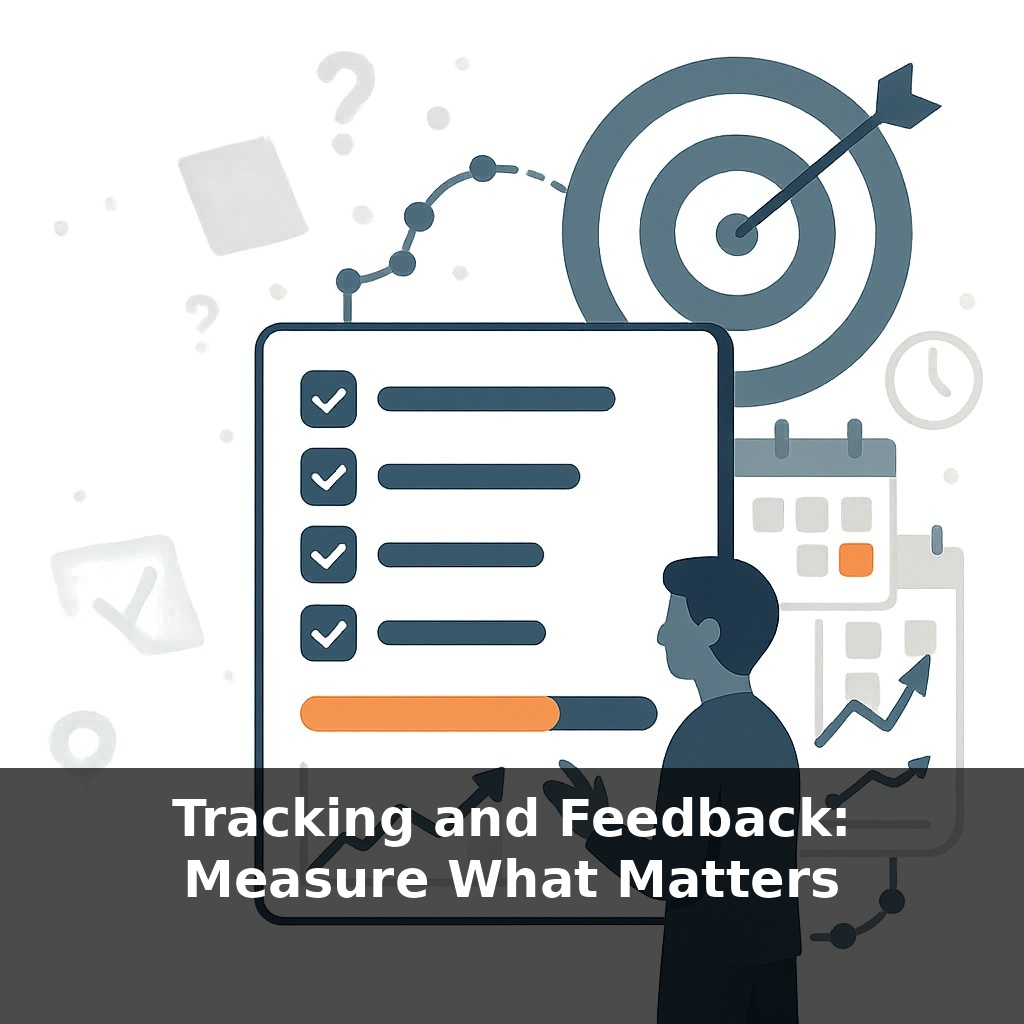
Next, decide on a visible scoreboard. This can be as low-tech as a sticky note grid with 7 columns (days) and 3 rows (behaviors), or a notebook page with three daily lines like: • Deep work (minutes): ___ • Practice (reps/pages): ___ • Sleep wind-down (time started): ___
The key is that you can glance at it in under 5 seconds and see today versus yesterday. Studies on visible progress bars show completion bumps of around 10–18%; your homemade version is just a stripped-down progress bar for your life.
Now, link your tracking to specific “check-in” moments. For example: • Immediately after finishing a 25-minute focus block • As soon as you close your workout app or put the weights down • Right before you plug in your phone at night
You’re trying to get the delay between action and record under 60 seconds so the brain ties the tiny reward (a checkmark, a number going up) to the behavior that earned it.
Finally, schedule a 5-minute weekly review with two questions and hard numbers: 1) What got at least 4 out of 7 this week? 2) What stayed at 0–2, and why?
If “practice Spanish (10 minutes)” shows 6/7 but “no phone after 10:30 p.m.” shows 1/7, you don’t need guilt; you need a small tweak—like moving your charger across the room or setting a 10:15 alarm labeled “shutdown.”
A practical way to put this into play is to design a tiny “scoreboard” around one specific goal. Say you want to get better at public speaking for work. Instead of tracking “confidence,” you log three visible behaviors: • 1 short voice note rehearsal (2–3 minutes) before any important meeting • 1 deliberate pause before answering big questions • 1 sentence of feedback requested afterward (“What’s 1 thing I could improve?”)
Across a 5-day workweek, your page might show: Rehearsals: 4/5, Pauses: 3/5, Feedback asks: 2/5. Those numbers tell you exactly where to focus next week—probably doubling the feedback reps.
Or take learning to code. You could track: • 20 lines of code written • 1 bug intentionally debugged • 1 concept summarized in your own words.
After 10 days, “concepts summarized: 8/10” versus “bugs debugged: 3/10” reveals why you understand theory but freeze on real problems—and where to push.
AI will soon turn personal metrics into coaching, not just dashboards. Picture your watch noticing your focus dips every 23 minutes and suggesting a 3-minute reset right then. In 5 years, mood, sleep, and inflammation could be inferred from 10–15 passive signals—typing speed, speech rhythm, micro-movements—yielding early warnings days in advance. Your challenge this week: decide which 1–2 data streams you’d actually trust as inputs before that world arrives.
Your challenge this week: run a 3-day “tight loop” experiment. Pick 1 behavior, log it 3× per day, and add a 30-second note: “What helped? What got in the way?” At day 3, choose 1 adjustment (earlier start time, shorter session, clearer cue) and test it for 2 more days. Compare day 1 vs day 5 numbers and keep the version that wins.