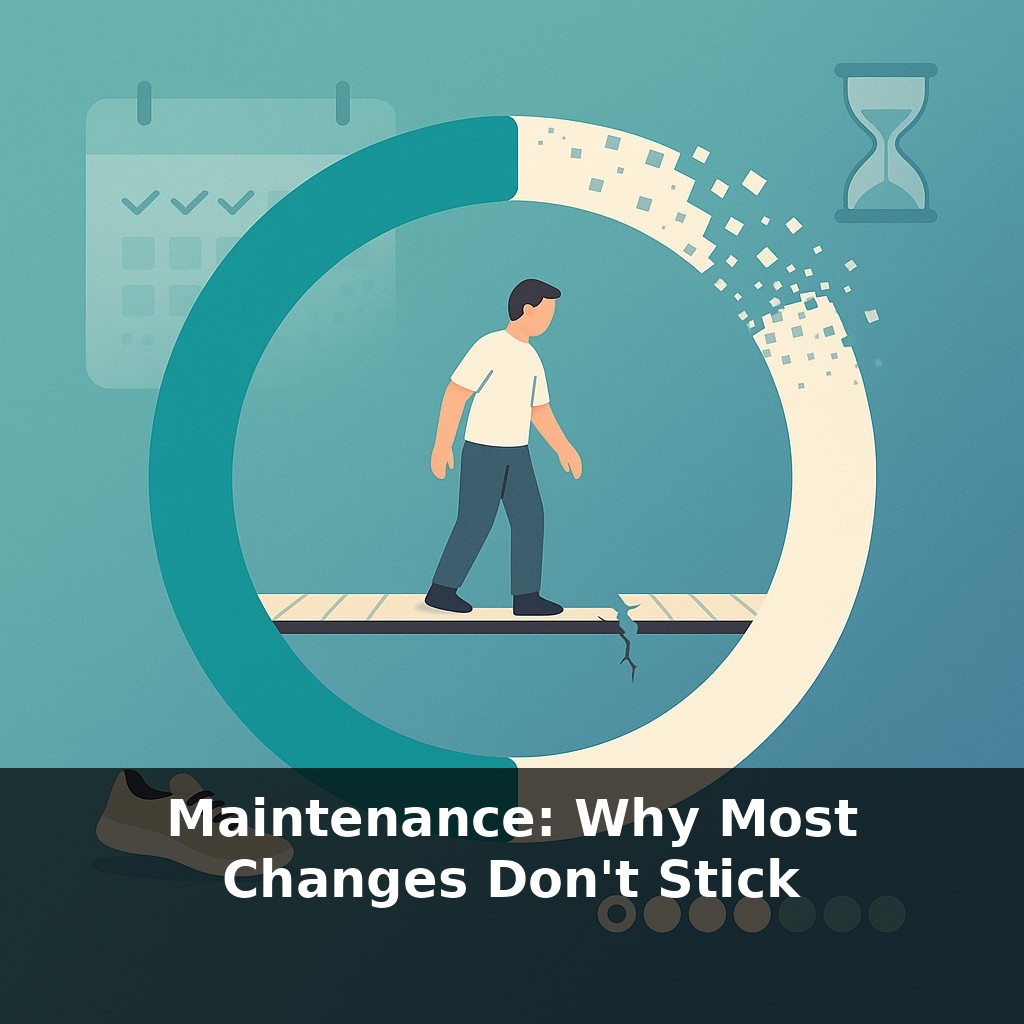
By mid-February, most New Year’s resolutions are already gone. Not loudly, just… quietly abandoned. One skipped workout. One “I’ll start again Monday.” One small exception at work that becomes the new normal. How do tiny lapses keep beating even our biggest goals?
UCL researchers found it can take anywhere from 18 to 254 days to make a new habit feel automatic. That’s a huge range—and it explains why early enthusiasm so often runs out long before real change has had time to “set.” Your brain isn’t wired for “new,” it’s wired for “predictable.” When you try to change, you’re not just making a different choice; you’re competing against an older, faster pathway that’s been rehearsed hundreds or thousands of times. And it’s not just in your head. Your calendar, your coworkers, your family routines, even the apps on your phone all quietly tug you back toward what you usually do. The surprising part? People who succeed long term don’t rely on more willpower. They redesign their environment, set up tripwires that alert them early when they’re drifting, and treat maintenance as a skill—not an afterthought.
McKinsey estimates about 70% of digital transformations fail to sustain their gains. The pattern shows up in health, too: CDC data suggests only about a third of people who quit smoking are still smoke‑free a year later. This isn’t because people don’t care or don’t try hard enough. It’s because most plans obsess over the “kickoff” and barely design for the long, boring middle. The brain defaults to what’s easiest, organizations default to what’s cheapest, and social circles default to what’s familiar. Without active maintenance, even smart changes slowly get absorbed back into “how things have always been done.”
Most change plans quietly ignore three forces that are constantly working against you: your brain’s efficiency drive, your existing systems, and the absence of honest feedback.
First, the brain. Once a pattern is “good enough,” your brain automates it to save energy. That’s why you can drive home on autopilot. New patterns have to compete with these well‑worn “default” circuits. Early on, they’re clumsy and slow. What keeps them alive isn’t intensity but repetition *plus* reward: something that tells your brain, “This new thing is worth the effort.” That reward can be emotional (pride, relief), social (recognition), or practical (less chaos, more time). Without it, the brain quietly tags the new behavior as “optional” and drifts back.
Second, systems and culture. In organizations, people often try to change behavior while leaving the surrounding system untouched: the same incentives, the same reporting lines, the same overloaded calendars. The result is predictable: the old way keeps winning because it’s structurally easier. When hospitals successfully cut hand‑hygiene infections, they didn’t just tell staff to “try harder.” They moved sanitizer dispensers to where hands naturally paused, built reminders into workflows, and had visible leaders model the behavior on rounds. They made the desired action the path of least resistance.
Third, feedback loops. Most of us notice slippage only when it’s big and painful: the project is off the rails, the weight is back, the new software is being bypassed. High‑reliability teams do the opposite: they monitor small signals. Pilots don’t wait to see if the plane has drifted miles off course; they watch instruments that show tiny deviations and correct early. In personal change, that might mean tracking sleep before burnout hits. In companies, it could be a simple weekly metric showing how often the “old way” is still being used.
When these three elements line up—rewarded repetition, supportive systems, and early‑warning feedback—maintenance stops being a grind and starts feeling like the new normal. Change sticks not because people are more disciplined, but because everything around them quietly nudges in the same direction.
A fitness app team once noticed users stopped logging workouts after week three. Instead of adding more features, they ran a tiny experiment: a short check‑in message on the *first* missed day, not the tenth. Just asking, “Rough day or changing plans?” doubled the number who came back the next day. The win wasn’t motivation; it was a faster feedback loop.
On the personal side, think of a busy nurse trying to drink more water during 12‑hour shifts. She doesn’t “try harder”; she buys a bright bottle that clips to her badge, sets two silent alarms per shift, and asks a coworker to swap reminders. The behavior is the same, but now her tools, time cues, and social ties all lean in the same direction.
In medicine, post‑surgery care isn’t one instruction at discharge; it’s scheduled follow‑ups, reminders, and labs that catch problems early. Effective change plans work the same way: they assume drift will happen, then design how it’s spotted and corrected while it’s still small and reversible.
Most people won’t get a personal coach or a full consulting team—but maintenance tools are quietly moving into everyday life. Wearables, browser extensions, and even bill‑payment systems are starting to act like a “future‑you bodyguard,” stepping in before drift becomes damage. As these tools get smarter, the real question shifts from “Can I change?” to “What ongoing supports am I willing to let into my routine?” The frontier isn’t willpower; it’s choosing which guardrails you trust.
Change that lasts tends to be quieter than the dramatic “day one” energy. It looks like tweaking your calendar, renegotiating expectations, and letting tools nag you a bit so you don’t have to. Think of yourself less as the hero of a single push and more as a gardener setting up irrigation: you’re designing conditions so progress keeps happening, even on your off days.
To go deeper, here are 3 next steps: 1) Grab James Clear’s *Atomic Habits* and read the chapter on habit tracking, then set up a simple “maintenance calendar” in the Habitshare app specifically for the change you’ve already started (e.g., your new morning routine or workout schedule). 2) Watch BJ Fogg’s 20‑minute Tiny Habits talk on YouTube and use his method to design one “maintenance trigger” you’ll attach to something you already do daily (like after you make coffee, you review your 3 non‑negotiable maintenance behaviors). 3) Open Notion or Google Sheets and build a “Maintenance Dashboard” with three columns—Behavior, Risk Factor, Backup Plan—then actually plug in your current change, list 3 real-world derailers you’ve faced, and write the exact backup behaviors you’ll use next time instead of abandoning the habit.