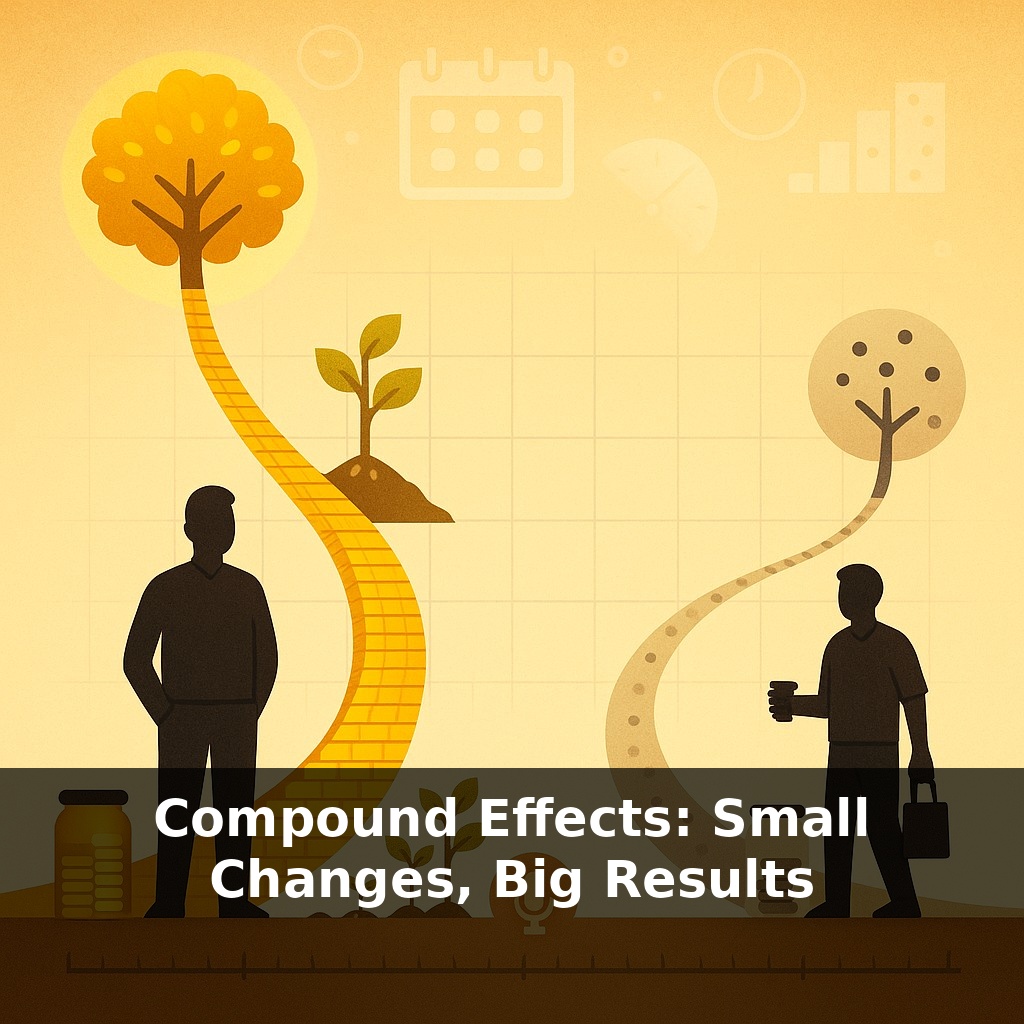
Warren Buffett made most of his fortune after middle age. Not at the start, but in what looked like “extra innings.” Contrast this: two friends side by side—one saves a few dollars a day, the other waits “until it’s worth it.” For years they’re neck and neck—until, suddenly, they’re worlds apart.
Most people wildly overestimate what they can change in a week and wildly underestimate what they can change in a decade. That gap between short‑term impatience and long‑term potential is where the compound effect quietly lives.
You’ve already seen how it reshapes money over time; the same math is quietly running in your body, your skills, your career, even your energy bill. A tiny increase in how far you can jog, a microscopic tweak to how a team trains, or a barely noticeable cut in yearly power use looks trivial up close. Stretch the timeline, and those “too small to matter” shifts start to collide and stack.
The most striking part? Compounding is neutral. It will just as happily amplify daily distractions, late‑night snacks, and missed opportunities as it will savings, training sessions, or practice reps. The question now isn’t whether compounding is happening—it’s: what, exactly, are you letting it multiply?
A strange pattern shows up whenever researchers study long‑term change: the biggest visible jumps often trace back to tiny, almost boring adjustments repeated over and over. British Cycling’s decade of sub‑1% tweaks, or runners following nine small “Couch to 5K” steps, look unremarkable from up close—until the medal counts or fitness scores arrive. The same pattern appears in health markers, skill mastery, even household energy data. What changes the game is not a single heroic effort, but choosing a direction and nudging it forward so gently and consistently that it becomes part of your ordinary day.
Most people meet this principle in a bank statement, then stop there. But the same math is quietly rewriting your body, your skills, and even your surroundings—often in ways that feel unfairly slow at first.
Start with health. Those “barely worth it” choices—five minutes of stretching, swapping one sugary drink for water, going to bed 15 minutes earlier—rarely register on a single day. No one wakes up transformed by a week of slightly better sleep. Yet biological systems react to steady nudges: blood pressure lowers in small increments, insulin sensitivity improves, resting heart rate eases down. Over hundreds of days, the risk curves for heart disease, diabetes, and depression start to bend. That bend is just another version of the same math that turns 1% yearly energy cuts into double‑digit reductions over a decade.
Skill is similar. A musician practicing 20 focused minutes daily will usually outperform the one who plays in erratic three‑hour marathons. Memory research backs this: spaced, repeated exposure builds stronger neural connections than cramming. The first month feels flat—your fingers still fumble, your foreign‑language sentences still collapse—but under the surface, circuits are being thickened, coordinated, and pruned. The real inflection point often arrives long after you would have quit if you’d only trusted how progress “felt.”
Even your environment compounds. A single unplugged appliance barely moves a utility bill. A home, a street, or a city full of such small decisions, repeated year after year, reshapes demand curves, pricing, and even infrastructure. That’s how a 1% annual reduction scales to a national‑level change in electricity use.
Here’s the uncomfortable side: neglect compounds, too. A missed workout isn’t a problem; the identity of “someone who skips when tired” is. Occasional impulse buys are fine; a pattern of “I’ll start saving later” quietly trains your future self to do the same. The math is indifferent: it will amplify whatever you repeat, for or against you.
Your challenge this week: pick ONE domain—health, a skill, or your environment—and design the smallest daily action so easy you almost feel silly doing it (for example: two pushups, five new vocabulary words, turning off one always‑on device each night). Commit to it for seven days, but also track something that reveals its trajectory, not just its size: how much easier it feels, how often you do “a bit more” once you’ve started, or what it nudges you to change next. At week’s end, don’t ask “Did this change my life?” Ask, “If this exact pattern continued for a year, where would it realistically lead?”
Think about how this plays out in places you rarely notice. A junior software engineer fixes one tiny bug per day and leaves a short note about what they learned. After a month, they’ve got a personal handbook of “gotchas”; after a year, newer teammates treat those notes like a mini‑course. Or take a chef who adjusts a recipe by a single ingredient each weekend—slightly less salt, a touch more acid, a different cooking time. None of those Saturdays is dramatic, yet six months later, the dish is unrecognizable in depth and balance.
The same pattern shows up in relationships. Replying thoughtfully to one message a day, adding one extra question in each conversation, or regularly sending a brief “here’s what I appreciated today” email to a colleague doesn’t feel like “working on your network.” But those micro‑interactions slowly shift who thinks of you for opportunities, who shares information with you first, and how much trust you can draw on when stakes are high.
Compounding will matter even more as life speeds up. The real leverage won’t just be “working harder,” but choosing what your small, repeated inputs are aimed at: learning how to learn, collaborating with tools like AI, and protecting your attention. Think of your attention like a daily medication: taken consistently, it quietly shifts your long‑term health; scattered or skipped, side effects accumulate. Over years, the biggest gap may be between people who design their defaults and people who drift.
You don’t need a perfect system; you need a direction and a nudge you’ll actually repeat. Think of each day like seasoning a meal: a pinch more attention here, a little less noise there. Over time, your routines start to “taste” different. The real question isn’t how fast you change, but whether tomorrow’s default is 1% better aligned with who you want to become.
To go deeper, here are 3 next steps: (1) Grab Darren Hardy’s book *The Compound Effect* and read just Chapter 1 today, then plug one current habit into his “bookend your day” idea using the free Habit Tracker in the Streaks app to start a visible streak. (2) Open a free account with a micro-investing platform like Acorns or Robinhood and set up an automatic weekly transfer of a specific small amount (e.g., $10) to experience the financial side of compound effects in real time. (3) Watch James Clear’s 15-minute Google Talk on *Atomic Habits* on YouTube and choose one 2‑minute “gateway habit” he mentions (like doing 5 pushups or reading 1 page) to anchor to something you already do daily—then schedule it as a recurring event in your calendar so it actually happens.