Right now, as you’re listening, almost half of what your brain is doing is on autopilot. You drive home, scroll your phone, reach for a snack—and later barely remember choosing any of it. The strange part? Those tiny unseen loops might be steering your biggest life outcomes.
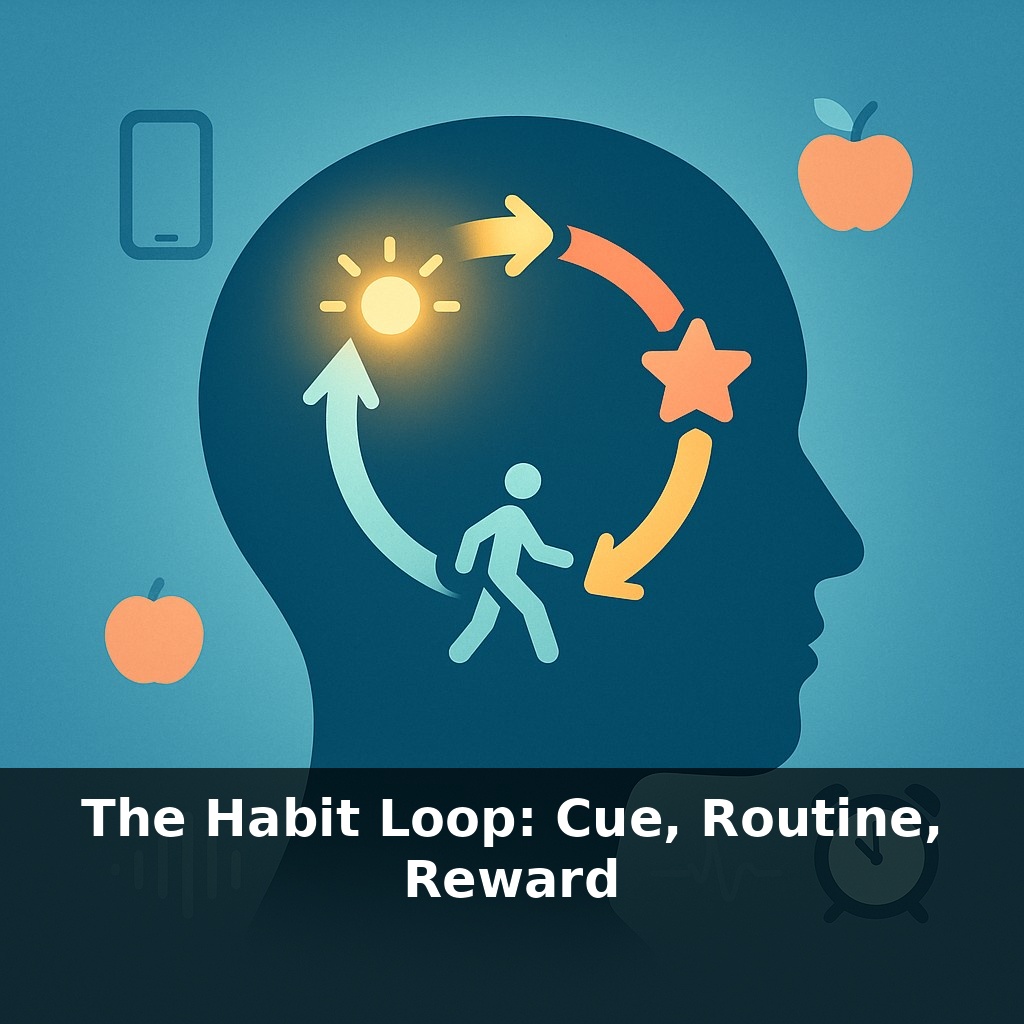
Habits don’t just “happen” to you; they’re built from a predictable pattern your brain runs over and over. And that pattern is surprisingly hackable. Researchers call it the habit loop: a repeating sequence that explains why your 3 p.m. sugar run, your midnight scrolling, or your reliable post-work workout show up almost without negotiation.
This loop has structure, like verses in a song: something starts it, something plays out, something makes it worth repeating. Tweak the right part and the whole song changes. Leave it alone and the chorus comes back tomorrow, and the next day, and the next.
The key shift for this episode: instead of blaming “lack of discipline,” you’ll learn to spot the components of a habit precisely enough that you can keep what you like about it—and surgically swap what’s hurting you.
To work with this loop, you don’t start by forcing willpower; you start by getting curious. Researchers who wired people up in labs found that brain activity flares at the beginning and end of a habit, but quiets in the middle. In real life, that means the moments just before and just after your “autopilot” behavior are where you have the most leverage. Notice what consistently comes right before you grab your phone, open the fridge, or procrastinate—that’s where cues live. Notice what you actually feel afterward—that’s the real reward, which is often different from what you assume.
Most people try to “fix” habits by attacking the middle—forcing themselves to stop snacking, stop scrolling, start working. That’s like yanking on the middle of a rope while ignoring who’s pulling at each end. The leverage lives at the edges.
Let’s zoom in on the first edge: what happens right before the behavior. When MIT researchers recorded neural activity during repeated actions, they saw something odd—the spike at the start got sharper over time, like the brain was learning to recognize a specific starting pistol. In daily life, that pistol is rarely one thing; it’s a pattern. Most habit cues fall into a few buckets: time of day, location, emotional state, people around you, and what you just did.
Notice the difference between “I snack too much” and “At 3:15, when I’m in the office, slightly bored between meetings, and I see Slack quiet down, I go hunting for something sweet.” The second version is actionable because it pins down the starting conditions instead of blaming your character.
Now zoom in on the other edge: what’s actually satisfying about the end. Often, the immediate outcome you think you’re chasing isn’t the real payoff. That coffee might be more about a social micro-break than caffeine. The endless news scroll might be more about avoiding a difficult task than loving headlines. Duhigg’s work with Procter & Gamble showed that Febreze only took off when it was linked to a specific payoff people craved: the “ahh, clean” feeling at the very end of tidying a room.
Once you can describe both edges in concrete language, you’re ready for the surgical move: keep the same starting conditions and the same payoff, but test different middles. If the cue is “end of a draining meeting” and the payoff is “feel reset and in control,” there are dozens of routines that can ride that same loop—five pushups, a two‑minute walk, a quick note planning your next step.
This is why the 21‑day myth is so misleading. In the UCL data, some habits settled in fast, others took months, but the common thread wasn’t a magic number; it was repetition of a stable loop: same cue, same kind of reward, gradually more efficient routine. Over time, the mental friction drops—not because you became a different person, but because the brain decided: “We’ve seen this pattern enough. No need to renegotiate every time.”
Think of this like running a tiny lab on your own life. Start with one concrete scenario: say, you always end up scrolling in bed longer than you’d like. Instead of trying to “be stronger,” treat last night like data. What were the last three things that happened right before it started? Not in theory—literally last night: maybe you closed your laptop, turned off the light, felt a flicker of stress about tomorrow. That cluster is your setup. Now look at the aftermath. Not just “I stayed up too late,” but what subtle relief or sensation showed up: distraction from worries, a sense of connection, feeling “caught up.”
Use other examples the same way. A mid-morning “snack run” might really be a break from decision fatigue at work. A nightly glass of wine might be more about signaling “day is done” than taste. When you name what’s actually helpful in the sequence, you can start to experiment with alternate paths that deliver that same “helpful bit” with less collateral damage.
A single nudge in that loop can quietly redirect whole lifestyles. As AI, wearables, and smart homes learn your “tells” before an unhelpful routine starts, interventions can become as timely as a friend’s well-placed tap on the shoulder. The risk: over-personalized prompts nudging you toward whatever keeps you clicking. The opportunity: design gentle defaults—at work, online, in cities—that make the helpful routines feel like the path of least resistance.
Your challenge this week: pick one stubborn pattern and treat it like a puzzle, not a flaw. For seven days, tweak just one element each time—change where you are, who you tell, or how you celebrate—and jot a one‑line note on what shifted. By week’s end, you’ll have a custom “recipe” instead of a vague promise to do better.