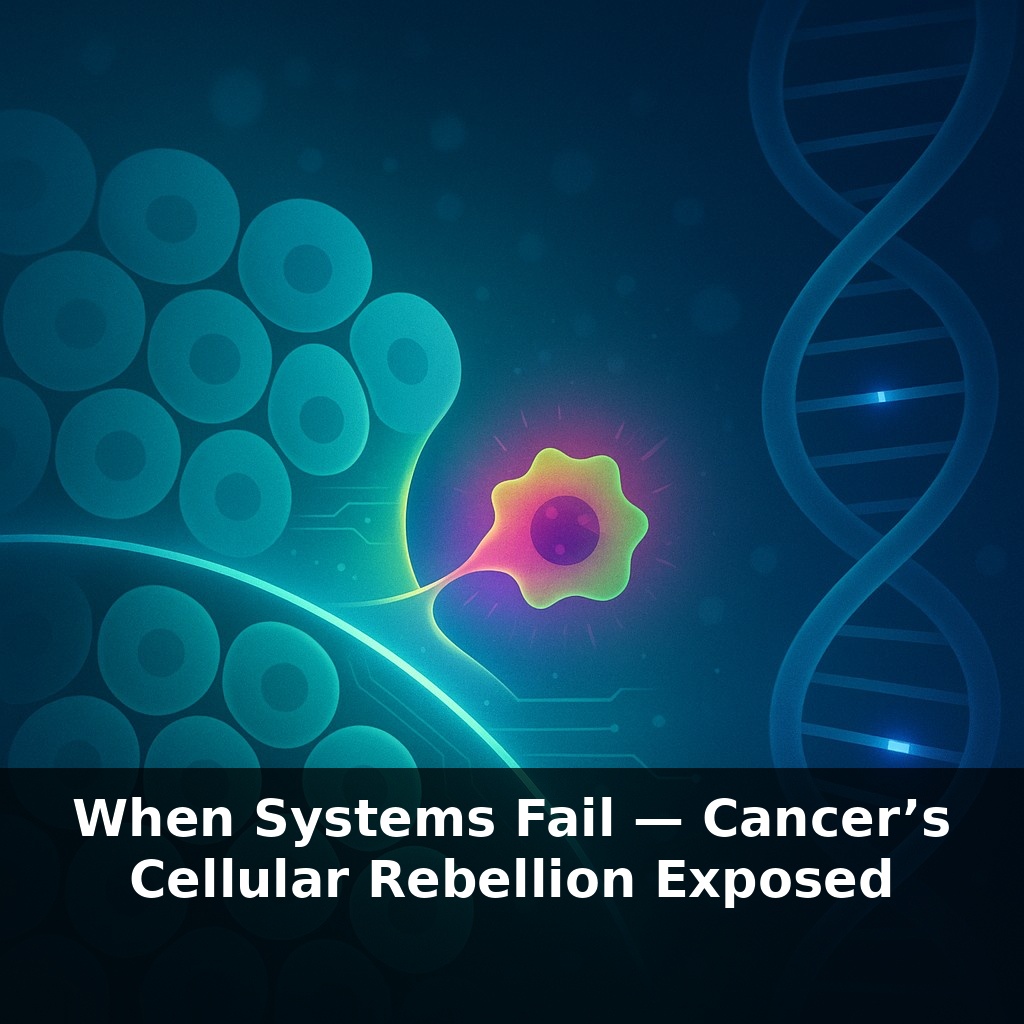
Right now, in a single breath, thousands of your cells quietly break the rules that keep the rest in line. Most will be caught and corrected. A few will slip through. Here’s the paradox: the same genetic flexibility that lets you heal also opens the door to cancer.
Some of the most dangerous rebellions in your body start with a single missed checkpoint. Cells normally patrol their own DNA for damage, pause to repair, or quietly self-destruct if the risks are too high. But as we saw before, rule‑breaking happens. What’s new here is scale: by the time a solid tumor is detectable, its cells may carry thousands of mutations—yet only a handful, maybe two to ten, truly steer the fate of the whole mass.
These “driver” changes hit key systems that coordinate growth, repair, and immune surveillance. One of the most famous, TP53, is altered in about half of all cancers, turning a central guardian into a bystander. Most other mutations are just “passengers,” along for the ride. The real threat emerges when enough drivers line up in the same cell community, allowing not just survival, but invasion into neighboring tissue and, eventually, distant organs.
Each driver sits inside a broader network of pathways that cells use to sense context: how much fuel is available, whether oxygen is scarce, whether neighbors are sending growth‑factor signals. When several pathways are distorted at once, cells start interpreting ordinary cues in extreme ways—like hearing a gentle tap on the door as a blaring alarm. Genomic studies now reveal patterns: lung tumors in smokers, melanomas in frequent tanners, and colon cancers in people with chronic inflammation each carry distinct mutation “signatures” that trace back to their particular environmental histories.
main_explanation: Not all drivers push in the same direction. Some act as faulty accelerators, amplifying growth signals from growth‑factor receptors or downstream pathways like RAS–MAPK and PI3K–AKT. Others sabotage DNA repair teams—BRCA1/2 and mismatch‑repair genes, for example—so errors accumulate faster than usual. Still others tweak how cells respond to low oxygen, scarce nutrients, or inflammatory cytokines from nearby immune cells. That’s why two tumors from the same organ can behave like very different species: the particular combination of altered circuits shapes how aggressively cells divide, adapt, and resist treatment.
Modern sequencing lets researchers reconstruct a tumor’s “life story.” By comparing shared and unique mutations across different regions of the same mass, they infer a branching family tree: early drivers near the trunk, later changes out on the twigs. Often, the abilities we fear most—therapy resistance, relapse, metastasis—arise from small subclones that weren’t dominant at diagnosis. A chemotherapy round might wipe out the obvious branches, only to leave behind a twig with just the right combination of alterations to survive and re‑expand.
The local ecosystem matters just as much as the genome. Cancer cells recruit fibroblasts to lay down remodeled extracellular matrix, coax blood vessels to sprout in their direction (via VEGF and related signals), and persuade some immune cells to switch from attackers to helpers. The result is a niche that shelters aberrant cells while starving or excluding more vigilant defenders. In this sense, tumors are not just masses of wayward cells, but distorted micro‑organs that rewrite the rules of cooperation.
Environmental histories leave their marks, too. UV exposure tends to produce characteristic C→T changes; tobacco smoke leaves a different pattern; some viruses bring their own oncogenes. By reading these signatures, scientists can often tell which pressures nudged a cell lineage toward rebellion—and sometimes, which vulnerabilities those pressures created.
Think of metastasis less as a single leap and more as a relay race with brutal qualifying rounds. A cell has to loosen its attachments, squeeze through dense matrix, survive in the bloodstream, then colonize a new organ with unfamiliar nutrients and immune defenses. Each stage filters out most would‑be invaders; only rare clones with the right mix of traits complete the journey, which is why metastasis still accounts for nearly 90% of cancer deaths.
Real tumors show this stepwise gauntlet. In some breast cancers, early regions mainly boost local growth, while distant liver deposits carry extra tweaks in adhesion and metabolism genes that favor survival in that specific tissue. Melanoma cells that reach the brain often rewire how they use glucose and lipids to match the brain’s energy economy.
Here’s where modern genomics adds nuance: those 2–10 drivers don’t just appear at once. Longitudinal sampling during treatment reveals new drivers emerging under drug pressure, like antibiotic resistance in bacteria. In lung cancer, for example, sequencing has caught minor EGFR‑mutant clones expanding only after targeted therapy blocks their competitors.
Eighteen million diagnoses a year hint at how often cellular order slips. The next frontier is catching rebellion while it’s still a whisper. Pan‑cancer blood tests listen for faint molecular “radio stations” tumours leak into circulation, long before scans see a shadow. AI then sifts these signals, matching patterns to drugs the way a DJ layers tracks to avoid discord. If we can also make distant organs less welcoming to stray cells, treatment could shift from late rescue to quiet prevention.
Your body’s defenses are already learning from each failed skirmish, editing responses like a musician refining a theme. Next‑generation trials pair standard drugs with vaccines built from each tumor’s unique soundtrack, training T cells to recognize faint riffs before they crescendo. The mystery ahead: how far can we push this tuning without silencing healthy improvisation?
Here’s your challenge this week: Pick **one hallmarks-of-cancer behavior** (e.g., chronic inflammation, metabolic dysregulation from ultra-processed food, or disrupted circadian rhythm) and run a 7-day “anti-cancer systems experiment” on yourself. For the next week, **replace your usual evening ultra-processed snack with a whole-food option** (like berries, nuts, or plain yogurt), **stop eating 3 hours before bed**, and keep a simple daily log of your sleep quality (time you fall asleep, wake-ups, morning energy from 1–10). At the end of the week, compare how your body felt on “system-supporting” choices versus your usual defaults and decide one permanent change you’re willing to keep.