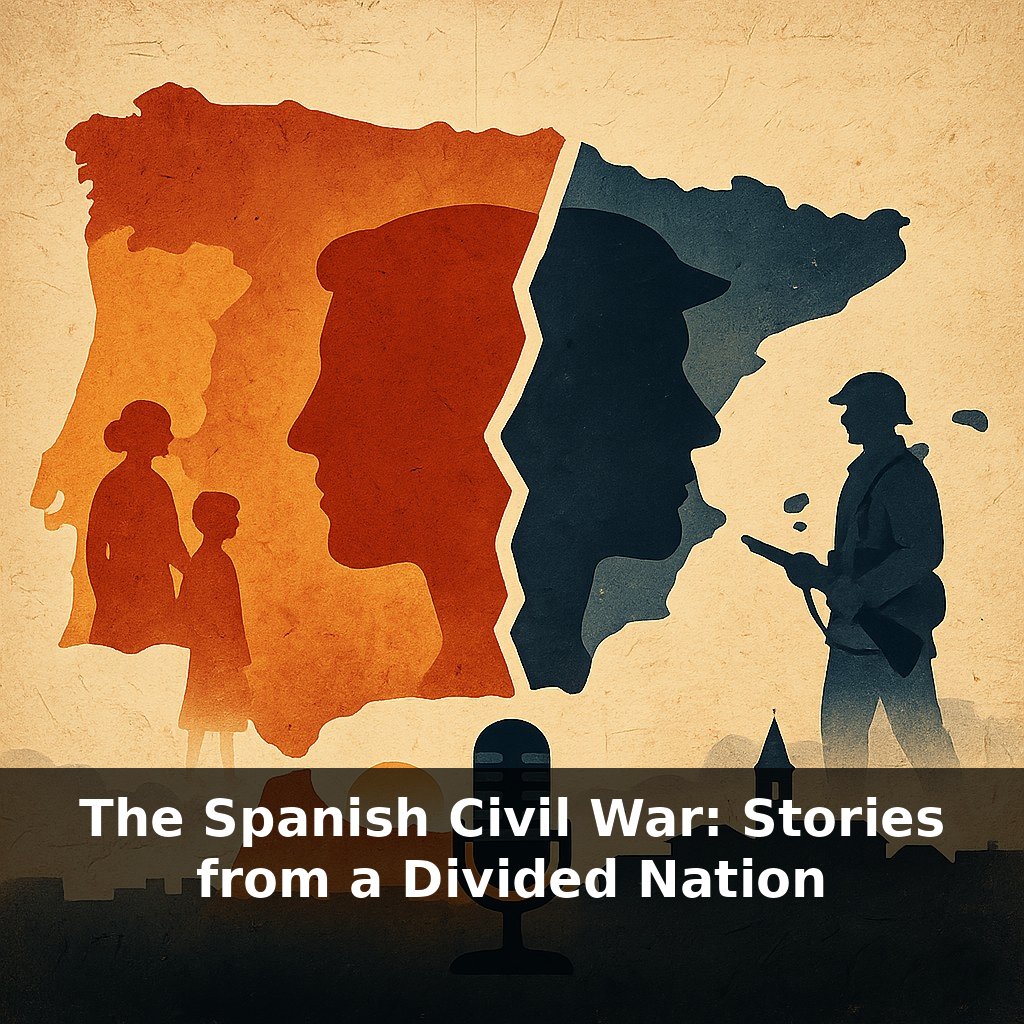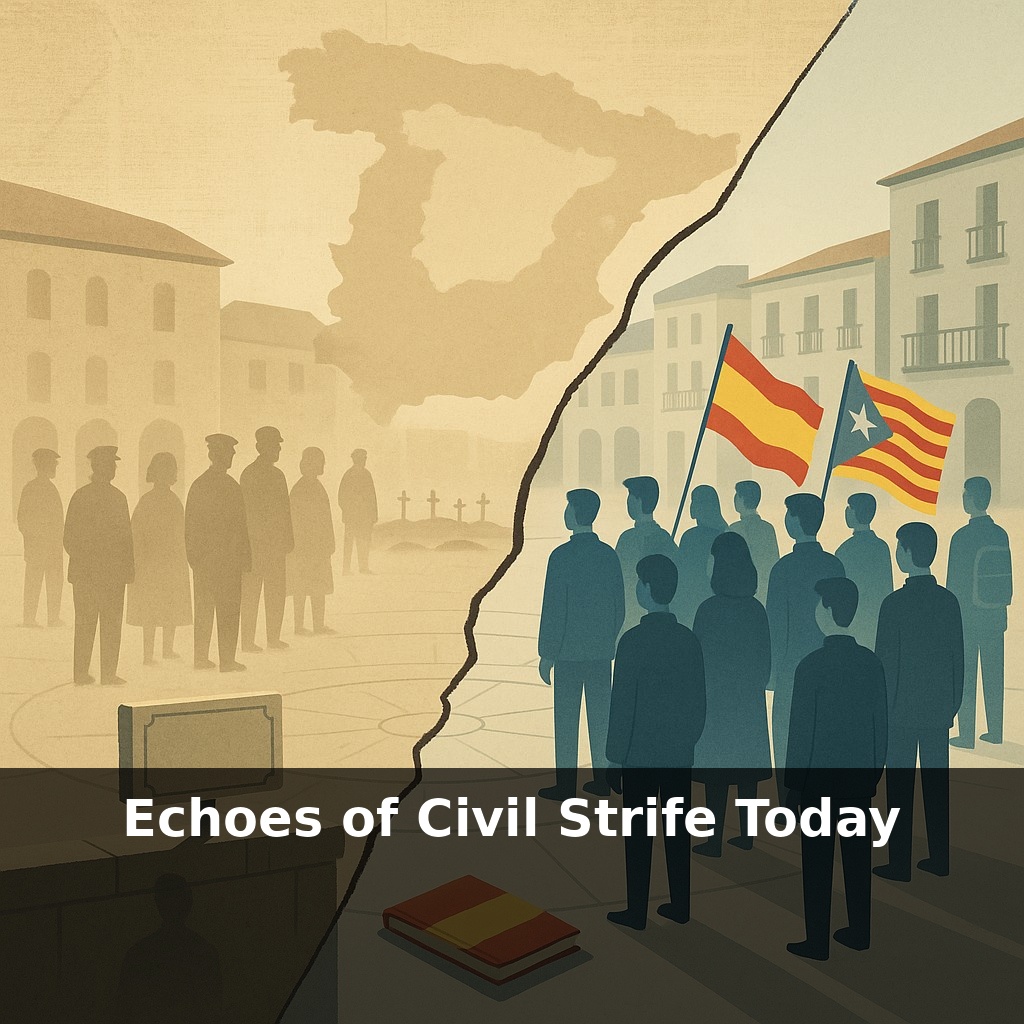
More than a hundred thousand Spaniards still lie in unmarked Civil War graves. Now jump to a modern election night: crowds argue over Catalan flags, church privileges, street names. Different battles, same invisible fault lines—how can a war that ended decades ago still choose the sides?
In today’s Spain, the past doesn’t just live in history books; it quietly shapes who gets a plaza named after them, which language is welcome in school, and what counts as “patriotism.” When a town council votes to rename an Avenida del Generalísimo, it isn’t only debating a street sign—it’s negotiating whose grandparents were heroes and whose were victims. Parliamentary arguments over Catalan independence or regional financing often carry an extra, unspoken layer: older family stories about “reds” and “nation-saving” generals. Even where no one mentions the war aloud, it works in the background like a software update you never saw download but suddenly notice in the way your system behaves—who trusts the state, who fears central power, and who demands a public reckoning.
Walk through a Spanish town today and you might pass a school where classes are taught in Catalan or Basque, a plaza where a statue quietly vanished last year, and a church that still hosts official ceremonies. Each of these choices rests on decades of argument about how to live with a past split between victims, victors, and those who kept silent. Since Franco’s death, Spain has alternated between pact-style forgetting and bursts of “let’s finally talk.” Governments swing between funding exhumations and tightening budgets, as if turning a dimmer switch on how brightly the past should shine into daily life.
Walk into a town hall where councillors are debating whether to take down a Franco-era plaque. On paper, the motion is about “compliance with the law.” Underneath, it’s about whether the town sees its past as something to honour, to mourn, or to finally interrogate. That’s where today’s “memory wars” in Spain really live: in these ordinary, bureaucratic spaces that quietly decide how history shows up in daily life.
After 1978, the Amnesty Law shielded crimes from legal prosecution, but it couldn’t stop moral and emotional verdicts. Those moved into other arenas. Courts, for instance, became unexpected battlegrounds when judges tried to investigate Francoist repression and ran into legal barriers. Local associations turned instead to international bodies like the UN or Argentine courts, using human-rights frameworks to push where domestic law would not.
Education is another front. The same civil-war episode might be a small paragraph in one region’s textbook and a full chapter, with local names and photos, in another’s. Teachers in Catalonia or the Basque Country often weave in stories of banned languages and clandestine schools; elsewhere, lessons might stress postwar “development” or national reconciliation. So a teenager in Seville and a teenager in Girona can graduate with very different emotional maps of the same twentieth century.
Media and culture amplify these divides. Films like “La lengua de las mariposas” or “Pa negre” spotlight victims and complicity, while some TV debates resurrect old labels—“reds,” “anti-Spanish”—that many thought buried. Social media adds a faster, harsher layer: clips of exhumations, parliamentary shouting matches, or vandalized monuments circulate with partisan captions, turning local disputes into national identity tests.
The regional question intersects with memory too. Calls for Catalan or Basque self-determination are not simply about tax revenue or language policy; for many supporters, they’re also claims that their communities’ suffering under dictatorship was distinct and never fully recognized by the state. For opponents, those same claims sometimes look like a weaponization of history to justify breaking up the country.
Your challenge this week: when you see a news story about Spain—an argument over a flag, a school-language dispute, a row about a statue—pause and ask: “What earlier story about the war or the dictatorship might each side be carrying into this fight, even if no one names it out loud?”
Scroll a Spanish news feed and you’ll see how abstract “memory” turns concrete. A town in Aragón renames a sports centre that once honoured a local Falangist; overnight, its Facebook page fills with grandchildren of victims posting family photos, while others insist “he built our roads.” In Pamplona, a council votes to fund a small plaque listing executed councillors from 1936; right-wing parties walk out, arguing the list is “partial” and ignores priests killed by Republicans. A Madrid school asks students to interview elders about the dictatorship; some bring rich testimonies, others discover their grandparents still refuse to talk. The classroom suddenly mirrors the country: uneven knowledge, awkward silences, sharp emotions. Handling all this is less like choosing a single “true” storyline and more like updating a complex operating system: each patch fixes a bug for some users, risks breaking compatibility for others, and forces everyone to decide which legacy programs they’re finally ready to stop running.
Future implications might hinge less on law than on habits. If Gen‑Z grows up fact‑checking TikToks about the war the way they check transfer rumors in football, distortions lose some power. Courts may cautiously test how far “never again” can go without reopening every wound at once. Meanwhile, series, podcasts, and school projects could normalize asking awkward questions at home—like airing a tense family group chat instead of leaving it on mute forever.
Spain’s next steps may look less like a single grand reform and more like iterative “beta releases”: updated school syllabi here, a local archive going online there, a podcast that nudges one more family to compare stories. None of this guarantees agreement, but it widens the shared screen where competing memories at least have to look each other in the eye.
Try this experiment: For the next 48 hours, every time you see a post or headline about a current political conflict that reminds you of “us vs. them” Civil War thinking, pause and send one sincere, curiosity-based question to someone on “the other side” (a relative, coworker, or online acquaintance) instead of reacting with your opinion. Keep your question grounded in something specific the episode mentioned—like asking how their family history, region, or community news shapes the way they see this issue. Notice how often the conversation shifts from battle mode to story-sharing, and how that changes your own level of tension or certainty. After two days, decide whether this kind of “curiosity interruption” makes you feel more or less pulled into modern echoes of civil strife.