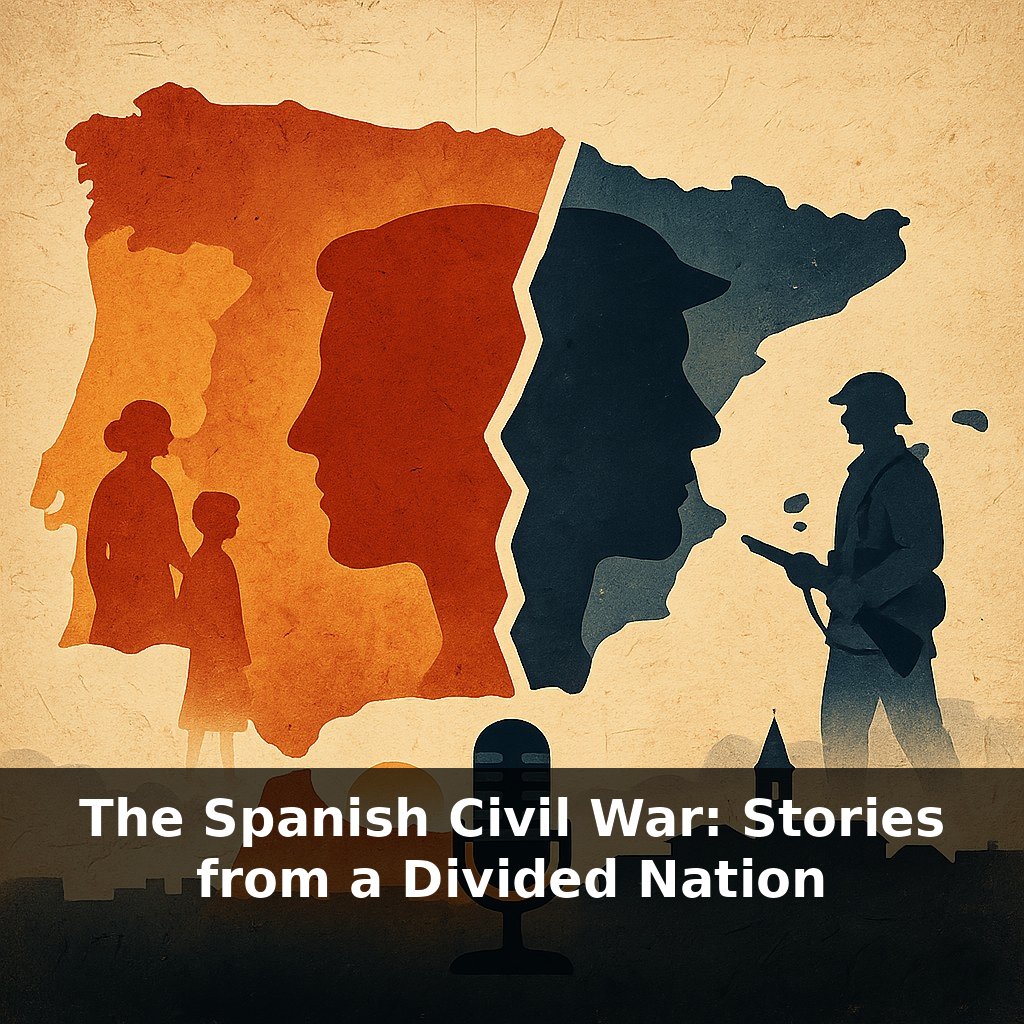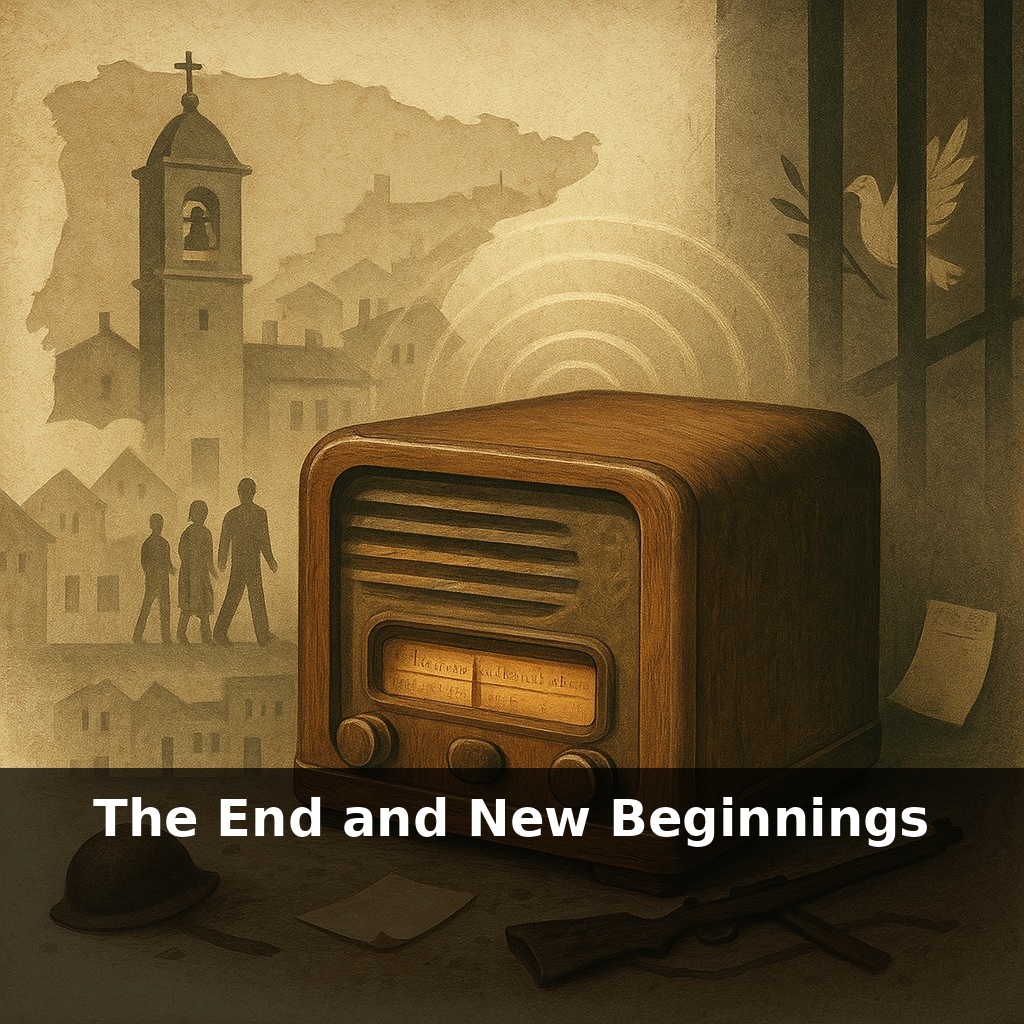
The Spanish Civil War ended with a radio announcement so brief that many listeners missed it—yet it reshaped their lives for decades. As church bells rang and prisoners filled overflowing jails, Spain stepped into a peace that felt, to many, more suffocating than war.
On paper, the war was over. In daily life, it often felt as if the front lines had simply moved indoors—into schools, churches, workplaces, even family dinner tables. Franco’s victory did not just redraw Spain’s political map; it tried to redraw Spaniards’ inner maps: what language they spoke in public, which memories were safe to share, which hopes were too dangerous to keep.
A new, single ruling party claimed to speak for “eternal Spain,” while regional flags, songs, and even names were pushed out of sight. Ration cards replaced ballots; whispers replaced open debate. Some people adapted, some resisted quietly, others collaborated eagerly, betting their future on the regime’s promises.
This episode explores how that post-war order took shape, why economic change arrived so late, and how its legacy still shadows Spain’s arguments about justice, identity, and memory.
Franco’s new regime did not arrive fully formed; it was assembled step by step, like a sprawling building site where blueprints kept changing. One wing housed the official party, the Falange, claiming to embody unity. Another relied on the Church, now restored to a privileged position in schools and public ceremonies. Army officers, monarchists, and conservative businessmen competed for influence in the corridors. Meanwhile, ordinary Spaniards learned to navigate permits, censored newspapers, and neighborhood informers—a daily choreography of caution that shaped careers, friendships, even marriages.
The official end of fighting on 1 April 1939 did not bring a clean break so much as a change in the tools of conflict. Courts, police files, and prison registers replaced trenches and casualty lists. The new state moved quickly to label winners and losers in legal terms: “reds,” “separatists,” “Masons,” “Freemasons,” or simply “suspect.” Special tribunals reviewed people’s pasts, often on the basis of denunciations from neighbors or rivals, producing an enormous machinery of depuration that could strip a person of their job, their pension, or their right to teach or practice law.
Prisons overflowed. Some inmates were awaiting trial, others serving long sentences for vague offenses like “aiding rebellion.” The numbers are debated, but what is clear is that the immediate post-war years were marked by a deliberate strategy to intimidate, humiliate, and exhaust any potential opposition. Public executions and forced participation in “patriotic” ceremonies sent a clear message: dissent was not merely illegal, it was framed as treason against the nation itself.
Beyond the courts, the regime tried to reorder everyday life. Regional languages were banned from schools and official documents. Street names and monuments were altered to honor fallen Nationalists and erase Republican references. Joining official unions and neighborhood associations became almost compulsory if you wanted access to scarce jobs, housing, or food. At the same time, a tightly controlled media environment offered a constant stream of heroic war narratives and moralizing sermons, encouraging people to interpret their own hardships as necessary sacrifices for national redemption.
Yet obedience was never total. In the countryside and mountain regions, armed guerrillas—the maquis—continued to operate, sabotaging infrastructure and attacking outposts. Their support networks depended on villagers who risked severe punishment to provide food or shelter. In cities, more discreet forms of resistance appeared: clandestine political cells, illegal pamphlets, covert aid to prisoners’ families. As years passed and open defiance grew harder, many Spaniards developed quieter strategies of survival—saying one thing in public and another at home, cultivating a double life in which inner beliefs and outward behavior rarely matched.
Think of post‑1940s Spain as code constantly patched but never rewritten: each “update” fixed bugs while hard‑wiring new limits. Early on, black markets became a parallel operating system. Smugglers in border regions moved coffee, penicillin, even nylon stockings; in many towns, everyone knew who could find extra flour or fuel, but no one said their names aloud. Cultural workarounds spread too. In Catalonia or the Basque Country, choirs, hiking clubs, and language circles doubled as semi‑hidden meeting spaces where songs, jokes, and poems carried meanings that would never pass a censor’s desk. Families developed their own encryption: nicknames for banned ideas, coded references to relatives in exile, stories where “a distant kingdom” stood in for a very present dictatorship. Even popular football clubs gained layered significance. A victory for Barcelona or Athletic Bilbao could feel, to some fans, like a small symbolic win for places and identities that official speeches insisted were secondary—or suspect.
Contemporary Spain still negotiates how to live with this past. Court rulings, exhumations, and street‑renaming laws act like incremental software updates, altering how history runs in public space. Younger generations often meet the era first through films, memes, or family silence, then confront archives that feel like a spoiler revealing an alternate storyline. Abroad, Spain’s experience now feeds debates on what to do with toppled statues, encrypted police files, and digital hate campaigns.
Today, arguments over exhumations, school curricula, and amnesty laws act like mirrors, forcing Spaniards to decide which past they can live with. As new archives open and old taboos fray, each generation edits the story again—less like closing a book than updating a shared playlist whose skipped tracks say as much as the songs left on repeat.
Start with this tiny habit: When you close something for the day—like shutting your laptop lid or turning off a light—whisper to yourself, “This is an ending,” and then add one specific thing you’re grateful that it gave you (even if it’s just “it paid my bills” or “it got me through today”). Right after that, say one tiny new beginning out loud, like “Tomorrow I’ll send that email,” or “Next week I’ll look up that class I keep thinking about.” Let this one-sentence pairing—honor the ending, then name the next beginning—be your daily reset ritual.