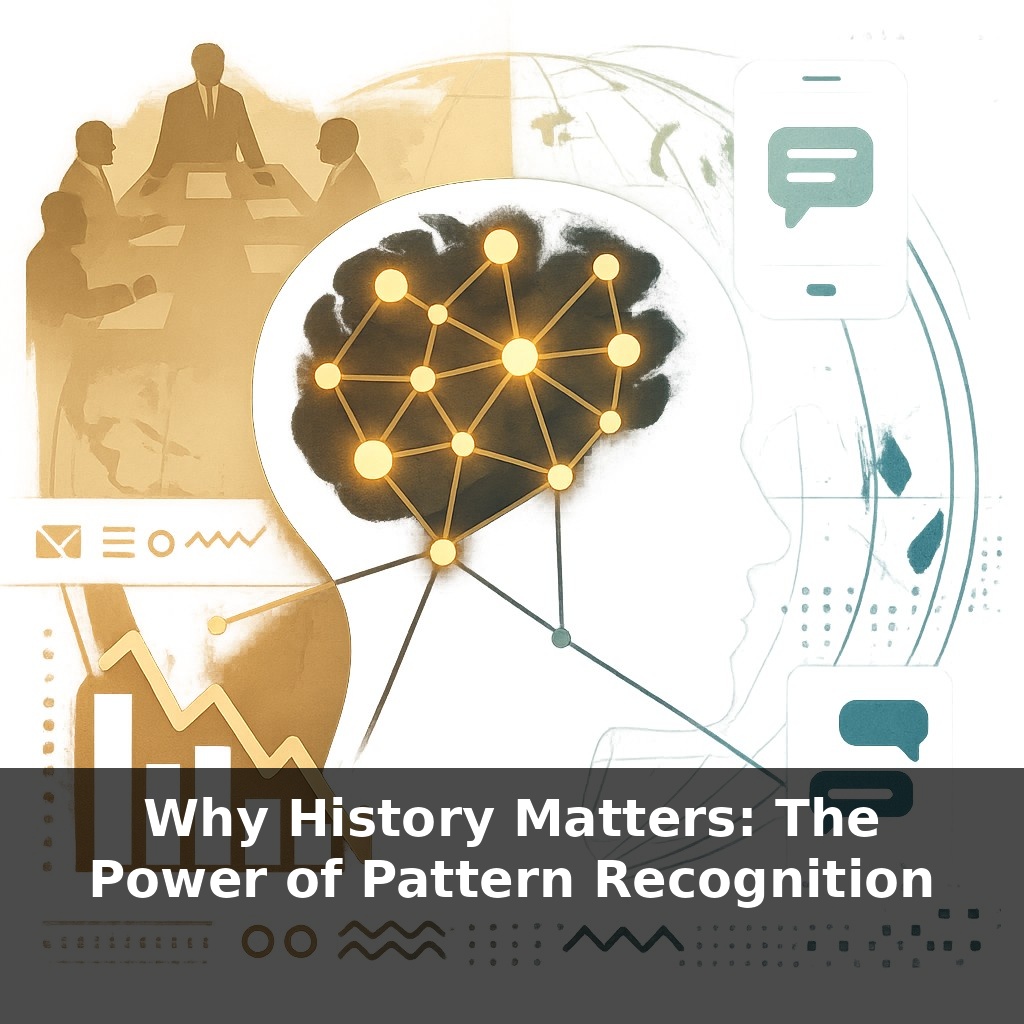
Why History Matters: The Power of Pattern Recognition
📝 Transcript
“Those who cannot remember the past are condemned to repeat it.” Now, jump to a tense cabinet meeting, a volatile market crash, and a viral tweet storm—three different moments, all driven by the same hidden patterns. The mystery is: why do we keep missing the clues?
A 2019 Stanford project fed 15 million old diplomatic cables into machine-learning models—and the system correctly predicted who would form alliances nearly 9 times out of 10. That’s not nostalgia; that’s strategy. History, handled this way, stops being a shelf of stories and starts looking a lot more like a dashboard.
This is where pattern recognition gets practical. Think of a CEO weighing a risky merger, a mayor facing a simmering protest, or a central banker staring down stubborn inflation. None of them are replaying the past. But each is standing in a situation whose dynamics rhyme with earlier ones: similar incentives, fears, bottlenecks, and blind spots.
Historians, especially those teaming up with data scientists, treat those rhymes as testable clues. They don’t just ask, “What happened?” They ask, “When the world was shaped like this before, what tended to follow—and why?”
So when does this actually matter? Usually at the moment things feel “unprecedented.” A tech company facing a wave of user backlash; a startup drowning in sudden demand; a government scrambling during a currency scare. The details are new, but the structure often isn’t: overconfidence before a crash, slow response to early warnings, blame-shifting once costs appear.
Historians map these recurring sequences the way a good doctor tracks symptom clusters. The goal isn’t to script the future, but to narrow the range of surprise—and to spot which “unthinkable” outcomes have, in fact, happened many times before.
When professionals get this right, it looks surprisingly concrete. A 2021 study in Foreign Policy Analysis tracked real-world decision memos and found something striking: when policymakers used historical analogies, their forecasts only improved if they had systematically vetted the comparison. Casual name-dropping—“this is our Vietnam” or “another 2008”—did nothing. But when they checked:
- How similar are the incentives of each actor? - Which constraints match—and which don’t? - What was actually known at the time, versus what we know in hindsight?
…accuracy jumped by 18%. The lesson isn’t “use more history,” it’s “use history with discipline.”
Good historians quietly run a sort of pre-flight checklist. First, they disaggregate the present problem: is this primarily about technology, institutions, social trust, elite rivalry, or something else? Then they search for multiple past cases that share that specific structure. A labor dispute at a gig-work platform might have more in common with 19th‑century railroad strikes than with other modern tech controversies.
Next comes stress-testing the analogue. Where does the past case break? Maybe today’s actors have faster communication, or face different legal limits, or operate under global scrutiny. Those differences don’t invalidate the comparison; they tell you where the old pattern is most likely to distort your expectations.
This is why interdisciplinary methods matter. Quantitative historians mine big datasets for recurring setups and trajectories. Political scientists contribute theories about how coalitions form or fail. Psychologists flag predictable biases—like leaders overreacting to the last crisis they survived. Used together, they turn “this feels like…” into a structured forecast: “In 70–80% of comparable cases, X happened before Y, unless condition Z was present.”
Historical thinking, then, is less about reverence for the past and more about running cheap experiments in your head. Instead of treating every shock as wholly new, you’re quietly asking: “Which shelf of past scenarios does this most resemble—and what usually came next when people ignored, or heeded, those warnings?”
A city planner weighing whether to pedestrianize a major street might start by asking: when did similar moves elsewhere spark backlash, and when did they quietly become beloved? They’d look at cases where shop owners feared revenue loss, then track what happened to foot traffic, rents, and elections five years out. The point isn’t to copy Paris or Bogotá, but to see which combinations of timing, communication, and compensation usually flipped opponents into advocates.
Or take a product manager at a fast‑growing app. Instead of just watching dashboards, they might study earlier waves of tech regulation fights, from railroads to early radio. Who overreached and provoked a clampdown? Who set voluntary standards and shaped the rules?
Reading history is like interpreting long‑term weather patterns: specialists don’t predict tomorrow’s exact storm from a 50‑year‑old chart, but they do know which pressures tend to precede a hurricane—and when you’re standing on a familiar shoreline.
Soon, the most valuable leaders won’t just “know history”; they’ll be able to query it. Think of boards asking, “Show us ten past moments when supply chains cracked like this—what did survivors do differently?” or city councils running scenario drills the way hospitals run mass‑casualty exercises. As archives become searchable like code repositories, the competitive edge shifts to those who can frame sharp questions, spot weak parallels, and walk away from seductive but misleading echoes.
History turns into a living lab when you treat each crisis, launch, or election as one more data point in a long-running experiment. The goal isn’t certainty; it’s to shrink the fog just enough to steer better. Your challenge this week: when you spot a déjà vu moment, don’t dismiss it—write it down, then hunt for three past cases that rhyme.
Unlock all episodes
Full access to 7 episodes and everything on OwlUp.
Subscribe — $1.99/monthLess than a coffee ☕ · Cancel anytime