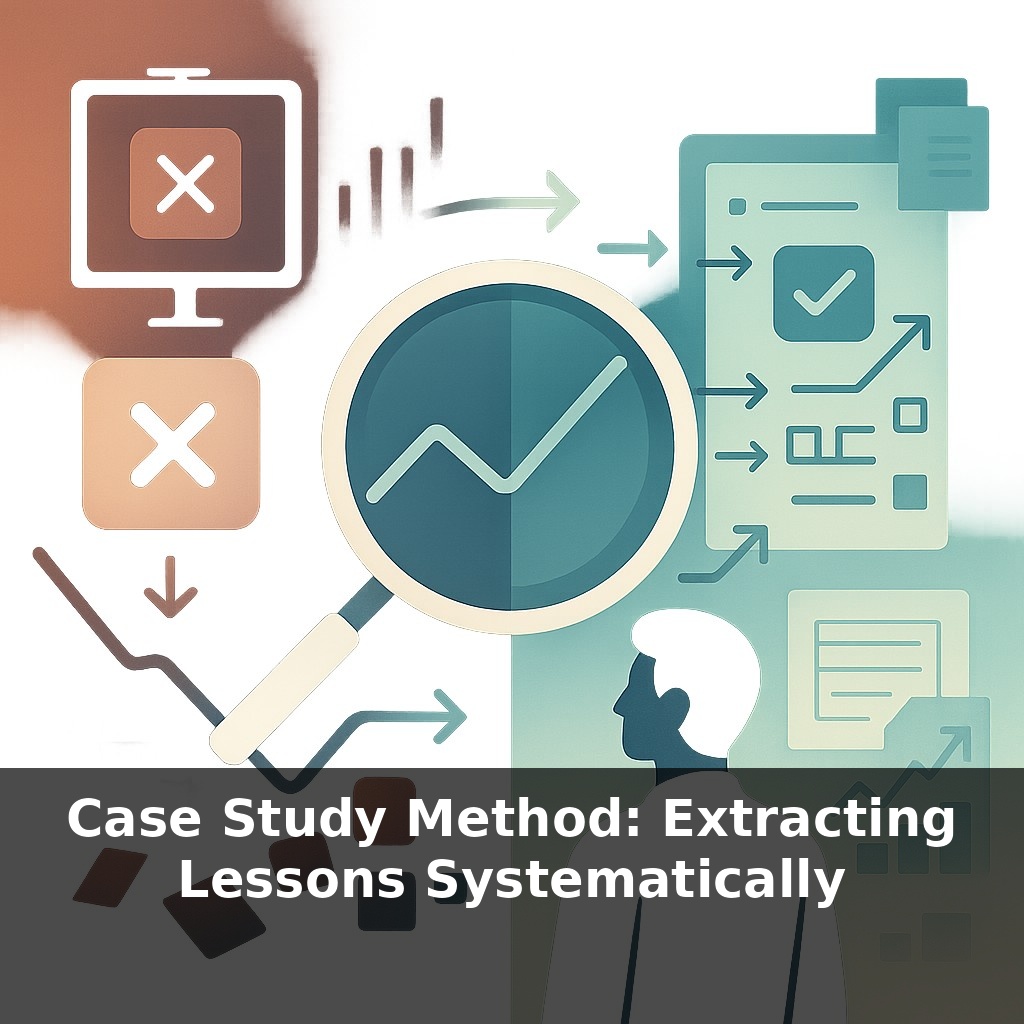
A single failed product launch can teach more than a semester of theory—if you know how to dissect it. A CEO bets big, the campaign flops, and the board panics. One team shrugs and moves on. Another turns that flop into a step‑by‑step playbook for their next win.
Most people treat a historical episode like a story: beginning, middle, end, moral. The case study method treats it like a structured experiment you didn’t have to pay for. Instead of asking, “What happened?” you ask, “What decision did someone face, what options did they see, which did they choose, and what followed?” That shift turns narratives into reusable tools. A merger, a coup, a pandemic response—each becomes a kind of recipe you can test, modify, or reject. Crucially, this isn’t about cherry‑picking examples that confirm what you already believe. It’s about systematically collecting evidence, comparing rival explanations, and seeing which patterns hold up when you change the time period, the actors, or the stakes. Done well, case work turns scattered historical episodes into a cumulative stock of know‑how you can actually apply when you’re on the hook for a decision.
In practice, this is why business schools churn out hundreds of new cases a year and why militaries maintain vast case libraries: they’re not preserving stories, they’re stockpiling decision tests. A good case doesn’t just say, “Here’s what leaders did”; it freezes the moment before a choice and forces you to live with their constraints, blind spots, and pressures. Over many cases, you start to notice recurring moves—how certain coalitions get built, how risks are framed, how timing quietly shapes outcomes—much like a seasoned cook who can spot a doomed recipe from the first few steps.
Robert Yin once argued that the power of a case isn’t in its drama, but in its “how” and “why” questions. That’s the mindset shift: instead of asking whether something worked, you probe the mechanism that made it work here, now, under these conditions.
To do that systematically, case work usually moves through four tight moves:
First, you bound the case. You decide precisely what episode you’re studying, where it starts and ends, and which actors matter. The 2008 financial crisis isn’t a case; “the decision by Firm X to hold or dump mortgage‑backed securities between March–September 2007” is. Clear boundaries stop you from smuggling in convenient hindsight.
Second, you map the decision space as it looked then, not as it looks to you now. What information was available? What did different players believe? Which options seemed realistic? That’s why serious case research digs into memos, minutes, interviews, and contemporaneous media—not just later memoirs.
Third, you trace the chain of events in detail. This is where process tracing comes in: you line up actions, reactions, and contextual shifts, then test rival mini‑theories against that sequence. Did the policy fail because of flawed design, poor implementation, or an external shock? A strong explanation has to survive contact with the fine‑grained timeline.
Fourth, you extract claims that travel. You’re not trying to produce a slogan like “diversify suppliers” or “communicate more.” You’re looking for conditional lessons: “In markets with X and Y features, delaying announcement tends to backfire because Z.” Those if‑then‑because statements are what let a logistics manager, a school principal, and a foreign minister all draw value from a case that didn’t happen in their domain.
This is why institutions invest in case libraries. Harvard’s hundreds of new cases each year, or the U.S. Army’s thousand‑plus operational studies, aren’t random war stories and business dramas; they’re inputs for pattern recognition. When firms in that Academy of Management study built structured reviews into their culture, their success rates rose not by magic, but because each project enlarged a tested catalogue of mechanisms, pitfalls, and workable moves they could reach for under pressure.
Consider how airlines investigate near-miss incidents. After a runway confusion scare, one carrier pulled flight recordings, tower transcripts, crew interviews, and weather data—not to assign blame, but to reconstruct the moment pilots had to choose between go‑around or landing. That single case led to a revised approach checklist and subtle cockpit layout tweaks; months later, another crew facing low visibility used that new checklist to break off a risky approach earlier.
Or take a city that overhauled its snowstorm response after an infamous traffic gridlock. Officials bounded the case to a 36‑hour window, then walked through timing of school closures, salting routes, media alerts, and bus dispatches. Their key exportable lesson wasn’t “prepare more,” but a specific trigger rule: when forecasts cross a defined probability band, they pre‑position plows and stagger dismissals. The next winter, applying that rule cut commuter delays by half—even though the storm was technically worse.
AI tools will soon scan meeting notes, emails, and news in minutes to flag “hidden cases” you didn’t know you had. Leaders might query: “Show me three past crises where we misread early signals,” then walk through VR reconstructions that restore pressure, noise, and partial information. Over time, linked mega‑cases—across cities, sectors, even countries—could work like a shared climate model, stress‑testing today’s plans against thousands of yesterday’s close calls.
Treat each past event less like a closed story and more like dough you can keep folding: new layers appear as you press on causes, context, and constraints. Your future edge won’t come from remembering more dates, but from stockpiling tested “if‑then‑because” patterns you can stretch across domains when the next uncertain decision lands on your desk.
Before next week, ask yourself: “Which 1–2 real situations from my own work or life feel ‘case-study worthy’ right now (a success, a failure, or a recurring pattern), and what actually happened step-by-step if I replay it like a scene in a documentary instead of a highlight reel?” Then ask: “If I separate the ‘surface story’ (who said what, the outcome) from the ‘mechanics’ (the incentives, constraints, information gaps, and timing), what 2–3 specific levers do I see that really drove the result?” Finally: “If this exact scenario showed up again next month, what concrete decision rule, checklist, or ‘if X, then I do Y’ principle would I test, based on what this mini case study just taught me?”