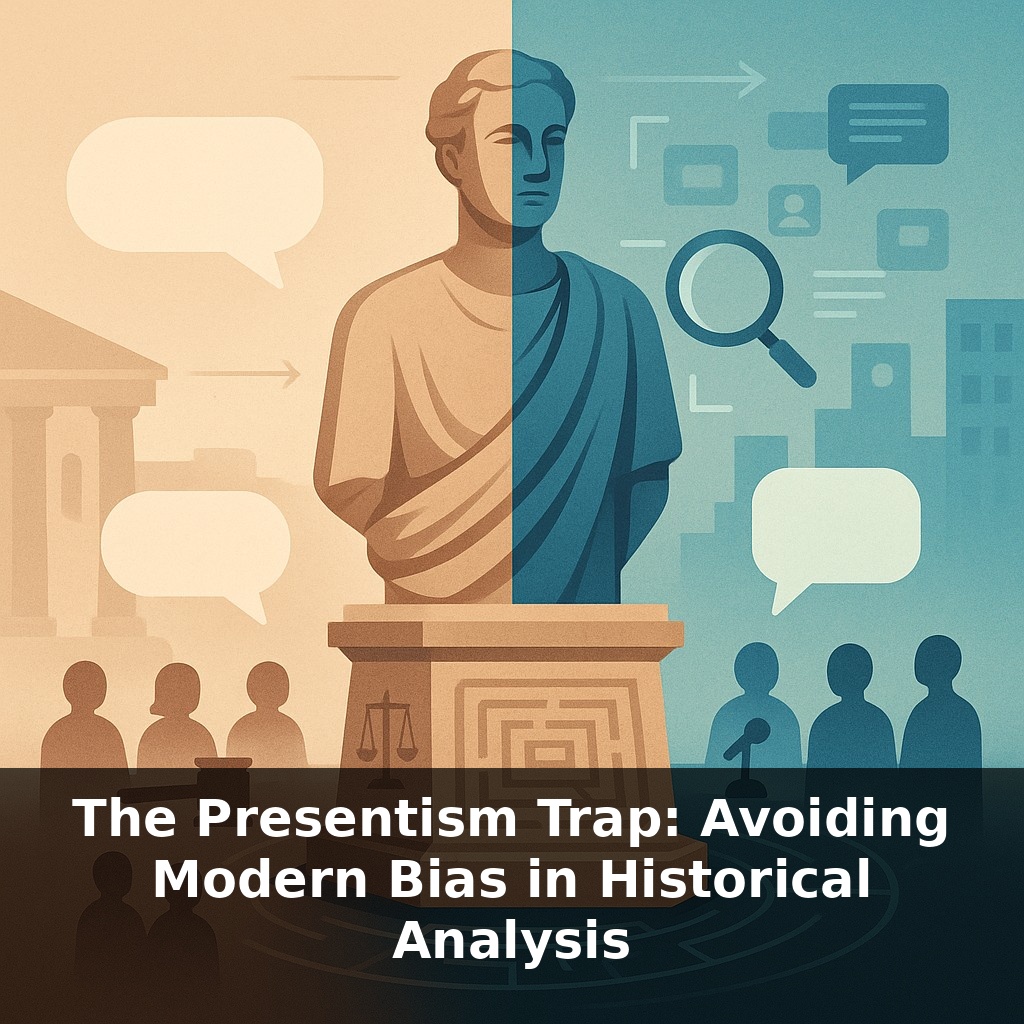
About half of people in a recent poll said they’d rather add context to controversial statues than tear them down. Now drop into a city council meeting: one side yells “erase the past,” the other “honor our values.” The real tension? We’re judging history with today’s rules.
Nearly every heated argument about the past hides a quiet assumption: that our current values are the finish line of moral evolution. From school curriculums to social media pile‑ons about historical figures, the script is often the same: “We know better now, so the verdict is obvious.” But history resists being turned into a simple courtroom drama with us as the all‑knowing jury.
Professional historians work differently. They ask: what options did people *think* they had? What counted as “common sense” or “morally obvious” to them? That doesn’t mean excusing atrocities; it means first understanding the mental world in which choices were made.
This episode is about dodging the presentism trap: learning to hold two thoughts at once—moral clarity about harm, and intellectual humility about how differently people once saw the world.
Historians sometimes call presentism a kind of “time travel arrogance”: we stroll into another era, declare the good guys and bad guys, and leave without learning much. Herbert Butterfield warned about this in 1931, and it’s still a live debate in today’s journals and classrooms. The alternative isn’t moral silence; it’s disciplined curiosity. Before passing judgment, you ask: what did this person know, fear, and take for granted? Like a careful physician, you try to understand the whole situation before deciding what went wrong—and what could realistically have gone differently.
When historians warn about presentism, they’re not defending the past; they’re defending *evidence*. The core worry is simple: if you walk into another century already convinced you know who everyone “really” was, you stop seeing what the sources are trying to tell you.
A practical way around this starts with a shift in questions.
Instead of: - “How could they be so evil/ignorant?” try: - “What problem did they think they were solving?”
Instead of: - “Why didn’t they just do X?” ask: - “Did anyone around them even imagine X as an option?”
That change pulls you from verdicts toward mechanisms: institutions, incentives, fears, and blind spots. It’s the difference between saying “they were monsters” and noticing, for example, that legal systems, economic structures, and religious doctrines all narrowed what felt possible.
This is where contextualization gets concrete. Historians reconstruct: - **Information environments** – What news, rumors, and data were available? Who controlled them? - **Social penalties** – What did you risk by dissenting? Prison? Exile? Losing your livelihood? - **Moral vocabularies** – What counted as a recognized “wrong”? What harms had no language yet? - **Material constraints** – Technology, transport, communication, money: what physically could or couldn’t be done?
Think of it like diagnosing an illness: a good doctor doesn’t just ask, “Is this patient healthy by today’s ideal standard?” They ask, “Given this body, history, and environment, what actually happened—and what was preventable at the time?” You still end up saying, “This was harmful”; you’re just precise about *how* and *why*.
This precision matters because presentism doesn’t only distort villains; it distorts reformers too. Praising a historical figure for holding all your current views can be as misleading as condemning someone for not holding them. Often, the most interesting people are those who pushed *one* boundary while accepting many others we now reject.
Another pitfall: using the past mainly as a mirror for today’s debates. That’s where that survey of recent history articles is instructive: only a minority used explicit contemporary moral frameworks, and even then, the better ones kept tight to archival ground. The moment a narrative starts sounding too neatly aligned with a present agenda—left, right, or corporate brand strategy—you should suspect that context is being trimmed to fit.
Avoiding presentism, then, isn’t a ban on judgment. It’s a method: slow down, widen the frame, and let the dead be strange before you decide what they mean for the living.
Consider three quick cases. First, debates over 19th‑century factory workers: if you start by asking, “Why didn’t they just unionize and win better rights?” you’ll miss that in some regions, organizing was criminalized, newspapers were censored, and many workers believed child labor was simply family survival. The interesting question becomes: who *did* see alternatives, and how?
Second, early environmental policy. It’s tempting to fault governments for “ignoring climate change,” but many policymakers in the 1950s had never seen global atmospheric models. Their “pollution” worries were smog you could taste, not CO₂ you couldn’t see. The story shifts from malice to the slower emergence of new kinds of risk.
Third, look at historical heroes. Abolitionists who opposed slavery often defended other hierarchies we now question. Instead of discarding them as “inconsistent,” historians track *which* injustice they could name, with what concepts, and at what personal cost. That pattern—partial breakthroughs inside tight constraints—is much closer to how change usually happens.
Algorithmic feeds increasingly fossilize our moment’s assumptions, then replay them as if they were universal. As AI tools start drafting textbooks, museum captions, even game narratives, whoever sets the “default” moral lens quietly scripts which pasts feel intelligible and which get flattened. Think of training data like soil: if it’s thin, every story grows with the same bent. Rich, multi-period corpora let future systems surface genuinely unfamiliar voices—and preserve their strangeness.
Treat past eras like unfamiliar cuisines: don’t rename every dish to match your favorite takeout. Let odd ingredients, lost techniques, and vanished tastes stand before rating them. Your challenge this week: when a historical story angers or inspires you, pause once to ask, “What were the live options here?”—then adjust your verdict, even slightly.