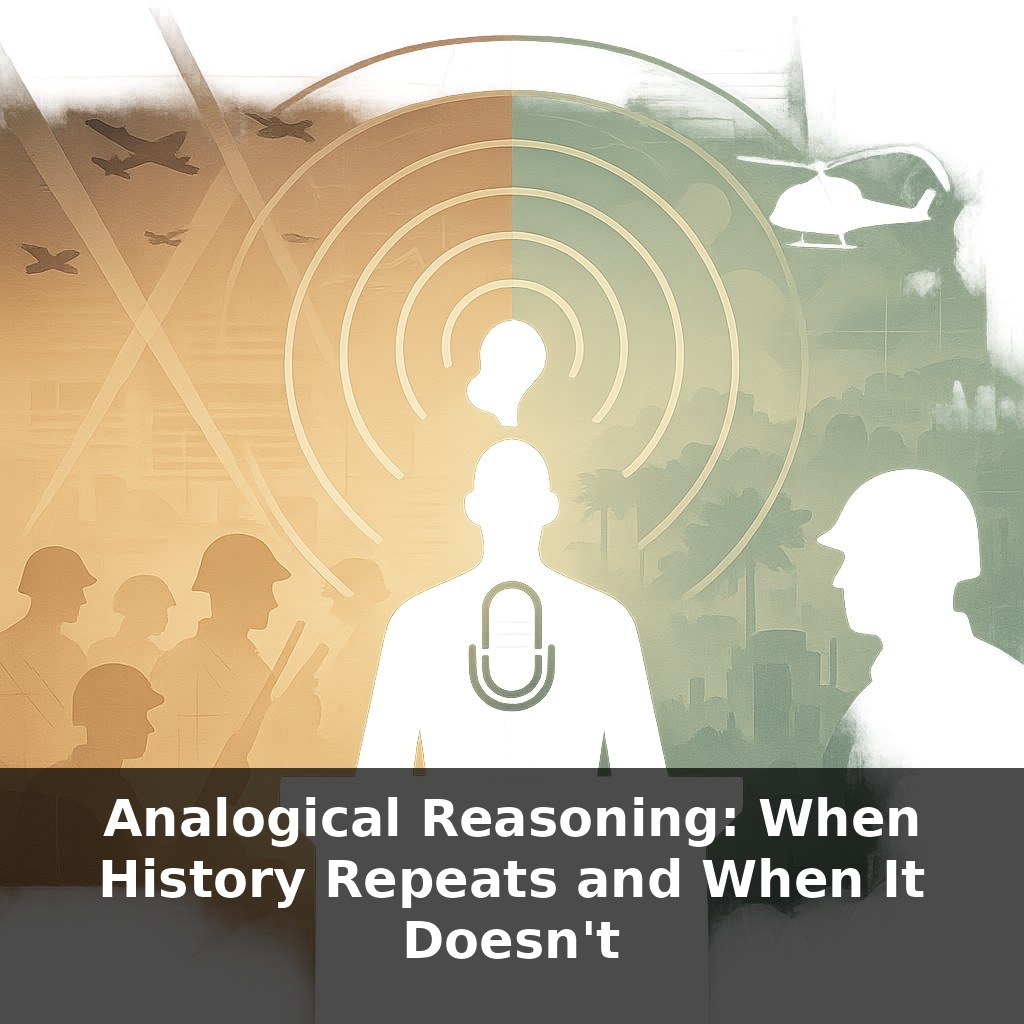
About half of U.S. foreign‑policy speeches quietly lean on a historical analogy. In one, a crisis is “another Munich.” In another, it’s “our generation’s Vietnam.” Same headlines, opposite lessons. The puzzle for this episode: when does history rhyme—and when are we forcing the echo?
Sixty‑eight percent of major U.S. foreign‑policy speeches since 1945 reportedly lean on at least one historical comparison—and that’s just the official record. In practice, leaders, pundits, and even friends at dinner tables reach for the past constantly: the “new Cold War,” “another Iraq,” “a second 2008.” But here’s the twist: the danger isn’t using history; it’s using it lazily. Cognitive scientists like Dedre Gentner find people are impressively good at spotting *deep* parallels when prompted—but they’re easily distracted by superficial look‑alikes. That means your mind can do the hard work; it just often doesn’t. This episode asks: how do you train that deeper pattern recognition so you’re not fooled by familiar labels? How do you decide when a comparison sharpens judgment—or quietly hijacks it?
So the real question isn’t “Should we compare?” but “What, exactly, are we comparing?” Historians quietly do something most of us skip: they map cause‑and‑effect first, labels second. Instead of asking, “Is this another X?”, they ask, “What forces are actually moving here—institutions, technology, public mood, economic constraints, time pressure?” Think of it less like matching headlines and more like tracing wiring behind a wall: which circuits connect, which don’t, and which new lines didn’t even exist last time we faced something that merely *sounds* similar.
Start with a strange fact: in Dedre Gentner’s lab studies, people *can* pick the right comparison most of the time—*if* the task forces them to spell out relationships step by step. In free‑for‑all real life—headlines, meetings, crises—that structure usually stays hidden, so superficial matches sprint ahead of better but less obvious ones.
Historians cope with this by quietly running three filters.
**Filter 1: Roles, not labels.** Instead of asking, “Is this leader like Churchill?” they ask, “Who is constrained, who has initiative, who needs whose resources?” The names change; the roles—hegemon, challenger, swing actor, spoiler—often don’t. If you mix up the roles, you’ll import the wrong script. Calling something a “new Cold War,” for example, skips over whether today’s rival is actually ideologically universalist, nuclear‑peer, and locked in a zero‑sum alliance system—or primarily an economic competitor inside the same global market.
**Filter 2: Mechanisms, not moods.** Fear, anger, hope show up everywhere, but they don’t *do* the same work. A frightened public in a conscript army democracy behaves differently from a frightened public in a professional‑military, low‑casualty environment. Same emotion, different political translation. So a historian will ask, “Through what channels does this emotion convert into action here—elections, markets, coups, street protests—and were those channels the same last time?”
**Filter 3: Constraints, not headlines.** Technology, logistics, and timing quietly dictate what is even possible. Railroads versus airlift. Weeks‑long information delays versus live video. Dollar reserves versus gold. When someone says “this is another 1930s,” the first historian’s question is often: “Do we even have the same financial plumbing or military logistics that made those options live?” If not, the old solution set may be closed, and the old failure modes too.
Here’s where your own reasoning often goes off track: you import an outcome along with the story. “Last time a country did X, it slid into quagmire—so that must be what happens now.” But historians treat outcomes as *hypotheses* about mechanisms, not templates. They ask: “If we remove one element that was crucial last time—say, draft conscription, or a fixed exchange rate—does the old chain of events still run, or does it stall halfway?”
A useful check is to flip the analogy against itself: “If I didn’t know how the earlier case ended, would I still think these two situations belong in the same family?” If the comparison only feels strong because you already know the punchline, that’s a warning that you’re being steered by narrative gravity, not by structure.
A quick way to feel the difference is to watch how analogies behave in domains where you *can* check the result. Take the rush, early in COVID‑19, to call it “another 1918.” Some commentators jumped straight from the label to prescriptions: close schools the same way, expect a brutal “second wave,” brace for a decade of gloom. Others quietly asked: what’s the incubation period now, how fast can tests be deployed, what tools do ICUs actually have, how does global travel redraw the map of spread? They weren’t denying the comparison; they were pruning it.
You see the same split in business. A startup pitches itself as “the next Amazon,” so investors import a growth arc and tolerance for losses that made sense in the late 1990s but not in a saturated, data‑rich market. The sharper ones ask instead: who controls logistics, who owns the customer relationship, what frictions dominate this sector? That’s how some firms used “another 2008” to de‑risk balance sheets early in 2020—while others clung to the headline and missed how stimulus, not austerity, was now the default reaction.
Narrow, well‑vetted analogies will become a kind of cognitive exoskeleton: humans deciding where to look, AI hauling in candidate episodes we’d never recall on our own. But this raises new risks. An opaque model suggesting “cases that look similar” can freeze debate, the way a GPS voice can silence arguments over which road to take. The frontier skill won’t be spotting echoes; it will be *arguing with the echoes*—asking who trained them, whose values they encode, and what they’re quietly leaving out.
Treat each analogy as a provisional recipe, not a sacred script: taste, adjust, and sometimes throw it out. As archives digitize and models scrape centuries in seconds, you’ll be offered more “rhymes” than ever. The real skill is staying curious enough to ask, each time: what’s truly the same here—and what’s just a comforting, familiar garnish?
To go deeper, here are 3 next steps: (1) Read Yuen Foong Khong’s *Analogies at War* alongside the Cuban Missile Crisis chapter in Graham Allison’s *Essence of Decision*, and make a side‑by‑side comparison of how different historical analogies (Munich vs. Pearl Harbor) led to opposite policy intuitions. (2) Install and try the “NewsGuard” or “Ground News” browser tools, then pick one current conflict and deliberately test 2–3 historical analogies you see in headlines (e.g., “is this really another Vietnam/Munich/Cold War?”) using Wikipedia and the *Oxford Research Encyclopedia of International Studies* to quickly fact‑check similarities and differences. (3) Watch the “Thinking in Bets” talk by Annie Duke on YouTube, then grab any recent policy op‑ed that leans on a historical analogy and explicitly list its assumptions about “what’s the same” and “what’s different,” rating each on a 1–5 scale for plausibility to train your analogical skepticism.