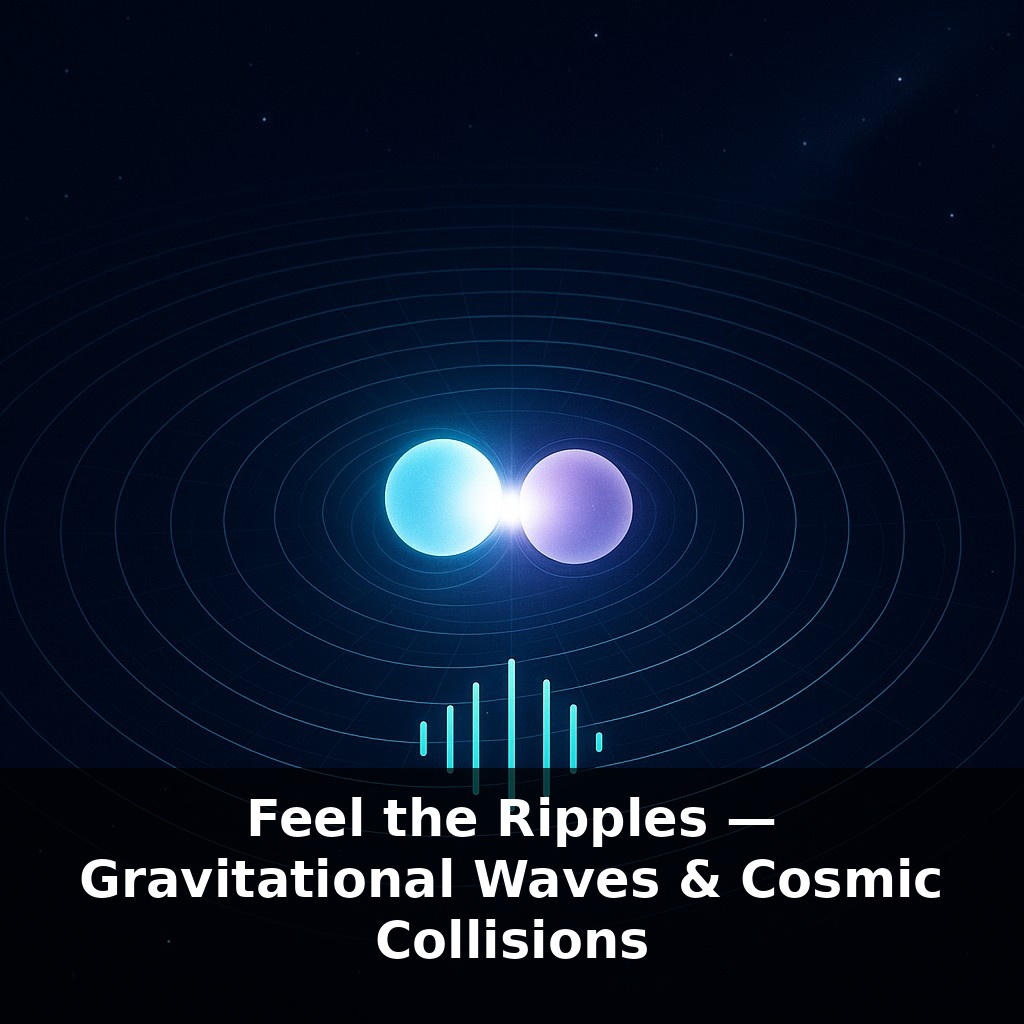
Right now, somewhere in the universe, two dead stars are colliding so violently that, for a heartbeat, they outshine every galaxy combined. Yet no telescope can see that moment. In this episode, we’ll learn how we *feel* those invisible cosmic crashes through spacetime itself.
For most of human history, the universe was whatever our eyes could catch: starlight, nebulae, galaxies, and, eventually, the faint glow of the cosmic microwave background. But light only tells part of the story. Some of the most dramatic events in the cosmos barely flicker electromagnetically, yet they shake the universe so thoroughly that space itself stretches and squeezes. In this episode, we step beyond “seeing” the universe and into *listening* to it. We’ll follow how laser interferometers on Earth detect shifts thousands of times smaller than a proton, how a single collision can briefly outshine all stars in gravitational-wave power, and how timing the steady ticks of distant pulsars lets us sense a low hum from countless mergers spread across cosmic time. Bit by bit, we’re learning to read the universe’s soundtrack, not just its scenery.
When LIGO first reported a detection in 2016, it wasn’t just a new data point; it was a new *sense* for astronomy. Until then, our picture of the universe came almost entirely from photons—radio to gamma-rays. Now, astronomers coordinate “multi-messenger” campaigns: when a gravitational-wave alert goes out, telescopes worldwide swing toward the patch of sky where the disturbance came from, hunting for flashes from merging neutron stars or flares from disrupted matter. Each detection refines models of how heavy elements form and how often massive binaries collide across the universe.
Gravitational waves are described by a “strain,” written h: a dimensionless number telling you what fraction a distance is stretched or squeezed. The kind LIGO usually sees are around h ~ 10⁻²¹ by the time they reach Earth. That sounds abstract, so let’s anchor it: over LIGO’s 4 km arms, that translates into a ΔL of only about 4×10⁻¹⁹ meters—roughly a ten-thousandth of a proton’s diameter. Yet with enough laser power, isolation from noise, and clever data analysis, that tiny shiver is extractable from the chaos of ground motion, thermal jiggles, and even quantum fluctuations of light.
Each detected waveform is like a snippet of music from the cosmos. From its “pitch” and how that pitch sweeps upward, physicists can infer the masses and spins of the colliding objects, how far away the event was, and sometimes even how matter behaved at densities beyond anything reachable on Earth. GW150914, the first published detection, revealed two black holes heavier than many theorists expected to find in a binary, resetting ideas about how massive stars live and die in different environments.
Not all signals are isolated chirps. Some sources would hum continuously: a slightly lumpy neutron star spinning rapidly could send out nearly monochromatic waves for millions of years. Others, like supermassive black-hole binaries in distant galaxies, contribute to a background of overlapping signals. That’s where pulsar-timing arrays come in: by tracking the arrival times of radio pulses over decades, they’ve become sensitive to a gravitational-wave background with characteristic strain around 10⁻¹⁵ at periods of about ten years—far lower in “frequency” than ground-based detectors can probe.
The global network—LIGO in the U.S., Virgo in Italy, KAGRA in Japan—aims for more than 75% coincident observing time. When multiple detectors are operating together, they can triangulate where a signal came from and test whether it really matches General Relativity’s predictions. As the network grows, so does the volume of space we can “hear,” and the odds of catching rarer events: intermediate-mass black-hole mergers, asymmetric explosions, or entirely new categories of source.
Think of the current detector network as an evolving orchestra rather than a finished instrument. Ground-based facilities like LIGO and Virgo are “listening” to stellar-mass collisions, while future space missions such as LISA will be tuned to far slower, deeper notes from gigantic black holes millions of times the Sun’s mass. Even lower, pulsar-timing arrays trace a bass line stretching across decades, hinting at an ocean of supermassive binaries in merging galaxies. Together, these bands of frequency form a kind of gravitational-wave spectrum, much like the electromagnetic spectrum you meet in ordinary astronomy.
This layering matters. By catching similar types of systems at different stages and scales, we can reconstruct how black holes grow from stellar remnants into the monsters at galactic centers, and how often galaxies themselves collide. Subtle mismatches between predicted and observed signals could flag new physics—extra fields, hidden dimensions, or failures of General Relativity under extreme conditions—giving us a rare way to probe gravity where it’s strongest.
Each new detection is more than a “ping” from afar; it’s a data point in a growing cosmic census. As sensitivity improves, we’ll map how often black holes pair up, how galaxies assemble, and whether gravity ever bends the rules we’ve tested locally. Like adding deeper bass and brighter treble to a recording, future detectors will fill in missing notes from the universe’s earliest acts, letting us replay chapters of cosmic history that no light could ever have preserved.
As detectors sharpen and networks grow, we’ll start catching subtler tremors: newborn black holes ringing like struck bells, spinning remnants slowly shifting pitch as they cool, even hints of waves from the universe’s first seconds. Your challenge this week: follow one real gravitational-wave alert online and trace how its story unfolds.