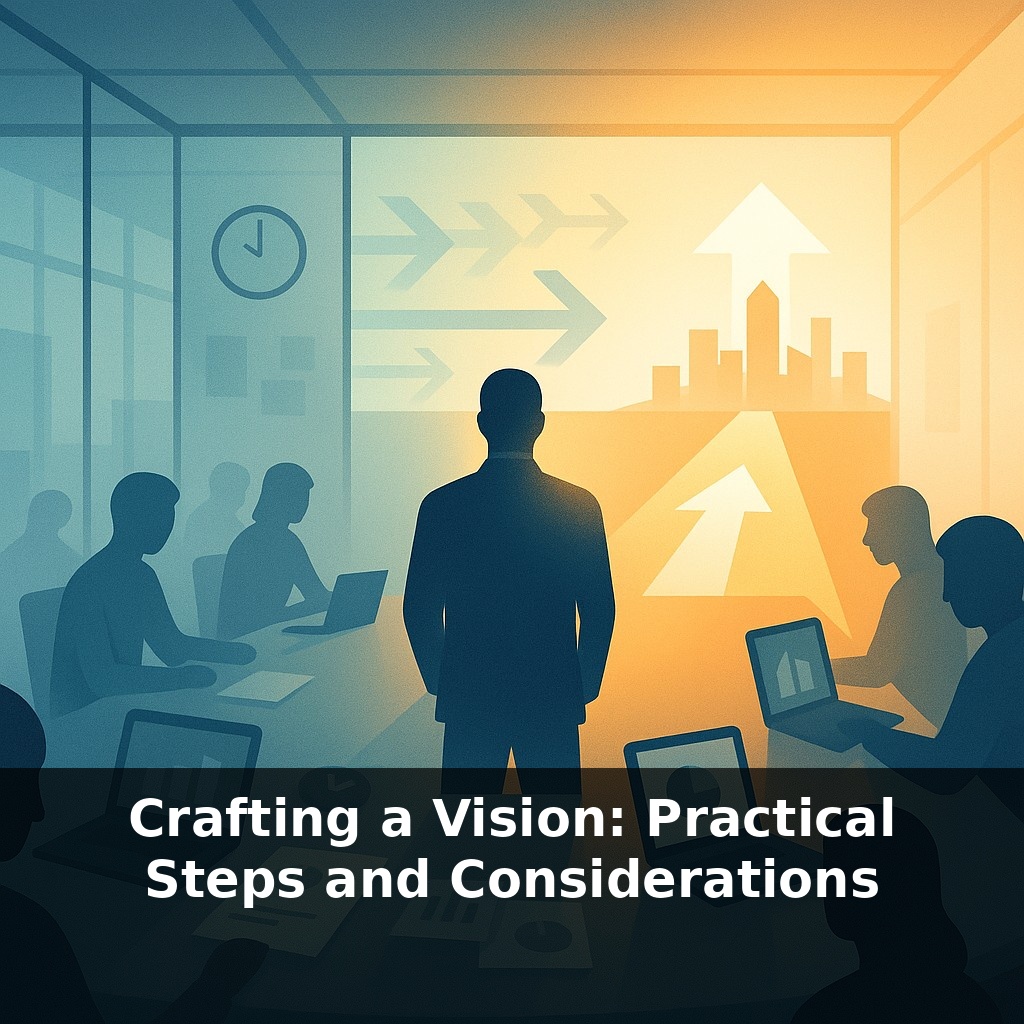
“Only about one in five employees thinks their leaders know where the organization is going. Now, drop yourself into a Monday meeting: endless updates, no clear destination. The paradox? Everyone’s working hard, but the harder they work, the more obvious it feels that no one’s steering.”
So if effort isn’t the problem, what is? Research points to something quieter but far more powerful: vision. Not as a slogan on a wall, but as a lived picture of the future that people can see themselves in. When it’s absent, teams default to short-term firefighting and local optimizations. When it’s present and clear, you see different behaviors: people decline work that doesn’t fit, they propose bolder ideas, and they can navigate ambiguity without constant escalation.
This isn’t just a “CEO thing.” Whether you lead a company, a function, or your own career, you’re already making micro-choices that add up to a direction. The question is whether those choices are anchored in an intentional vision or just inherited expectations. In this series, we’ll treat vision as a practical leadership skill you can build, step by step, not a mysterious gift some people are born with.
Most leaders try to “fix” this gap with better plans, more dashboards, sharper KPIs. Useful—up to a point. But plans answer “how”; your people are starving for “why” and “toward what?” That’s where a crafted vision comes in. It doesn’t predict the future; it chooses a future worth moving toward. In this series, we’ll treat vision like an architect treats a blueprint: translating fuzzy intent into something others can build against, question, and improve. We’ll start at the foundation—values and strengths—then layer in trends, scenarios, and real-world constraints so your vision is both inspiring and usable.
If you zoom out from the dashboards and roadmaps for a moment, a practical question appears: “Where does this vision actually come from on an ordinary Tuesday?” Not from a silent offsite or a single stroke of genius. In practice, visions start as rough, imperfect drafts stitched together from three kinds of raw material that leaders often overlook:
First, the friction points your people keep bumping into. Listen closely to complaints and workarounds; they’re often negative images of the future people *wish* they were operating in. “Why is it so hard to get a decision?” hints at a vision of faster, more empowered teams. “We never talk to real customers” points toward a more externally oriented future. Treat those irritations as data, not just noise.
Second, the bright spots that already exist. Somewhere in your organization or career, the future you want is already partially alive: a small team that ships faster, a process that delights customers, a side project where you feel “this is what my work *should* feel like.” Instead of dreaming from scratch, reverse-engineer these outliers. What conditions made them possible? If they were scaled 10×, what kind of organization or career would you be looking at?
Third, the edges where your world is colliding with change: new technology, shifting regulations, emerging customer behavior. You don’t need to be a futurist, but ignoring these edges forces your vision to live in a bubble. A leader who never talks with customers, scans industry moves, or experiments with new tools is effectively designing for yesterday.
A useful way to think about this early phase is like refactoring a large codebase: you don’t rewrite the whole system at once; you identify fragile modules, the clean, elegant parts worth preserving, and the new capabilities the environment demands. Then you start drafting a version of the product that could exist if you amplified the good, fixed the brittle, and built for where things are going.
Your challenge this week: for every meeting and 1:1 you’re already having, capture three short notes in a single running document: 1) one recurring friction that, if removed, would noticeably change people’s day-to-day experience; 2) one bright spot that feels like “more of this, please”; and 3) one external shift (customer behavior, competitor move, tech change) that could matter if it accelerated. By Friday, look across your notes and circle the three themes that repeat the most. Those themes are the first, messy contours of a vision worth taking seriously.
Think of a small product team that keeps missing launch dates. They finally pause to map three columns on a whiteboard: daily slowdowns, moments where work flows, and outside shifts they’re noticing from users and competitors. Patterns jump out: approvals jam at one manager, a single cross-functional squad ships in weeks instead of months, and customers have quietly moved to mobile-first. No one says “vision” aloud, but they’ve surfaced raw material for one.
A career example: a manager feeling stuck starts tracking recurring drains, energizers, and market pulls. Over a month, three themes repeat: mentoring lights them up, complex stakeholder politics drain them, and AI is reshaping their field. Those notes don’t yet tell them *what* to become, but they clearly suggest *where not to stay* and *where experiments belong*.
In both cases, the shift isn’t a grand retreat; it’s a disciplined habit of noticing. The draft future emerges from evidence, not wishful thinking.
Those notes you’re collecting are more than complaints and compliments; they’re early warning signals. As AI, climate pressure, and social expectations reshape your landscape, those weak signals often move faster than formal plans. Treat your document like a live radar screen: patterns that keep resurfacing hint at where risks may cluster and where new opportunities might open, long before your org chart or KPIs catch up. Leaders who learn to read that radar don’t just react; they quietly arrive prepared.
Treat this early vision work like tuning an instrument before a performance: small adjustments now prevent chaos later. As patterns solidify, start testing sentences that name the future you’re leaning toward, then watch how people react. Curiosity is your guide—follow the questions that light people up, not just the ones that calm them down.
Here’s your challenge this week: Block 45 minutes today to draft a one-page “Vision Snapshot” for three years from now that includes a specific morning routine, the kind of work you’re doing, who you’re collaborating with, and how many hours you’re working each week. Then, choose ONE area from that snapshot (work, health, or relationships) and reverse-engineer three concrete milestones you’d need to hit in the next 12 months to make it realistic (with dates and rough metrics like hours, revenue, or frequency). Finally, share that one-page snapshot and 12‑month milestones with a trusted friend or colleague and ask them two questions: “What feels unclear?” and “What feels most exciting or believable?”