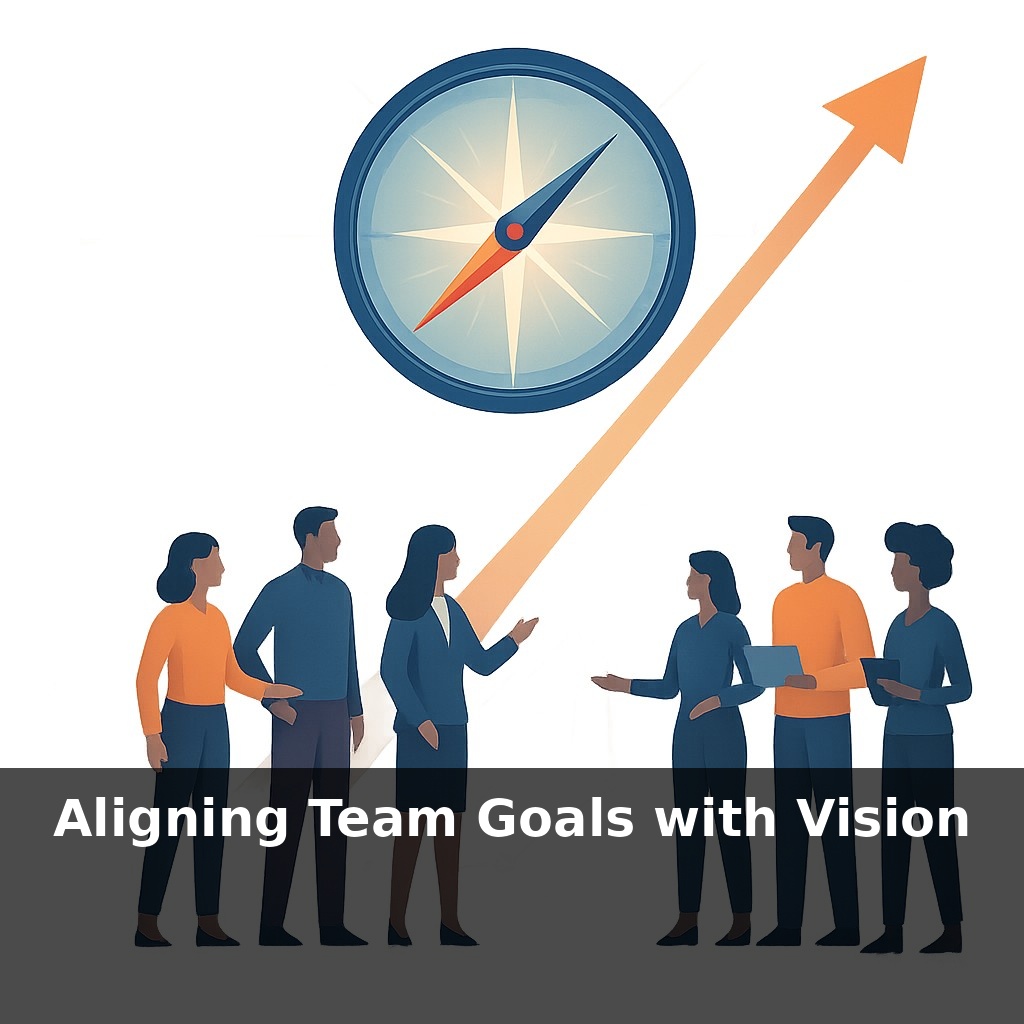
Teams that say their work clearly connects to the company’s vision bring in dramatically higher revenue—yet in many organizations, almost half of team goals quietly drift off-course. You walk into Monday’s meeting feeling productive, not realizing you’re rowing hard in the wrong direction.
Aligned companies grow revenue 58% faster and are 72% more profitable—yet most teams still treat the vision like a poster on the wall, not a daily operating system. The gap isn’t desire; it’s translation. Leaders talk about “north stars,” but teams wake up to calendars, tickets, and fires to put out. The real challenge is turning that high-level direction into choices about what gets done this week, and what doesn’t.
Think of the vision as the source code and your goals as the running app. If the code and the features drift apart, users (your customers and employees) feel it as bugs: conflicting priorities, stalled projects, and endless “why are we doing this?” debates.
This episode is about building the bridge: how to wire your team’s objectives, rituals, and metrics so every sprint quietly reinforces the bigger story you’re trying to tell as an organization.
The leaders who do this well don’t shout the big picture louder—they wire it into how work is chosen, sequenced, and measured. Three things show up again and again in companies like Google, Salesforce, and Patagonia. First, they’ve sharpened the “why” behind their direction until it’s specific enough to say “this fits, that doesn’t.” Second, they use a shared structure—OKRs, V2MOM, or similar—to translate that intent into concrete, trackable outcomes. Third, they treat alignment as a living system, using frequent check-ins to adjust when markets, customers, or priorities shift.
Revenue leaders at Google once killed an entire quarter’s worth of “successful” experiments because they couldn’t defend how those wins advanced the company’s long‑term direction. The message was blunt: if you can’t connect it, you don’t keep it.
That’s the level of honesty alignment requires—and most teams never get there because the connections between direction and work live only in slide decks or kickoff speeches. To make it real, you need visible “translation points” where your team can see, question, and refine how their efforts ladder up.
Start with a simple discipline: before locking any major objective, force a one‑sentence answer to, “If we nail this, what becomes newly possible for our customers or our company?” Not “we increase NPS,” but “we make it twice as easy for new users to experience value in their first day.” The more concrete the answer, the easier it becomes to say no to clever but distracting ideas.
Companies like Salesforce bake this into their planning. Their V2MOM isn’t just a document; it’s a constraint generator. Every team has to show how their focus areas serve the shared direction, and leaders are expected to send items back when the link is vague. Alignment shows up less as cheerleading and more as editing.
You can mimic this with lightweight practices. In planning reviews, annotate your team board with short “because” tags: “Launch referral program – because we’re shifting from paid to word‑of‑mouth growth.” Over time, patterns emerge: some efforts clearly reinforce the story; others look like legacy projects nobody wants to own.
One helpful structure is to treat each measurable outcome as answering a different type of question: • “Protect” outcomes: what must not deteriorate while we chase new bets? • “Advance” outcomes: where are we deliberately pushing the frontier? • “Learn” outcomes: what uncertainties must we resolve this cycle?
Like a good software architecture diagram, this makes trade‑offs visible. You’re not just listing targets; you’re showing what you’re safeguarding, what you’re stretching, and where you’re exploring so your team can challenge priorities with shared language instead of gut feel.
Watch how Patagonia handles a new initiative: a product manager proposes a limited-edition line that could spike short‑term sales. Before anyone gets excited about designs, they run it through three filters: Does it deepen our promise to “cause no unnecessary harm”? Can we tie it to a measurable environmental outcome, not just revenue? And is there a clear way to inspect the impact mid‑launch and either double down or shut it off? Only when all three answers feel solid does work begin.
You can borrow that rigor even in a small team. Take your next big idea and write three short statements: “This supports our direction by…,” “We’ll know it’s working when…,” and “We’ll review and adjust on… (date).” If any line feels fuzzy, treat that as a signal—not to abandon the idea, but to refine it until the link, the metric, and the feedback moment are crisp enough that everyone could defend them in a tough exec review.
As AI platforms surface live progress, alignment shifts from quarterly ritual to constant recalibration. Leaders will increasingly co‑design goals with their teams, using real‑time dashboards less like scoreboards and more like flight instruments during turbulence. Gen Z’s bias toward impact means they’ll ask “show me” instead of “trust me,” pushing you to tie work to societal outcomes. Regulatory pressure adds another twist: financial, climate, and social targets will sit side‑by‑side, forcing richer trade‑off conversations.
When this alignment clicks, decisions start to feel less like debates and more like moves in a shared game: you can see the board, the clock, and the next best play. Over time, your role shifts from traffic cop to coach, helping people choose smart shots, adjust mid‑match, and still keep energy for the long season ahead.
To go deeper, here are 3 next steps: Block 60 minutes to run the “vision cascade” from the episode using the free Team Vision Canvas template from Strategyzer, and rewrite one of your current team OKRs so it clearly ties to your company’s 3–5 year vision. Queue up and listen to Michael Hyatt’s *The Vision-Driven Leader* (audiobook or Kindle) and pause after chapter 3 to draft a first-pass “Vision Script” for your team that you can pressure-test at your next stand-up. Finally, set up a simple dashboard in Notion or ClickUp where you translate your top three vision-driven priorities into weekly team commitments, and share it in your team channel so everyone can see how their work maps directly to the vision.