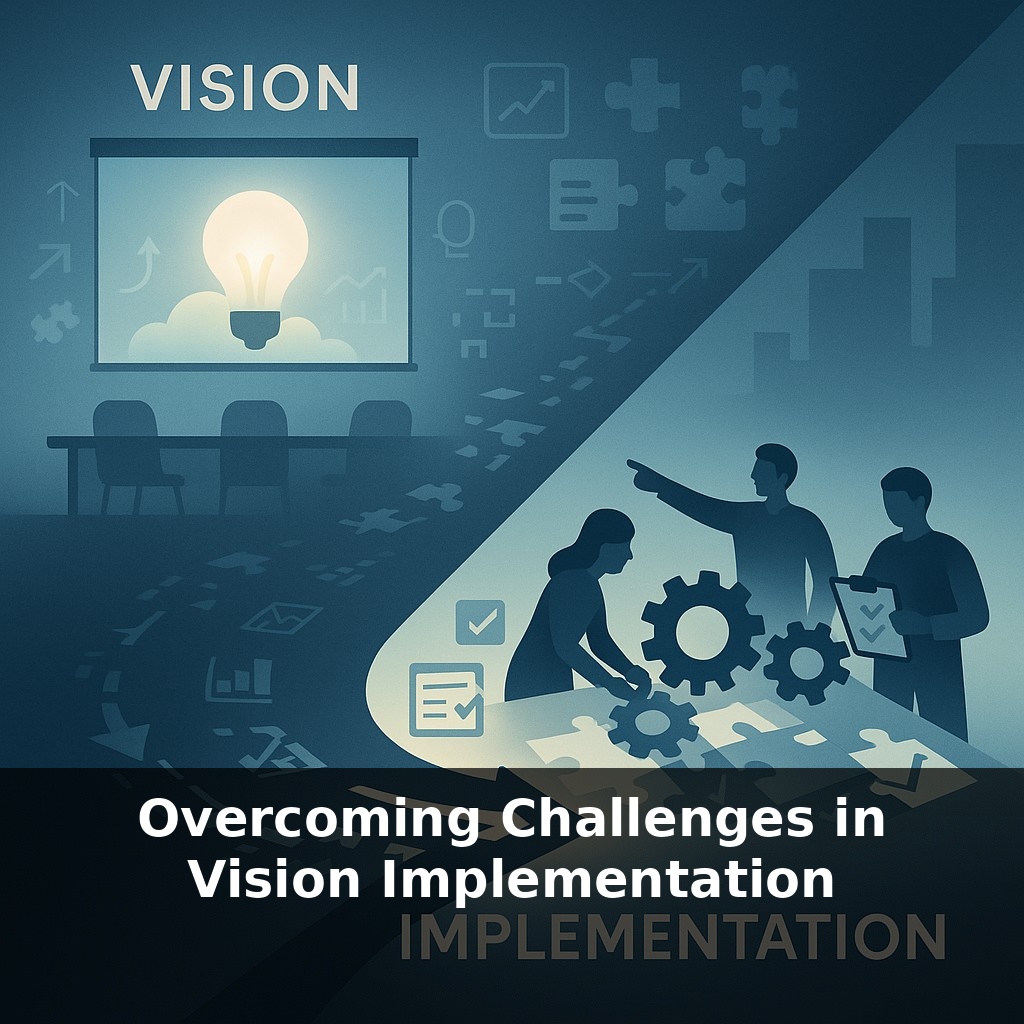
About two-thirds of “great” strategies never make it off the slide deck. The vision sounds brilliant in the town hall… then six months later, teams are quietly back to business as usual, wondering: did we miss something, or was that big vision never meant for real life?
Harvard Business Review once estimated that most failures happen *after* the “big idea” is agreed, not before. In other words: the problem usually isn’t the destination, it’s the roadwork. Leaders obsess over slides and slogans, then under-invest in the messy, unglamorous mechanics of follow-through: who does what, by when, and how we’ll know it’s working.
This is the quiet gap where momentum leaks out. People leave the town hall energized, then collide with unchanged priorities, clogged approval paths, and conflicting signals from leaders. Over time, teams learn that the safest move is to wait—wait for clarity, for budget, for “real” direction.
In this episode, we’ll zoom in on that gap. We’ll look at the specific behaviors and systems that reliably turn ambitious direction into daily decisions—and why most organizations never make that shift on purpose.
Execution also fails for quieter, less dramatic reasons: people don’t share the same mental picture of success. Leaders say “customer-first” and one team hears “faster shipping,” another hears “premium service,” and a third hears “more discounts.” Multiply that fuzziness across functions, geographies, and levels, and the gap widens daily. Research backs this up: most employees can’t accurately repeat their company’s direction without prompts. In this episode, we’ll treat implementation less like a one-time rollout and more like configuring a complex software system—tested, tuned, and updated in real time.
Most leaders underestimate how *confusing* the early months of implementation feel to everyone else. From the top, the direction seems obvious; from the middle, it often looks like a dozen half-finished initiatives and an already-full plate. That gap in perception is where resistance quietly breeds—not from malice, but from overload and ambiguity.
The research is blunt: only about a third of employees can accurately state their company’s direction without help. That means two out of three people are making daily decisions based on guesswork, local priorities, or whatever their immediate manager emphasizes. You don’t get coherent execution from incoherent understanding.
So the first essential is ruthless clarity in communication—not more *information*, but more *precision*. Instead of repeating slogans, translate direction into three things people actually use: - A short list of near-term outcomes that matter most - What will be different in how we work - What is *not* changing or can be safely deprioritized
Leaders who skip the “what we’ll stop” piece almost guarantee hidden conflicts and quiet workarounds.
The second essential is visible short-term wins. This isn’t about cosmetic victories; it’s about building a proof-of-concept inside your own organization. When people see a team they recognize hitting a concrete milestone tied to the new direction—and being rewarded for it—they update their mental model: “Oh, this is real.” Without that, even sincere town halls fade into background noise.
Third, adaptive planning. Annual cycles alone are too sluggish for a moving environment. Teams that work with quarterly, outcome-focused goals effectively create built-in feedback loops: what did we learn, what shifted externally, and what does that mean for next quarter’s focus? You’re still committed to the same direction, but you’re constantly refining the route based on real data.
Finally, none of this survives without sustained sponsorship. Not grand speeches, but leaders repeatedly doing three unglamorous things: reallocating resources when trade-offs arise, protecting early adopters when experiments are messy, and aligning their own calendars, metrics, and recognition with the new direction. When those signals stay consistent over time, the organization stops treating the new direction as a campaign and starts treating it as the new normal.
At one fintech scale-up, the CEO stopped assuming everyone “got it” and ran monthly 30‑minute “direction clinics.” Managers brought real decisions they were wrestling with; together they rewired them in line with the new direction. Within a quarter, duplicate projects dropped and cycle times improved—people weren’t faster, just less conflicted.
A global manufacturer used a different entry point: they picked three frontline locations and funded tiny, 60‑day pilots. Each site chose one outcome they could move, reported weekly, and shared unfiltered learnings. The first two pilots were messy, but the third produced a small but undeniable customer win—suddenly other plants were *asking* to join.
One useful way to picture this: think of an architect walking a construction site with the blueprint in hand. They’re not redrawing the whole building; they’re making on-the-spot adjustments—where a window should shift, how a doorway should widen—so the structure matches the intent, not just the drawing. Effective leaders do the same “walkthroughs” with their direction.
Leaders who master this “last mile” will soon have far more leverage. As AI surfaces live execution gaps—like a heat map for misaligned decisions—you’ll be able to course-correct before drift becomes visible. Think less about writing a perfect plan and more about designing a feedback-rich environment: fast sensing, low-friction adjustments, and honest signal over corporate theater. The real differentiator won’t be who has the boldest direction, but who can iterate it in public without losing trust.
Treat this phase less like enforcing a master plan and more like running a series of well‑designed experiments. Instead of asking “Are we on track?” start asking “What did we learn this week that should change how we move next week?” Leaders who normalize that question turn course corrections from admissions of failure into routine system upgrades.
Before next week, ask yourself: “Where in my current vision am I hiding behind vague language (like ‘grow my impact’ or ‘be more consistent’), and how can I rewrite that into one clear, measurable outcome for the next 30 days?” Then ask: “Looking at that clearer outcome, which specific obstacle the podcast mentioned—fear of failure, lack of time, missing skills, or unclear priorities—is actually getting in my way right now, and what is one concrete constraint (deadline, rule, or boundary) I’m willing to set today to protect progress on it?” Finally, ask: “If I had to commit to just one non‑negotiable daily behavior that directly moves this vision forward (like 20 minutes of outreach, drafting, or building the system we discussed), what would it be, and what will I stop doing or postpone to make space for it starting today?”