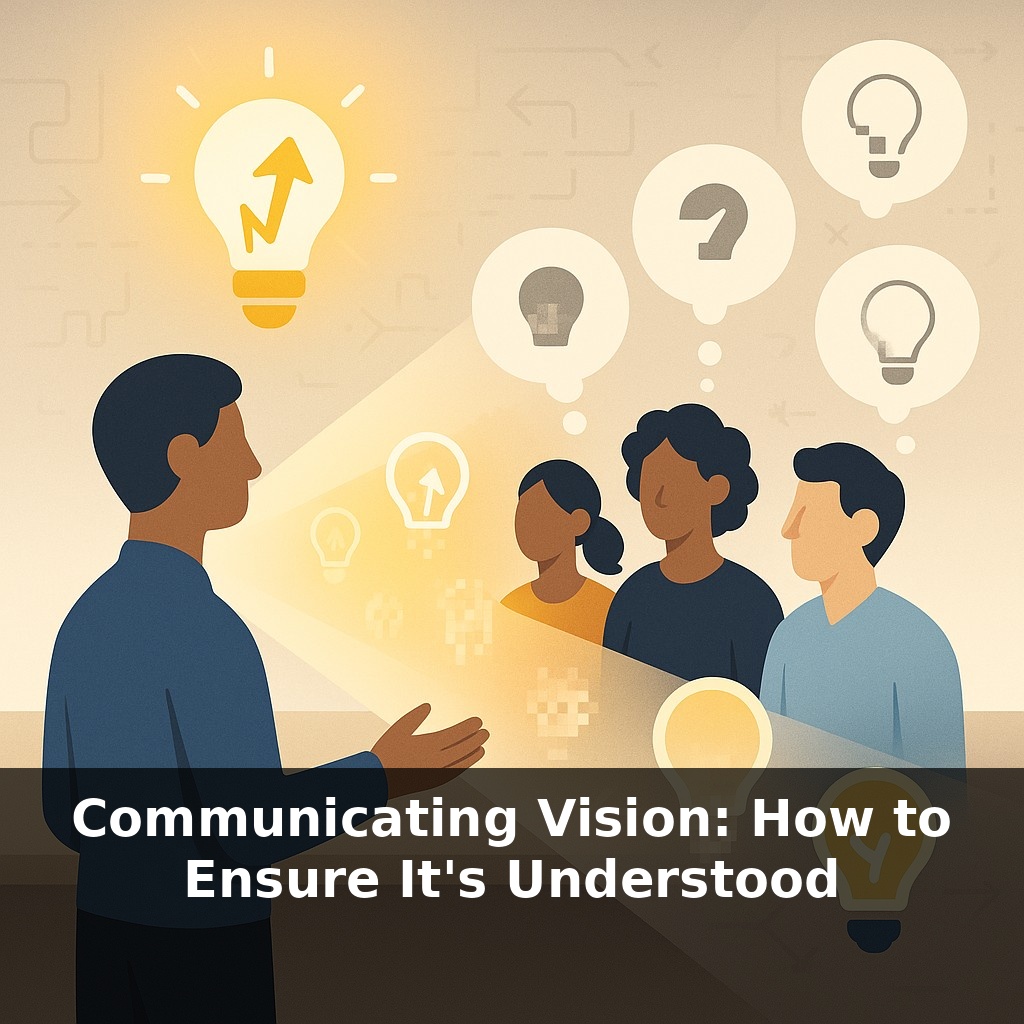
Most leaders think their vision is clear—yet in many companies, only about half of employees can explain where the organization is headed. You announce the vision at an all-hands, people nod, then…nothing changes. This episode is about what quietly breaks in that gap.
Most leaders assume “I said it clearly” equals “they heard it clearly.” But in practice, people don’t just need to hear your vision; they need to *reconstruct* it in their own minds—and that’s where it usually falls apart. In one global survey, fewer than 40% of employees could connect their company’s top priorities to their daily work. In another, over 60% said strategy messages “don’t feel relevant” to their role. The problem isn’t intelligence or motivation; it’s translation. Vision travels through overloaded inboxes, dense slide decks, and rushed town halls. By the time it reaches the front line, key intent is diluted or distorted. In this episode, we’ll focus on how to communicate so that people not only repeat your vision, but can use it to make decisions on a random Tuesday afternoon without you in the room.
Here’s the catch: even when people *can* repeat your vision, they often can’t *work with it*. In one study, 95% of employees couldn’t name their company’s top three priorities without checking notes. In another, managers spent less than 3% of meeting time linking decisions back to strategic direction. Meanwhile, neuroscience research shows that when messages trigger emotion and visual imagery, recall and application jump significantly—sometimes by over 20× compared to dry data. So the question shifts from “Did I announce the vision?” to “Did I encode it in a way their brain can find and use under pressure?”
Think of this section in three parts: clarity, consistency, and conversation—each with its own failure mode and fix.
**1. Clarity: make it quotable and testable**
If you can’t write your vision in one or two punchy sentences, no one else will be able to either. But brevity alone isn’t enough; specificity matters. “Be customer-obsessed” is vague. “Resolve 80% of issues in a single interaction, without handoffs, by 2027” gives people a yardstick.
A useful stress test: in one European bank, leaders gave their top 200 managers a blank card and 90 seconds to write the vision from memory. Only 17% wrote the same core idea. After sharpening language and cutting jargon, that match rate rose above 70% within six months. The wording didn’t just sound better; it became easier to reuse in meetings, performance reviews, and hiring.
**2. Consistency: saturate channels, not people**
Repetition works, but only if it’s coherent. In a tech company I worked with, the CEO used three different phrases for the same direction across email, town halls, and board decks. Employees created their own mental versions—and alignment splintered along team lines.
Quantify your own consistency: pick the last 20 communications you sent to more than five people. How many explicitly restate the same short vision line or tagline? If it’s under 30%, your message is probably fragmenting. High-performing firms often push that to 60–70%: not the *only* thing they say, but the anchor everything else hangs from.
**3. Conversation: design for echo, not applause**
Understanding deepens when people talk *back*. Kotter International’s data shows companies where employees can describe how their work links to direction are 3.5× more likely to beat revenue peers. That doesn’t happen through monologues.
Treat every meeting as a small experiment: instead of asking, “Any questions?”, use prompts that force application. For example: - “Given this direction, what would we stop funding first?” - “If we could only hit one of our current KPIs, which one best represents this future?” - “How would a customer *see* this change in 12 months?”
Track how often you hear people, unprompted, using your language in their own updates. That “echo rate” is one of the most reliable leading indicators that your vision is truly understood.
At one retail chain, the COO realized store managers gave wildly different explanations of “premium service.” Instead of another memo, she ran a 45‑minute exercise with 120 managers. Step 1: show three short customer scenarios on video. Step 2: ask each table to *rewrite* the scenarios as if “premium service” were already true—specific words, actions, timing. Step 3: each group distilled theirs into a one‑sentence “service headline.” Within two sessions, they had 8 clear, vivid examples and one shared line everyone could quote. Over the next quarter, shops using the headlines in daily huddles saw mystery‑shopper scores rise from 74% to 89%, and refunds drop by 18%.
You can do a lighter‑weight version with your team: pick one critical meeting, one customer email, and one internal process. Ask 5–7 people to rewrite each “as it would look if we’d nailed our direction in 18 months.” Compare drafts, then agree on 2–3 phrases and 1 concrete behavior you’ll all start using this month.
As channels multiply, the real advantage will come from precision, not volume. Over the next 3–5 years, expect tools that show which phrases trigger action for different groups, with dashboards that link specific wording to metrics like defect rates or sales conversion. Your job: treat every vision message as a micro‑experiment—A/B test subject lines, town‑hall formats, and leader stories, then double‑down on the top 10–20% that reliably move behavior.
Treat this as ongoing practice, not a one‑off speech. Set a simple target: in the next 30 days, run 3 “echo checks” with different groups and track one hard metric each time—e.g., priority misalignment in planning sessions dropping from 40% to 15%. Your challenge this week: ask 5 people to state your direction in 15 seconds. Compare the answers.