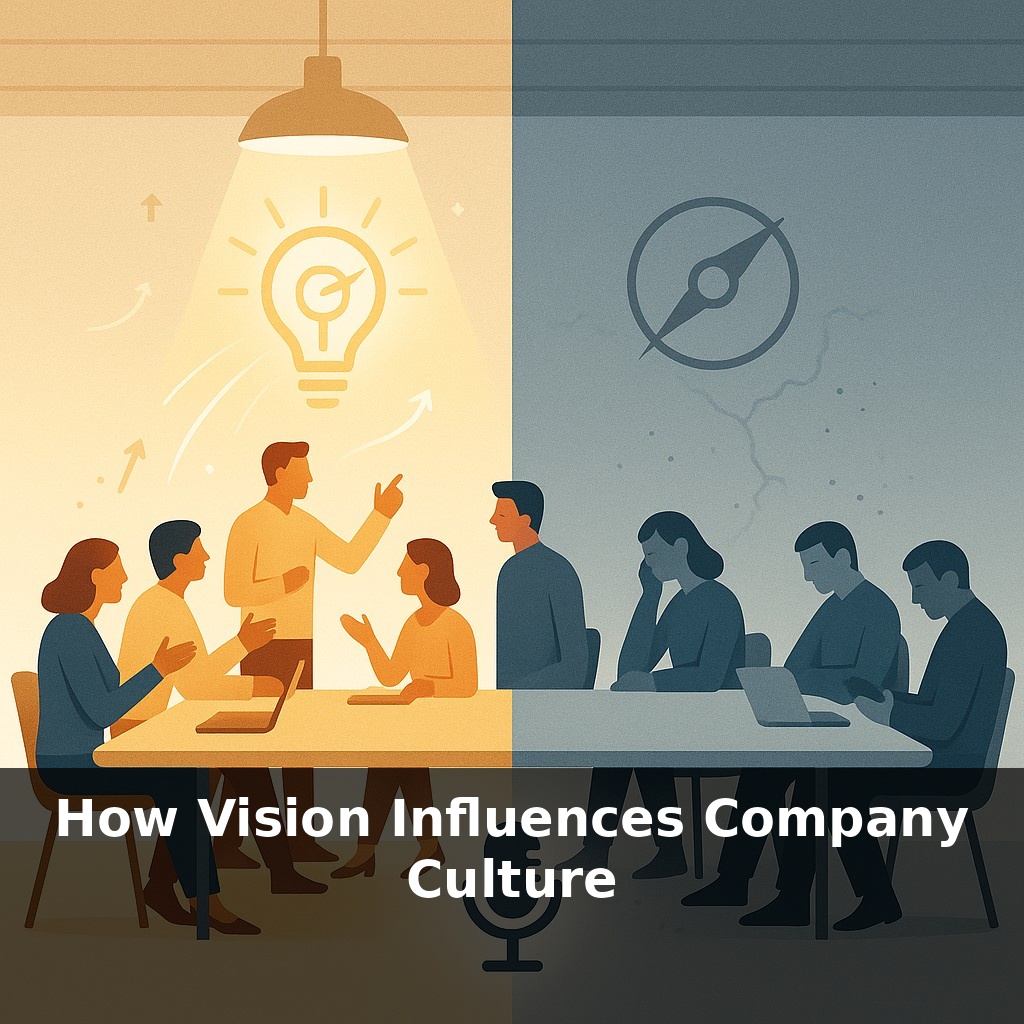
About three out of four job seekers say culture matters more than salary. Now, drop into a Monday meeting: same people, same goals—but in one company the room crackles with energy, in the other it’s quiet resignation. How did invisible words on a wall create that gap?
“Companies with a highly aligned purpose and culture can see innovation outcomes jump by up to 30%.” That sounds nice on paper—until you realize it means two similar teams, with similar talent and resources, can produce wildly different results simply because one thing is clear: where they’re going.
This is where vision quietly does its work. Not as a slogan, but as the shared story people believe they’re part of. When that story is crisp and convincing, it starts to shape who gets hired, what gets praised, and which tradeoffs feel natural instead of painful. When it’s fuzzy, people default to local priorities, personal incentives, or the loudest voice in the room.
In this episode, we’ll unpack how a clear vision becomes a daily filter for decisions—and why that filter can be the difference between pockets of excellence and a culture that consistently performs.
Listen closely in high-performing organizations and you’ll notice something subtle: people at every level use the same language when they talk about the future. In 1:1s, roadmap debates, even hallway chats, the same few phrases keep surfacing—not because they were memorized, but because they make intuitive sense. That shared language is where behavior starts to shift. Leaders stop arguing about “who’s right” and start asking “which option moves us closer.” Over time, meetings shorten, priorities sharpen, and turf wars lose oxygen because the long-term direction is doing the quiet, constant arbitration.
Look closely at organizations where people seem “on the same wavelength” and you’ll notice three quiet effects of a well-defined vision.
First, it rewires what “good” looks like. At Microsoft, Nadella didn’t just publish a new statement; he reframed success from “a PC on every desk” to “empower every person and organization on the planet to achieve more.” That shift subtly changed what got celebrated: learning over defensiveness, customer impact over internal politics, long-term ecosystems over short-term product wins. When the bar for “good work” is tied to a future state, people start self-correcting without being told.
Second, it changes who thrives. A clear direction acts like a magnet and a filter. Candidates who light up when they hear it are telling you they’re likely to reinforce the culture; those who shrug are telling you the opposite. Patagonia’s environmental stance doesn’t just retain people—it selects for employees who are willing to make unconventional decisions, like fixing old gear instead of pushing new sales, because that behavior feels obvious in the context of the future they’re building.
Third, it shapes how conflict plays out. Disagreement doesn’t disappear in vision-led companies; it gets reframed. Instead of “my team vs. your team,” the hard question becomes “which option best serves the world we’re trying to create in five or ten years?” That doesn’t make tradeoffs painless, but it anchors them. Over time, this reduces passive resistance and quiet sabotage, because debates are less about status and more about fit with the destination.
Think of it like good software architecture: when the core design is clear, thousands of small implementation choices can be delegated safely. People don’t need a playbook for every scenario; they need to know what future their choices are supposed to enable.
All of this has a flip side. When the vision is fuzzy, individual managers improvise their own versions. Micro-cultures spring up around personal styles or short-term metrics, and you start hearing phrases like “it depends who you work for here.” Performance then becomes uneven not because talent is wildly different, but because the underlying story is.
At a fast-growing fintech, leadership quietly tested how direction shaped behavior by giving two pilot teams different north stars. One was told to “increase transactions,” the other to “become the most trusted platform for first-time investors.” Six months in, both hit their numbers—but the second group redesigned onboarding, simplified language, and rewrote error messages unprompted, because “a nervous beginner” became their mental reference point.
A similar pattern showed up at a hospital network. One site framed its future around “operational efficiency,” another around “zero avoidable harm.” The first unit optimized schedules; the second obsessively refined handoffs and briefings. Same budget, different futures, different reflexes.
Your own org is already running dozens of these micro-experiments. Listen to teams that consistently punch above their weight: how do they describe the future they’re building, in their own words? Then notice which everyday choices that story quietly makes feel obvious—or impossible.
Innovation metrics, candidate pipelines, even customer loyalty scores will start behaving like “vision barometers.” As AI flattens technical gaps, people will scan employers the way savvy travelers scan hotel reviews—looking less at glossy photos, more at patterns in recent comments. Expect boards to ask not just “What’s our strategy?” but “What evidence shows people believe it?” Leaders who treat this as soft will quietly lose the next generation of builders.
When you study teams that feel “lucky,” you often find something else: leaders who keep testing their vision in the wild—asking customers, new hires, even critics where they think the company is headed. Treat those answers like app store reviews: not vanity scores, but bug reports and feature requests for the culture you’re still shipping.
Start with this tiny habit: When you open your laptop in the morning, rewrite your company vision as a single, plain-language sentence that a new intern could understand, using no buzzwords. Then add just one concrete behavior under it that you want your culture to reflect that day (for example: “Ask one ‘why’ question in every meeting” if your vision includes curiosity). Before you shut your laptop at the end of the day, glance at that sentence and quickly highlight one calendar event where you actually lived it.