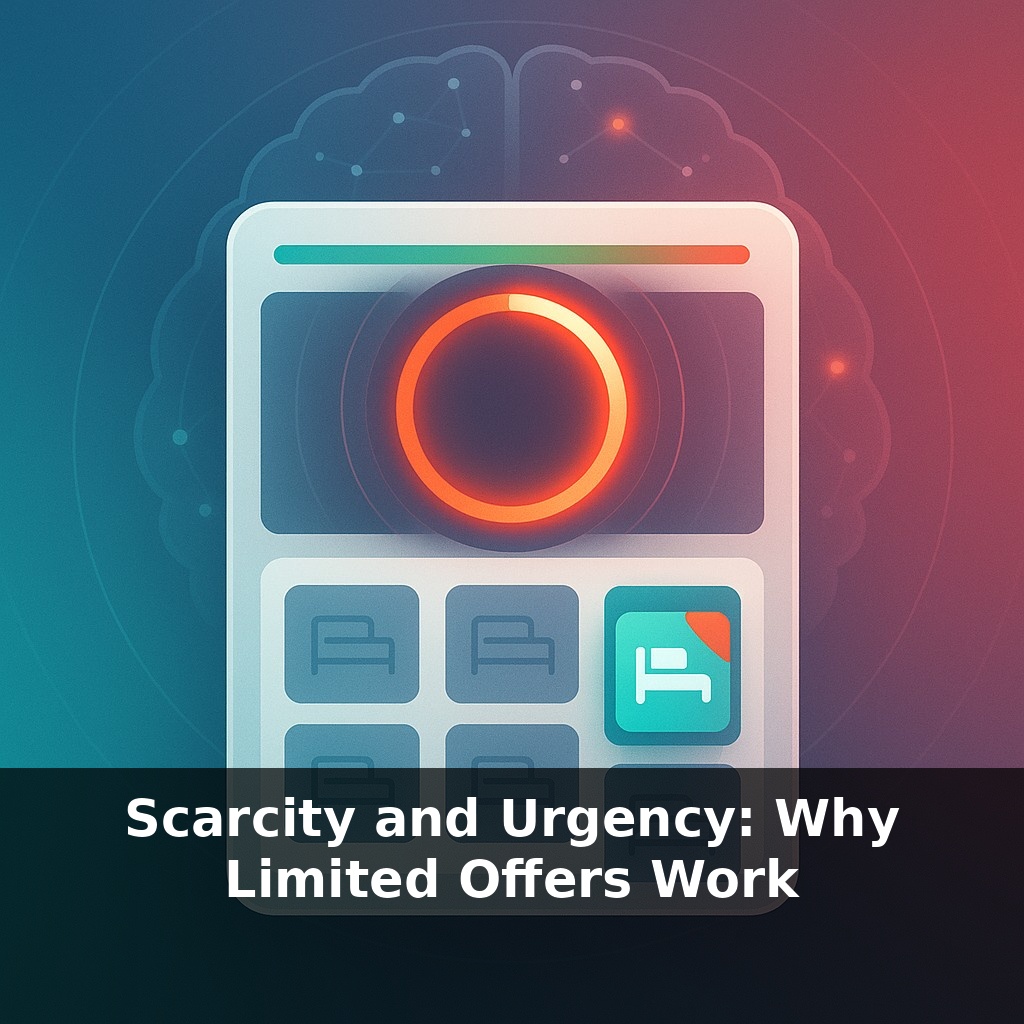
A hotel site flashes “Only 1 room left at this price.” Within minutes, the last rooms vanish. Here’s the twist: demand didn’t suddenly spike—your brain did. In this episode, we’ll explore why limits on time and quantity can make ordinary offers feel impossible to pass up.
A countdown clock hits 10 minutes, a stock bar slips from green to red, and suddenly the same product feels more urgent, more desirable, almost…special. What changed isn’t the product; it’s the *context* surrounding your decision. In this episode, we’re moving beyond what scarcity and urgency are and looking at how they get engineered into everyday shopping: the “only 3 left” banners, “cart reserved for 5 minutes” timers, and “early-bird” tiers that quietly push you to act now instead of later. We’ll unpack how brands decide *which* limits to show you, when they cross the line into manipulation, and why some people are especially sensitive to these cues. We’ll also look at why younger shoppers, who’ve grown up on disappearing stories and flash drops, can be both savvy to these tactics and surprisingly vulnerable to them.
Marketers now fine-tune *how* they present scarcity and urgency the way a chef adjusts seasoning: too light and you don’t notice it, too heavy and you push the plate away. They test whether “selling fast” feels better than “almost gone,” or whether a soft “early access ending soon” beats a flashing “final chance!” banner. Some brands even personalize these signals—showing tighter deadlines to frequent browsers who hesitate, or highlighting low stock only on items you’ve clicked twice. Others layer in social proof, like “23 people have this in their cart,” to turn quiet interest into visible competition.
Think of scarcity and urgency as “volume knobs” that brands adjust on top of everything else you already see—price, design, reviews. What’s changed in the last decade is how precisely those knobs are tuned.
On travel sites, “Last room!” banners are now the result of controlled experiments, not guesswork. Booking platforms test tiny variations: “Only 1 left” vs. “Only a few left,” or red text vs. orange. One version quietly lifts bookings a few percentage points; another gets ignored. Even that small lift at scale means millions of extra dollars, so the winning version becomes the new default until the next round of testing.
Retailers treat countdowns the same way. Amazon’s Prime Day “Lightning Deals” don’t just end at a random time; the remaining-time window is calibrated so most shoppers feel a nudge, not a panic. Marketplace analyses show those timed deals move faster than regular discounts, especially in the final stretch of the clock, when hesitation drops and “good enough” beats “keep comparing.”
At the higher end, brands don’t need flashing banners at all. Streetwear labels and luxury watchmakers announce a fixed drop time and quantity, then step back. The combination of known limits and visible queues outside stores or digital waitlists often creates its own rush, pushing resale prices far above retail. The product hasn’t changed; the structured shortage has.
There’s also a generational twist. Surveys show many Gen-Z buyers openly admit to making at least one purchase mostly because they didn’t want to miss out. But “FOMO purchases” are no longer just random splurges. They’re happening in categories like event tickets, online courses, even crypto and NFTs—places where missing a window feels like missing a cultural moment or a financial opportunity, not just a discount.
Your own behavior shifts with these signals more than you might realize. You may tell yourself you’re immune, yet your cart tends to close faster when a shipping deadline is close, or when you know a ticket presale ends tonight. Brands aren’t counting on you being irrational; they’re counting on you being *busy*—too busy to keep searching when the clock and the counter both say “decide now.”
A sneaker drop page starts innocently: “New collection live now.” Early visitors see every size available, no pressure. As pairs begin to sell, the interface quietly shifts—smaller sizes gray out, larger ones show “moving quickly,” and the “next batch” date disappears. Nothing screams “hurry,” yet the shrinking options nudge fence-sitters to commit. Now compare that to an online course launch: the creator opens 200 seats, but only the first 50 include a live Q&A. Latecomers can still join, just with fewer perks. The limit isn’t on *access* but on *extras*, which feels more fair and still speeds decisions. Even grocery apps use softer versions: “Order in the next 2 hours for same‑day delivery” simply rearranges your priorities. Like adjusting ingredients while cooking, brands can change which *part* of the offer is finite—seats, bonuses, delivery windows—without touching price, and your behavior shifts accordingly.
Soon, “only 3 left” won’t be generic—it’ll be calculated just for you. AI will learn how fast you usually decide, then set clocks and stock notices like a thermostat tuned to your personal comfort zone. Brands will also be pushed to show their work: regulators may require proof that a deadline or cap is real, not theater. Your challenge this week: whenever you feel rushed to buy, pause and ask, “Who set this timer—and why now, for me?”
The more you notice these nudges, the more room you have to choose instead of react. Treat each flashing banner like spicy seasoning in a recipe: a little might sharpen your focus, too much can drown your taste. Over time, you can decide when a deadline truly matches your priorities—and when it’s just noise trying to turn a casual glance into a rushed “yes.”
Start with this tiny habit: When you open your laptop to work, add one simple scarcity phrase to a single offer you already have, like “Spots for this month: 3” or “Bonus disappears Friday at midnight.” Don’t redesign the whole page—just tweak one sentence so it clearly shows a limit (time, spots, or bonuses). Then, before you close your laptop, glance at that offer and ask yourself, “Would *I* feel a gentle nudge to act if I saw this?”