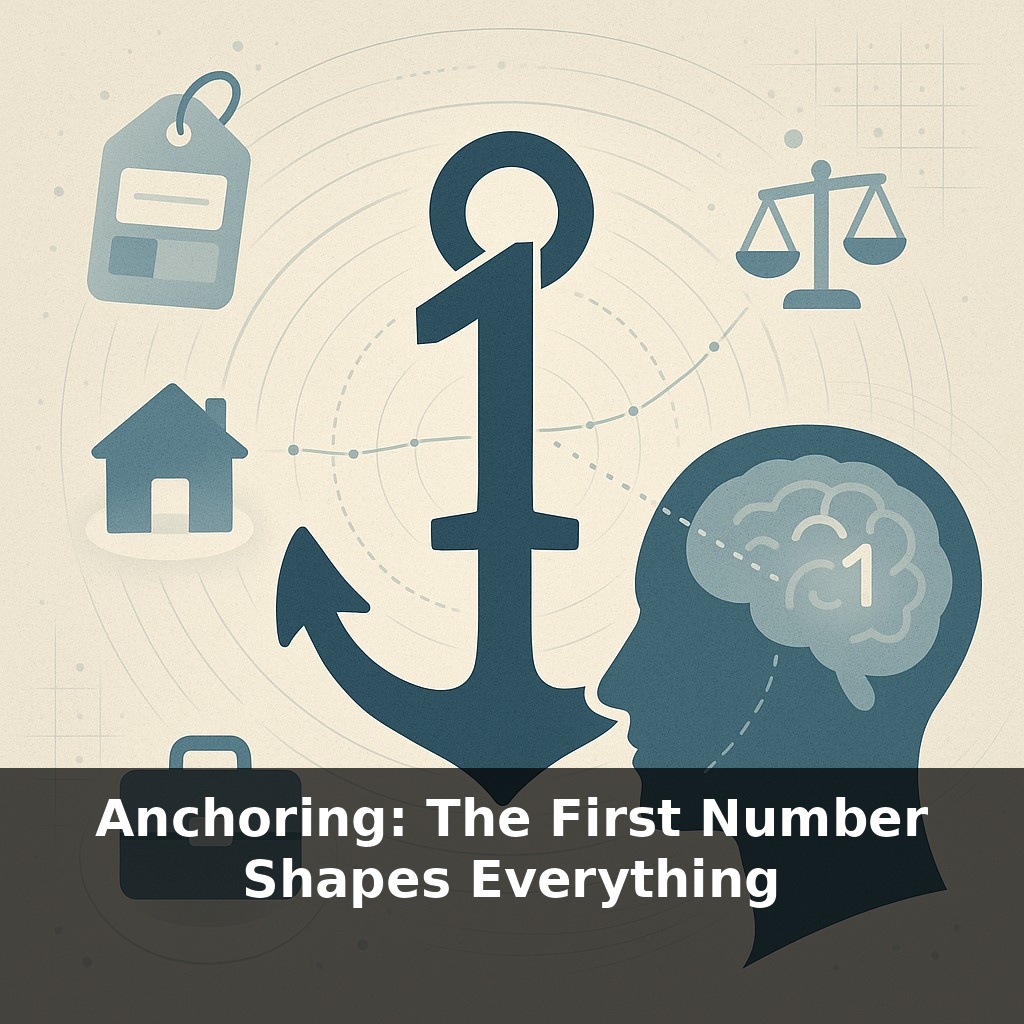
A single random number can change how much you’ll pay, how long someone goes to prison, even how valuable your home feels. A menu price, a “was” price on Amazon, a first offer in a salary chat—today we’ll pull apart how that very first number quietly steers everything.
That first number doesn’t just nudge you once—it quietly rewrites the entire story your brain tells itself about “what makes sense.” See a $180 sweater before a $90 one, and the cheaper option suddenly feels “reasonable,” even if you would’ve called it outrageous five minutes earlier. Walk into a grocery store where the first avocados you see are $3.99 each, and the $2.49 pile down the aisle feels like a deal, not a rip-off. The anchor doesn’t have to be fair, relevant, or even serious; your mind still starts its internal negotiation from there. And the effect isn’t limited to prices. It colors how long you think a task will take, how risky an investment seems, how “normal” a monthly subscription feels. In this episode, we’ll look at how businesses deliberately plant anchors—and how you can learn to spot, question, and sometimes even use them to your advantage.
Anchors show up in places that don’t look like “numbers” at all. A “limited time only” badge, “only a few left,” or “best value” label quietly tells you what’s big, small, or normal before you even see the actual price. Order on a page matters too: put the premium option first and the middle one feels safer, just like starting a playlist with a loud track makes the next song seem calmer. And because our brains hate feeling uncertain, we grab these cues quickly, then defend them—especially when the source looks expert, official, or like “everyone else is choosing this.”
That anchoring effect is not a party trick on gullible shoppers; it’s a robust, measurable shift in judgment. Across 31 studies, Furnham and Boo found an average effect size of r = 0.41—that’s big by psychology standards, on par with the link between ice cream sales and temperature. And it holds even when the first number is absurd or explicitly labeled as random.
Consider experts whose job is to “see through” noise. In the real-estate study from Stanford and UT, professional appraisers received identical property details but different listing prices. Every 10% bump in that listing nudged appraisals up about 3%. They didn’t say, “The seller’s dreaming.” They unconsciously used the listing as a starting point for “serious” reasoning.
The same pattern shows up in high‑stakes settings. In Englich’s work with German judges, simply hearing a higher sentencing demand led to prison terms roughly 50% longer on average—even though the judges believed they were relying on facts and law. Expertise doesn’t immunize you; it often just gives you fancier stories to justify the pull of the first number.
Retailers know this. When J.C. Penney tried to strip out fake “was” prices and just display everyday “fair” numbers, customers revolted. Revenue fell about 25% in a single quarter. Nothing about the physical products changed; what vanished was the high anchor that made the current price feel like a win.
Online, that same psychology gets weaponized at scale. A Profitero analysis suggested that Amazon items with a crossed‑out “was” price convert 25–30% better. That older, higher figure doesn’t just decorate the page; it rewrites what “worth it” feels like. Even if you never would’ve paid the original amount, its mere presence reshapes the deal in your mind.
And anchoring quietly extends beyond money. When a site says “Join 50,000+ subscribers,” that number becomes a reference point for how popular, safe, or mainstream the choice seems. When a forecast headline screams “up to 40% chance of recession,” that “40%” can cling to your sense of economic threat long after you read more nuanced details.
Anchoring is like that first pinch of salt in a stew: once it’s in, every taste and adjustment happens relative to that starting point, even if it wasn’t the amount you truly needed.
You see anchoring in places that feel totally unrelated to “being sold” something. Open a fitness app and log a run: the first week it suggests “10,000 steps” or “5 workouts,” and suddenly anything less feels like slacking—even if your old baseline was twice a week and you were proud of it. Or think about fundraising: when a charity sets preset buttons at $25, $50, and $100, far more people click $50 than if the options were $5, $10, and $20. The cause hasn’t changed; the scale of “normal generosity” has.
On streaming services, a “Top 10 in your country” banner does something similar. A show seeded at #1 looks like the obvious choice; by the time you scroll to #8, your brain has already treated those higher ranks as the standard, nudging you toward what’s been placed near the top.
Even in relationships, the first story you hear about someone—“she’s intense,” “he’s brilliant but disorganized”—sets a reference point. Every later detail gets filed as “more or less than” that first label, instead of starting from scratch.
“Smart” systems will soon learn not just what you’ll buy, but what number quietly resets your sense of “reasonable.” A health app might surface a “suggested” cholesterol target; a tax site might pre-fill a donation amount; a climate tool could highlight one emissions scenario in bold. None of these force you—but each bends the mental ruler you measure with. As virtual shops add 3D size and weight cues, even how “big” or “small” a deal feels could be tuned like stage lighting around you.
The next step is noticing where you quietly set anchors for yourself. The first price you’re willing to pay for concert tickets can become a mental speed limit; the first “acceptable” bedtime can harden into a curfew you never revisited. Like grooves in fresh snow, those early tracks make every later choice a little more likely to follow the same path.
Start with this tiny habit: When you see a price, number, or “special offer” today (online or in a store), quietly say to yourself, “That’s just an anchor, not the value.” Then, before reacting, think of *one* different number that could also be reasonable (like a higher or lower price, a different salary, or a different discount). This 3-second pause trains your brain to unhook from the first number instead of letting it silently steer your decision.