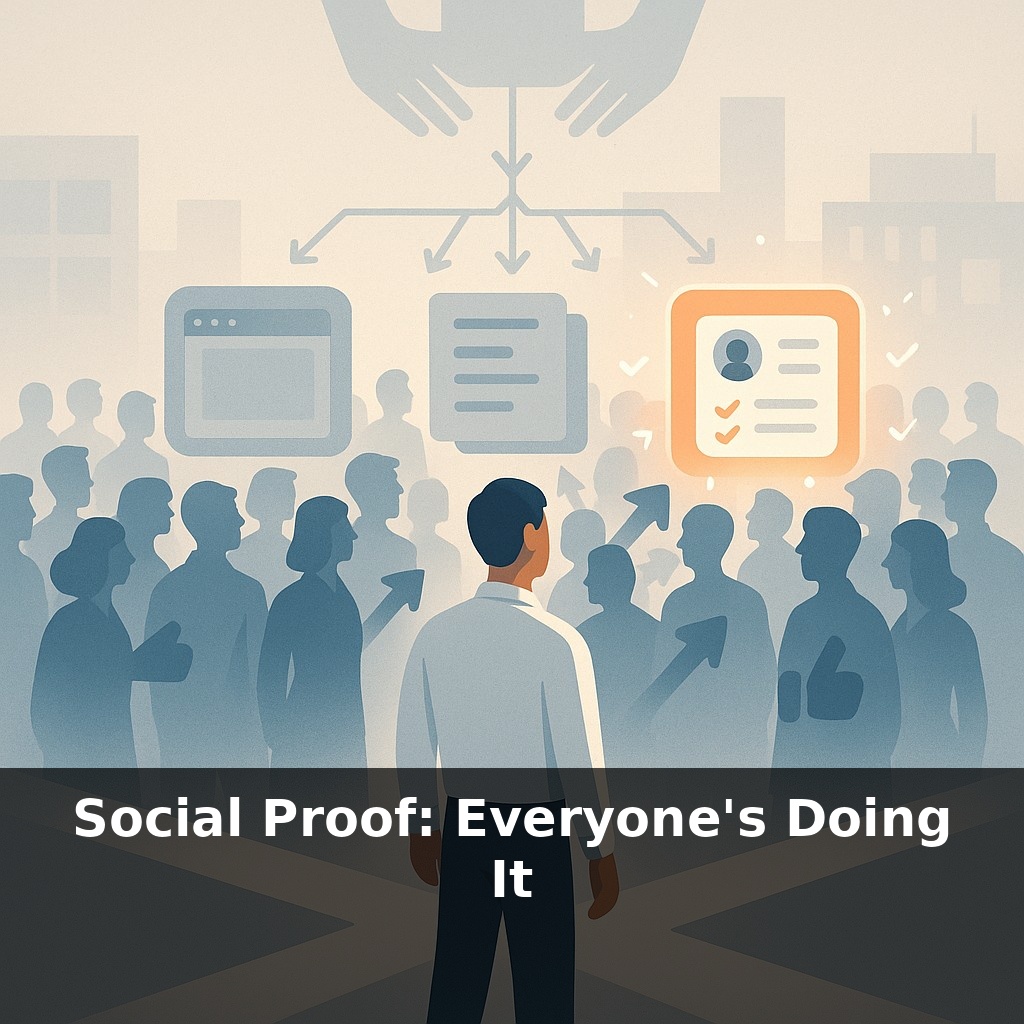
About half the time people “decide for themselves,” they’re actually copying someone else—and they don’t notice. A quiet candidate suddenly becomes the frontrunner. A so‑so proposal turns into the “obvious” choice. In each case, the real power belongs to whoever controls the crowd.
Sixty‑four percent of B2B buyers in a recent LinkedIn poll said the *number one* reason they approve software is simple: “people like me are already using it.” Not features. Not price. Peer use.
This is the quiet power of social proof in your career: decisions that look rational on the surface are often leaning heavily on, “What are others like me doing?”
In hiring, a “standard background” can beat a stronger but unconventional profile because it feels safer to follow the herd. In salary talks, a recruiter citing “what most candidates at your level accept” nudges you toward their target. Even in promotion discussions, leaders often ask, “Who else has done this before?” as if precedent were proof.
Social proof doesn’t just shape opinions; it silently redraws the boundaries of what feels possible—for you and for the people deciding your future.
At work, social proof hides in plain sight: “industry benchmarks,” “market rates,” “what other teams are doing,” “best practice decks” quietly steering choices. In negotiation, these signals are rarely neutral. A recruiter saying, “Most candidates at your level land around X,” isn’t just sharing data; they’re constructing a norm. A hiring panel noting, “Everyone we’ve promoted into this role had Y,” is defining the template you must fit. These “examples” become invisible guardrails—limiting what you think you can ask for, and what others believe they’re allowed to give you.
A hiring manager hears one thing from you—your experience—and ten things from the “crowd” around you: what similar candidates accepted, what other teams are paying, what’s “normal” in the org. The research is blunt: when those signals are clear, they often matter more than the specifics of your case.
Asch showed that even obviously wrong group answers pulled people off their own perception. Nail’s meta‑analysis shows the effect is sharpest in small, similar groups—exactly like a hiring panel of peers, or a cross‑functional promo committee. In those rooms, one well‑placed “everyone else at this level…” can tilt the whole discussion.
In negotiation, this plays out in two very practical ways:
First, whoever frames the “peer group” early tends to win. “Most mid‑level engineers here come in around…” quietly defines which comps are legitimate. If you let that stand, you’ve accepted their reference set—and their ceiling. If instead you anchor to a different but still comparable group (“Staff‑level engineers at companies with similar scale are at…”), you’re not arguing numbers yet; you’re arguing *which crowd counts*.
Second, people lean hardest on these cues when they’re uncertain. Northcraft’s housing study is a perfect parallel: buyers didn’t know the “true” price, so labeled averages dragged their offers by 12 %. In salary and scope talks, managers often feel that same fog. Clear, concrete peer behavior (“Three teams in our org already run with X budget and Y headcount”) gives them cover to stretch for you.
Ethically, the line is simple: accurate, relevant references sharpen the picture; vague or cherry‑picked ones distort it. “Typical” without a base rate, “everyone” without numbers, or “industry standard” without a source are red flags that social proof is being used as pressure, not information.
Your leverage comes from two moves: surfacing *better* crowds—those that truly match your skills and impact—and translating them into specifics. Not “people are paying more,” but “four offers this quarter for comparable roles came in 8–12 % higher, with similar scope.” Once that alternate crowd is visible, decision‑makers suddenly have permission to choose differently.
A senior designer angling for a title bump doesn’t start by arguing talent; she walks her manager through three internal cases where people with similar portfolios already hold the title she wants. Names, teams, LinkedIn screenshots. Suddenly, her ask isn’t a leap—it’s an alignment.
A sales lead negotiating scope on a new role comes prepared with a short slide: how comparable roles are structured at three companies their exec team openly admires. Not “the market,” but *those* firms. The debate shifts from “Is this too big?” to “How close do we want to be to them?”
Think of it like choosing a hiking route in unfamiliar mountains: you could stare at the whole range, or you could look for fresh footprints from hikers with your skill level and gear. In negotiations, your job is to lay those footprints where your counterpart can’t miss them—specific examples, clearly alike, and recent enough that saying “no” feels like stepping off the trail on purpose.
Soon, dashboards and AI tools will quietly script which “nearby” examples you see in every career choice—offers, promotions, even which skills to learn next. The risk is ending up in a cul‑de‑sac of safe, average moves, because every comparison points you back to the same narrow lane. Your edge will come from occasionally stepping outside those default mirrors, like taking a side street instead of the main road to notice paths the GPS never suggests.
When you notice these patterns, you can start editing them, not just enduring them. The quiet question behind big career moves stops being “What do people like me usually do?” and becomes “Which examples are worth copying on purpose?” Your challenge this week: treat every “everyone does X” as a prompt to ask, “Who exactly—and do I want their outcomes?”