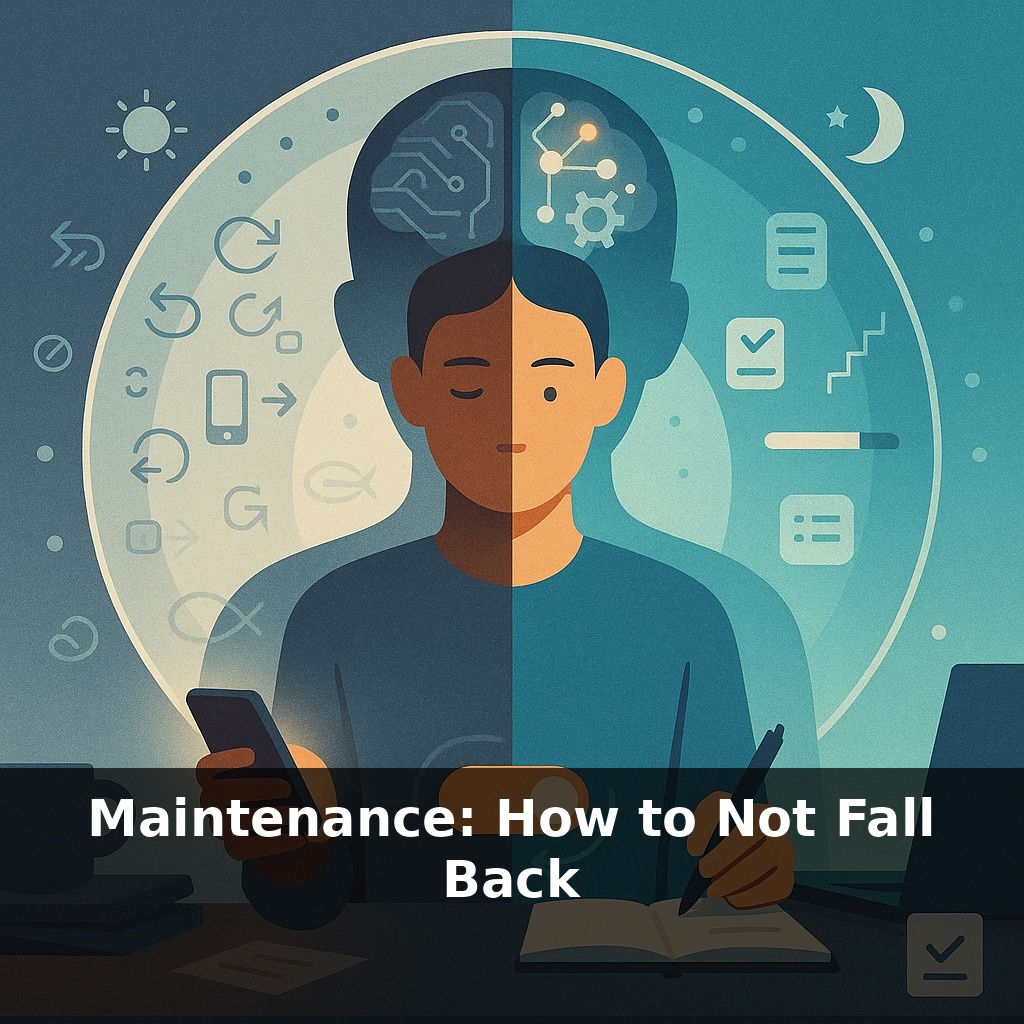
About half of what you did today ran on autopilot. Now here’s the twist: your new, hard‑won habits are not yet on that autopilot. You crush a big project deadline, feel the rush… and two weeks later you’re scrolling late at night, skipping the routines that got you here.
Duke’s data says about 40% of what you do today will run without conscious input. Here’s the catch: the upgrades you’ve made recently are still “manual mode.” Under stress, your brain will default to whatever is easiest, not whatever is best. That’s why people can sustain a new behavior for 30, 40, even 60 days, then bail the moment a crunch week hits or motivation dips 10%. The problem usually isn’t discipline; it’s a lack of maintenance. High performers treat stability as a system, not a mood: they build in checkpoints, energy resets, and tiny course‑corrections so they never drift too far off track. In one review, teams that ran simple, 15‑minute debriefs after key work cycles improved results by about 25%. You’ll use the same logic—on yourself—to keep progress from quietly unraveling in the background.
Think in seasons, not single sprints. A UCL study found it can take anywhere from 18 to 254 days before a new pattern runs with less effort—which means you’ll pass through multiple “stress weather systems” before things feel stable. The risk zone isn’t the first hard week; it’s month 3, when novelty wears off and life clutter quietly crowds your calendar. Maintenance is about engineering friction: making backsliding just 10–20% harder and staying on track 10–20% easier through tiny adjustments to tools, schedules, and social commitments you already use every day.
Most people relapse not in a crisis, but in a slow slide: one skipped walk here, a “just this week” late‑night work push there. By the time you notice, your calendar looks like the old you’s calendar again. To prevent that slide, you’ll set up three guardrails: reflection, refreshers, and recovery.
**1. Structured reflection: a 15‑minute “after‑action” for your week**
Borrow the 25% performance boost teams get from after‑action reviews and run one on your own work cycles:
- Every Friday, block **15 minutes**. - Answer three questions with 1–2 bullet points each: 1. “What did I do in the last 7 days that clearly supported my new way of working?” 2. “Where did I slip—and what was happening around me in the 60 minutes before the slip?” 3. “What is one tiny tweak (≤10 minutes, ≤$10, or ≤1 email) I’ll try next week?”
Keep these in one ongoing doc so you can see patterns over **4–6 weeks**, not just one bad day.
**2. Refresh motivation on a schedule, not when you crash**
Motivation fades predictably. Instead of waiting for a low, pre‑book quick “reboots”:
- Every **30 days**, schedule a 20‑minute review with yourself: - Re‑read your original reasons for changing. - Update them with **one concrete, recent benefit** (e.g., “3 evenings this month without work email”). - Set a **micro‑goal** for the next 30 days that’s 10–20% beyond what you’re already doing, not a giant leap (e.g., if you left on time 2 days/week, aim for 3).
Think of this like updating an app: frequent small updates keep it stable better than rare overhauls.
**3. Deliberate recovery: micro‑breaks as non‑negotiables**
Overload is one of the fastest ways to fall back. The APA’s data and the micro‑recovery research converge on the same pattern: short, regular pauses protect engagement.
Start with a basic rule: across your workday, insert a **3–5 minute pause every 90 minutes**. No phone, no email. Options: - Stand, stretch, drink water. - Look out a window and take **10 slow breaths**. - Jot one sentence: “What deserves my best energy in the next 90 minutes?”
If you do this across an 8‑hour day, you’ll have **4–5** recovery points, which is enough to materially reduce cognitive overload without blowing up your schedule.
Tie it together by choosing just **one adjustment** in each category this week: one weekly review, one 30‑day refresh block on your calendar, and one recovery rule you’ll actually follow. You’re not aiming for perfection; you’re installing rails so that when life tilts, you slide toward your new baseline, not back to the old one.
Think about a real Tuesday afternoon at 3:40 p.m.: your calendar is packed, a Slack fire drill erupts, and your “new way of working” meets live ammo. This is where maintenance actually happens—in the tiny, in‑the‑moment choices that either reinforce your system or quietly bypass it.
Example: You decide that every meeting over 45 minutes ends with a **60‑second review**. In that one minute, you note: - 1 thing you did that aligned with your new working style - 1 friction point - 1 tweak to test in the next similar meeting
Run this in **5 meetings per week** and you’ve created 5 built‑in feedback loops without adding a single new block on your calendar.
Or take recovery: instead of a generic “take breaks,” you install a rule with teeth—no back‑to‑back Zooms after **2:00 p.m.** More than 3 requests? You automatically move the extra to the next day. That one constraint can preserve **60–90 minutes** of higher‑quality focus when most people are running on fumes.
As organizations adopt 4‑day weeks and smarter workload routing, your maintenance skills become a career asset, not just self‑care. In a team of 8, even a 10% drop in burnout can mean 1 fewer resignation per year—saving ~$20,000–$40,000 in replacement costs. Start acting like your own “capacity manager”: track when you hit 80% load, then intentionally downgrade to lighter tasks for 25–30 minutes so you can finish the day strong instead of crashing tomorrow.
When this system works, your “normal” week shifts. Miss 1 review, and the other 2 guardrails still catch you. Over 12 weeks, that’s ~12 reflections, 12 reboot sessions, and ~240 micro‑breaks—enough data to see exactly which conditions derail you. Use that evidence to renegotiate 1 recurring meeting or deadline pattern that consistently pushes you back to overload.
Before next week, ask yourself: “Where in my current routine am I quietly loosening the standards that got me here—skipping planned meals, eyeballing portions instead of tracking, or letting ‘maintenance’ become code for ‘anything goes’?” “If I looked at my calendar like a contract with myself, what are three specific non‑negotiables (like planning dinners on Sunday, walking after lunch, or pre-logging weekday meals) that truly keep me from sliding backward?” “When I have a ‘maintenance wobble’—like a weekend of overeating or scale creep—how will I talk to myself in that moment so I respond with a reset plan (e.g., return to baseline meals for 3 days) instead of guilt or all-or-nothing thinking?”